
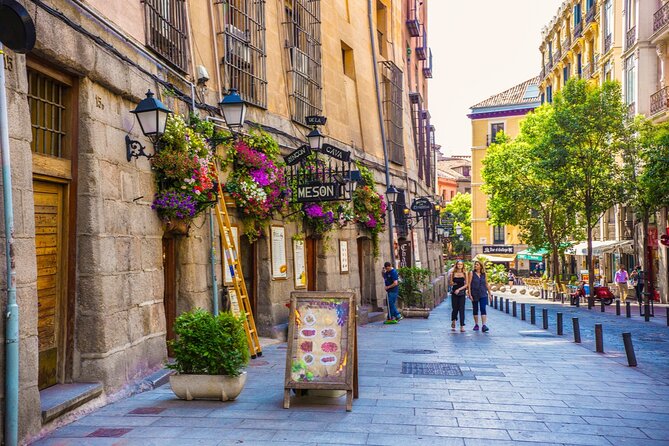
Review · MADRID
Don Quixote Quest Experience in Madrid
Madrid’s old center becomes a game board on this self-guided literary quest, linking Plaza Mayor, Cervantes sites, Lope de Vega’s home, and several lesser-known corners. You follow prompts in the Questo app, study your surroundings, and solve a challenge before moving on.
I like the freedom to start at any hour and pause for coffee, and I like that the activity is private, so your group can work at its own pace. At $8.40 per person, with children playing free, it is also an easy low-cost addition to a day in Madrid.
The main drawback is that this is not a walking tour with a human guide. One instruction may also need adjusting if construction has changed a street or landmark, so bring a little patience and use the nearby surroundings to confirm what you see.
In This Review
- Key points at a glance
- A Madrid walk told through puzzles
- Plaza Mayor: a grand first puzzle
- Puerta Cerrada and Madrid’s medieval trace
- The former customs quarter and the Treasury setting
- San Sebastián Church on Calle de Atocha
- Lope de Vega’s sixteenth-century home
- Cervantes and the world behind Don Quixote
- Cervantes’s burial place and the missing remains
- Plaza de Santa Ana and Madrid’s literary finish
- What $8.40 really buys you
- App play, timing, and group size
- Who should book this Madrid quest?
- Should you book the Don Quixote Quest?
- FAQ
- How long does the Don Quixote Quest take?
- Where does the activity start?
- Where does the game end?
- Is this a guided walking tour?
- Is the activity private?
- Do I need an internet connection during the game?
- Can I pause the experience?
- Are children allowed to participate?
- What is the cancellation policy?
Key points at a glance
- Plaza Mayor begins the game: Use Madrid’s grand central square as your first puzzle-solving stop.
- The route follows Spanish literary figures: Cervantes, Lope de Vega, Goya, Calderón de la Barca, and Federico García Lorca all connect to the experience.
- You control the pace: The game takes about two hours, but you can stop and resume later.
- The activity is private: Only your own group takes part, making it a good fit for families and friends.
- It works offline: Once the app is ready, you do not need an internet connection while playing.
- The finish is Plaza de Santa Ana: You end among cafés, tapas bars, and monuments in Madrid’s Literary Quarter.
A Madrid walk told through puzzles
This activity gives you a middle ground between a formal tour and wandering without a plan. You are not tied to a guide’s schedule, yet you have a clear route and a reason to look closely at each place.
The format is simple. Download the required app, go to the starting point on Calle del Marqués Viudo de Pontejos, and follow the instructions. At each stop, you search for an answer in the setting around you. Solve it, and the app sends you onward.
That small task changes the way you see familiar streets. Instead of crossing a square only to reach the next museum, you look at plaques, corners, façades, and old street names. The route also takes you to places that can be easy to pass without noticing.
The full game lasts about two hours. I would allow extra time if you want to enter museums, stop for food, or read the historical details at a slower pace. The supplied route descriptions do not promise admission to every building, so think of this primarily as an outdoor city game with literary and historic stops.
Other Madrid days people book alongside this one:
- Madrid: Tour Bernabéu Entry Ticket
★ 4.5 · 21,573 reviews - Madrid: Prado Museum Entry Ticket
★ 4.6 · 17,509 reviews - Madrid: Royal Palace Fast-Access Admission Ticket
★ 4.6 · 13,856 reviews
Plaza Mayor: a grand first puzzle
The game opens at Plaza Mayor, Madrid’s best-known historic square. It sits in the center of the old city and dates in its present form to the reign of Philip III, whose statue occupies the middle of the plaza.
The square has served many public purposes over time. Today, its arcaded edges, uniform red façades, cafés, and steady foot traffic make it an easy place to find and a useful starting point for a walking route.
Here, you look around for the answer to the opening challenge. That is a better use of the square than simply taking a quick photograph, since the puzzle pushes you to inspect the details around its broad open space.
Allow roughly ten minutes for this stop. The square is free to enter, but it can be crowded, and the open layout gives you little shade in some areas. If you are visiting with children, this first challenge should make the rules clear before the route moves into narrower streets.
From Plaza Mayor, Puerta del Sol is only a few blocks away, though this game does not appear to use it as one of the listed challenge stops. You may want to visit it separately if you have not already done so.
Puerta Cerrada and Madrid’s medieval trace
One early stop focuses on the place associated with Puerta Cerrada, or the Closed Gate. The name recalls an opening in Madrid’s Christian wall during the Middle Ages and Renaissance.
The gate was demolished in 1569 for the entry into Madrid of Isabel de Valois, wife of Philip II. You do not need to know this story before arriving. The app gives you the prompt, and you use what is around you to identify the answer and continue.
This is one of the more appealing parts of the route because the place is tied to a vanished piece of the city. Madrid’s main squares can feel grand and obvious. A former gate is less visible, and the game gives you a reason to pause over a name that might otherwise seem ordinary.
Do not expect a preserved medieval gate rising in front of you. The value here is in connecting the present street setting with an older city boundary. That makes the stop a good example of what this activity does best: it turns a small urban clue into a short history lesson.
The former customs quarter and the Treasury setting
Another challenge brings you to a square formed in 1926 after several buildings around the old Customs Square and the adjoining La Leña area were demolished. The changes also removed the Convent of the Trinitarios Calzados and the Almidón fish market.
The area has had a notable financial past. A palace built for the Five Major Guilds in the seventeenth century later became the property of the Bank of Isabel II. When that bank merged with the Bank of San Carlos, the site became the first headquarters of the Bank of Spain. Today, the building houses the General Directorate of the Treasury.
This stop is useful if you enjoy the less obvious layers of Madrid. It is not simply a viewpoint or famous monument. The challenge asks you to connect architecture and civic history, then use a detail in the square to proceed.
The drawback is that the supplied information does not identify the square by name in a clear way. You will rely on the app’s directions. If construction or street changes have altered the setting, compare the instructions with the visible buildings instead of assuming you are in the wrong place.
A different sort of afternoon around Madrid:
- Madrid: “Emociones” Live Flamenco Performance
★ 4.8 · 12,866 reviews - Madrid: Panoramic Route City Tour
★ 4.1 · 12,259 reviews - Madrid: Live Flamenco Show with Food and Drinks Options
★ 4.5 · 9,901 reviews - Avila & Segovia Tour with Tickets to Monuments from Madrid
★ 5.0 · 9,762 reviews
San Sebastián Church on Calle de Atocha
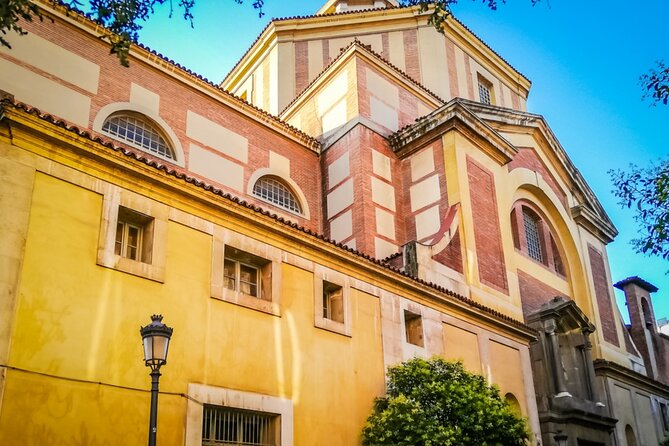
The route then reaches the Church of San Sebastián at Calle de Atocha 39. The church dates to the sixteenth century, and its name comes from a devotional chapel along the route to the Basilica of Nuestra Señora de Atocha. That chapel was founded in 1541.
This is a stop where the challenge can make a familiar street more interesting. Calle de Atocha is a major central route, yet a church façade can easily become background scenery when you are focused on getting somewhere else.
Look carefully at the outside details the app directs you toward. The activity does not state that admission is included, or that the group enters the church, so plan on solving this part from the public street unless the building is open and you choose to go inside independently.
For you, the practical value is location. The church keeps the route in central Madrid and connects religious history with the literary sites that come later. It also gives the walking game a change of pace after the more civic settings near the old squares.
Lope de Vega’s sixteenth-century home
The House-Museum of Lope de Vega occupies the former home of one of Spain’s major Golden Age writers. Lope de Vega bought the sixteenth-century house in 1610.
A house museum offers a different kind of literary connection from a statue or plaque. It points toward domestic life and the physical setting of a writer’s working years. The route description presents the house as a challenge stop, but it does not say that the entry ticket is part of the $8.40 price.
That distinction matters. If you want to tour the interior, check the museum’s own access arrangements separately. If the group stays outside, the game still gives you the building as a fixed point on the route and places Lope de Vega within Madrid’s literary center.
I like this stop for the way it broadens the theme. The experience is not only about Don Quixote or Miguel de Cervantes. It places several writers in the same urban setting and lets you move between them on foot.
Cervantes and the world behind Don Quixote
The childhood home of Miguel de Cervantes Saavedra now houses a museum devoted to the author of Don Quixote. Its rooms recreate customs, traditions, and daily life from the sixteenth and seventeenth centuries.
The museum also has a bibliographic collection with editions of Cervantes’ work from different periods and in different languages. Its program includes workshops for children and teenagers, conferences, plays, and musical events.
For families, this may be the most natural literary stop on the route. Children who might not want a standard lecture can first solve a puzzle, then decide if the museum’s displays or activities deserve more time. The experience itself does not include a physical guide or state that museum admission is included, so treat the building as a route point unless you arrange a separate visit.
This part works especially well because the app asks you to look around before moving on. You are not just told that Cervantes lived in Madrid. You are encouraged to connect a real place with the author whose novel gives the game its name.
Cervantes’s burial place and the missing remains
The route continues to the convent where Cervantes was buried in 1616. During rebuilding in 1673, his remains were moved temporarily and later lost. For centuries, the exact location was uncertain until forensic scientists identified them in 2015.
That detail gives the stop a strong human element. Literary fame did not prevent the physical record of Cervantes’ burial from becoming confused over time. The challenge lets you approach the convent through a question rather than a long explanation.
Again, the route information does not promise interior access. You can still appreciate the stop from the outside and use the app to connect the convent with Cervantes’ final resting place.
If you have read Don Quixote, the setting may carry extra weight. If you have not, the app still provides a clear story about a famous writer, a lost burial site, and the effort to identify the remains centuries later.
Plaza de Santa Ana and Madrid’s literary finish
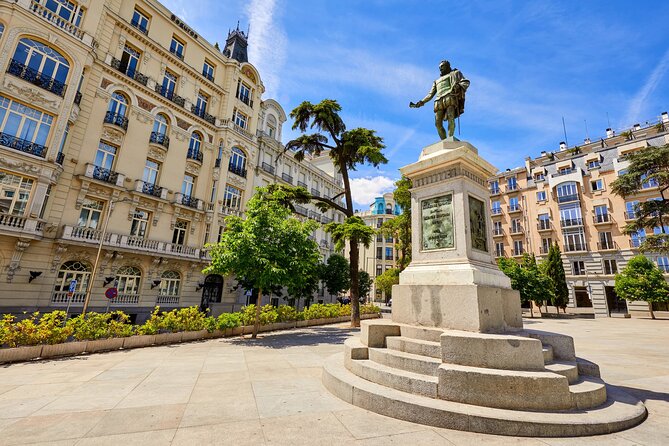
The game ends in the middle of Plaza de Santa Ana, in Madrid’s Literary Quarter. The square features monuments to Pedro Calderón de la Barca, a major Spanish Golden Age writer, and Federico García Lorca, the poet and playwright.
Restaurants, cafés, and tapas bars line much of the square, with terraces occupying many of its edges. This makes the finish practical. You can stop for a drink or a meal after the final challenge without having to find another part of the city.
The ending also ties together the route’s literary thread. You begin with Madrid’s grand civic center and finish among writers, performers, and outdoor dining. It is a pleasant place to decide if you want to continue exploring or simply sit down.
The listed end location is Calle del Príncipe 2, while the game finishes in the middle of Plaza de Santa Ana after you follow the instructions in Questo. Keep that distinction in mind when meeting friends or planning your next appointment.
What $8.40 really buys you
At $8.40 per person, this is inexpensive for a central Madrid activity, especially for a private group. Children play free, and group discounts are available, so the total cost can work well for a family or a few friends.
You are paying for a route, app prompts, puzzle design, and historical context. You are not paying for a person to interpret the city in real time, answer follow-up questions, or adapt the route around your interests.
That difference is the key value question. If you want a scheduled guide who explains every stop, choose a conventional walking tour. If you want a light structure that keeps everyone involved while allowing breaks, this price is easy to justify.
The game is booked, on average, 41 days ahead. That may reflect general advance planning for Madrid activities rather than a strict need to reserve early, since the experience is described as available at all times. Still, if you know your dates, booking ahead removes one more task from your trip planning.
App play, timing, and group size
You need a mobile device and the required apps. The activity includes mobile ticketing and offline play, so an internet connection is not needed once the city game is ready to use.
Offline access matters in practical terms. You can stop for a coffee, move through crowded streets, or continue if your connection drops without losing the route. Make sure the app and instructions are prepared before you leave the starting point.
The activity is private, meaning only your group participates. That gives you room to discuss the answers, let children take the lead, or pause when someone needs a break. It also means your group carries responsibility for navigation and solving each prompt.
The advertised duration is about two hours, but the ability to pause makes the time flexible. I would not schedule a tight museum reservation immediately after the finish. Construction has caused at least one instruction to become outdated, so allow a little margin.
The activity is available to most participants, service animals are allowed, and the route is near public transportation. The provided operating information says the service is open 24 hours a day, every day, while the dated hours also show Monday through Saturday. Because those details do not perfectly match, check the confirmation for your chosen date.
Who should book this Madrid quest?
I would choose this for families who want sightseeing to feel active, and for friends who enjoy solving clues together. It also suits Madrid residents who want a reason to inspect familiar streets from a different angle.
It is a good fit for independent visitors who dislike fixed departure times. You can begin at the stated starting point, pause whenever you want, and resume later. The route stays in central Madrid, so it can also fit around other plans.
I would be more cautious if you want detailed art history, long explanations, or personal recommendations from a local guide. The absence of a physical guide is not a flaw by itself, but it defines the experience clearly.
Be prepared for occasional instruction problems. A previous direction was not fully current because of construction work. The best response is to check the surrounding buildings and street layout, then use the app’s next clue rather than abandoning the route at once.
Should you book the Don Quixote Quest?
Book it if you want a low-cost, private way to connect Madrid’s central streets with Cervantes, Lope de Vega, and other Spanish writers. The puzzles give children and adults a shared task, and the flexible timing makes the activity easy to fit into a busy day.
Skip it if you expect a live guide, guaranteed museum entry, or a polished route that never needs local adjustment. At this price, the tradeoff is clear: you get independence, a playful structure, and literary stops rather than a full guided explanation.
For most families and small groups, I think the value is strongest when you treat it as a two-hour outdoor game, then add your own café, museum, or tapas stop afterward. Plaza de Santa Ana makes that final extension especially simple.
FAQ
How long does the Don Quixote Quest take?
The game takes approximately two hours. You can take breaks and resume later, so the total outing can be longer if you stop for food, museums, or sightseeing.
Where does the activity start?
It starts at C. del Marqués Viudo de Pontejos, 17, Centro, 28012 Madrid, Spain.
Where does the game end?
The listed end address is C. del Príncipe, 2, Centro, 28012 Madrid. Following the instructions in Questo takes you to the middle of Plaza de Santa Ana.
Is this a guided walking tour?
No. The activity is a self-guided city game played through an app, and it does not include a physical tour guide.
Is the activity private?
Yes. Only your own group participates in the activity.
Do I need an internet connection during the game?
No. The game can be played offline, so you do not need an internet connection while completing it.
Can I pause the experience?
Yes. You can start at any hour, take a break at any time, and resume later.
Are children allowed to participate?
Yes. The activity is designed for families and friends, and it is free for children.
What is the cancellation policy?
You can receive a full refund if you cancel at least 24 hours before the experience start time. Cancellations or changes made within 24 hours are not accepted for a refund.
Just added around Madrid
- Private Vacation Photography Session with Photographer in Madrid★ 5.0 · 3 reviews
- Arrival Private Transfer from MAD Airport to Madrid in a Minibus★ 5.0 · 3 reviews
- Segovia: 3-Hour Private Walking Tour★ 5.0 · 3 reviews
- Tour Segovia and La Granja de San Ildefonso from Madrid★ 5.0 · 3 reviews
- Madrid: Prado & Reina Sofia Museum Skip-the-Line Guided Tour★ 5.0 · 3 reviews
- Salamanca: Private Guided Customizable Walking Tour★ 5.0 · 3 reviews
- Total Reboot and Renew with top wellnes 3 hours couple experience★ 5.0 · 3 reviews
- Madrid: Prado Museum Private Tour★ 5.0 · 3 reviews