
Review · TOLEDO DAY TRIPS
Guided Tour of Underground Toledo
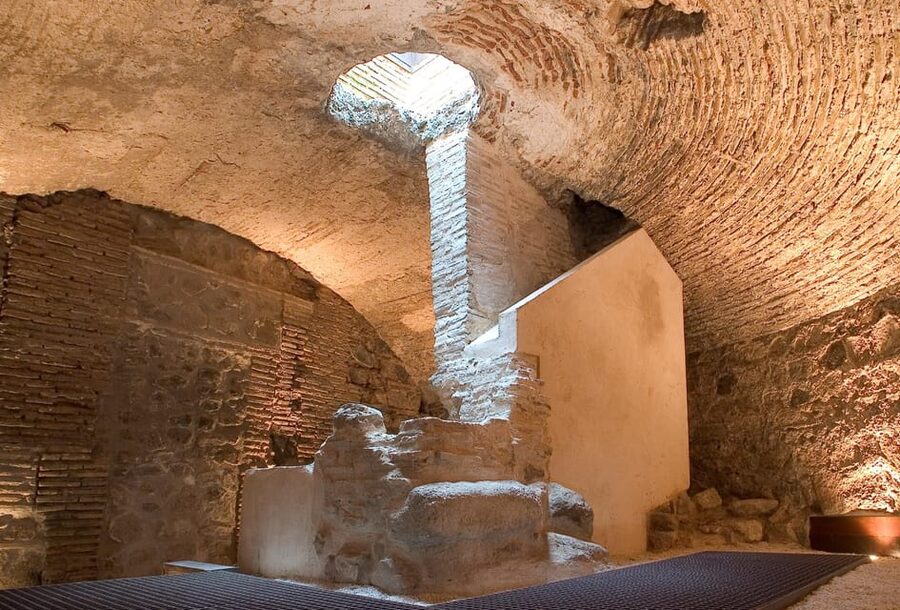
Toledo’s best stories are often below street level. This two-hour walk takes you into five underground sites, including an Arab hammam, a Jewish miqvé, Roman baths, a water cistern, and the surviving dungeons of the Holy Brotherhood. It is a fine way to see how ordinary life worked beneath the grand churches and old walls.
I like the compact route and the chance to enter places that require an accredited guide. I also like the human scale: hygiene, water, worship, imprisonment, and bathing tell you more about Toledo’s past than another quick look at a palace. The main drawback is that the tour is Spanish only, and it is not suitable for wheelchair users or people with mobility impairments.
In This Review
- Key points to know before booking
- Beneath Toledo, where the city gets personal
- The Holy Brotherhood dungeons and the medieval city
- The Cenizal baths and Muslim Tulaytula
- The Well of the Savior and Toledo’s water problem
- The Casa del Judío and a 14th-century miqvé
- The Roman baths of ancient Toletum
- What the $15 price really includes
- Language, pace, and access
- Who will enjoy this Toledo underground tour?
- Should you book the Underground Toledo tour?
- FAQ
- How long does the Underground Toledo tour last?
- Where does the tour begin?
- Which underground sites are included?
- What language is the tour conducted in?
- Is the tour suitable for wheelchair users?
- Can I cancel for a full refund?
Key points to know before booking
- Five different underground sites: Each stop presents a separate part of Toledo’s past, from Roman engineering to medieval prisons.
- A guide is required for access: Some of the spaces can only be visited with an official accredited guide.
- Strong focus on daily life: The tour explains how Muslims, Jews, and Christians used the city and its water systems.
- Mónica may lead the visit: She is praised for her friendly manner and for adapting carefully to the group, including one person using a cane.
- Two hours and about $15: That is a sensible price for five admissions plus a guided route through central Toledo.
- Spanish-language tour: You need enough Spanish to follow the explanations, or travel with someone who can interpret.
Beneath Toledo, where the city gets personal
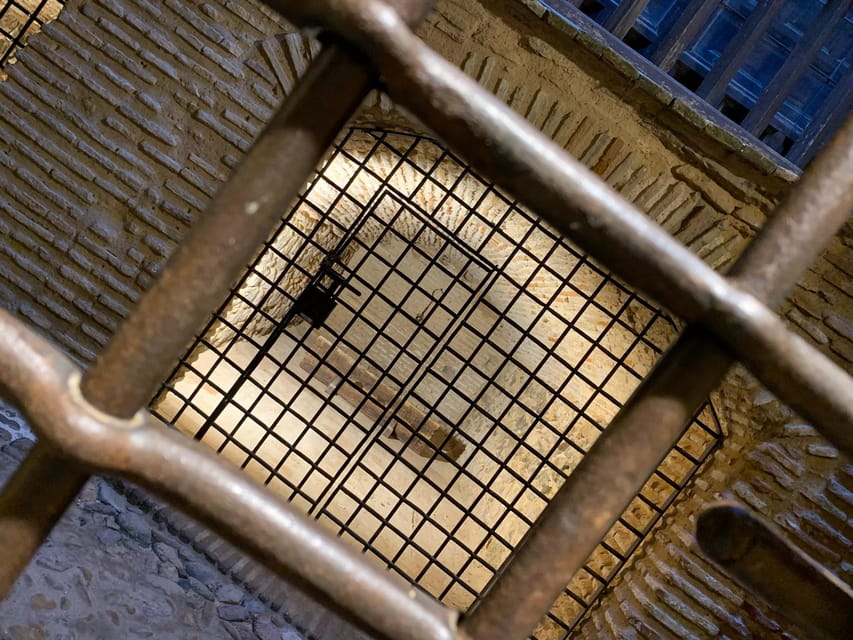
Toledo is famous for its hilltop setting, churches, stone lanes, and layered past. But the underground spaces give you something different. They are less about grand rulers and more about how people washed, prayed, stored water, served time, and built a city on a difficult rock.
The route covers the era often described through Toledo’s three cultures: Christian, Muslim, and Jewish life. That phrase can sound tidy, but the sites make it more concrete. At the baths, you consider hygiene and religious practice. At the miqvé, you learn about Jewish ritual. At the well and cistern, you see the practical problem of supplying water to a high city.
I like this approach because each stop has a clear purpose. You are not simply looking at another old wall. You are asking what the room was for, who used it, and what that says about Toledo at the time.
The tour begins at Plaza de Zocodover, the city’s central meeting place. Find the guide in the center of the square with a green umbrella. That marker matters in a busy plaza, so arrive with enough time to get your bearings before the group moves off.
The exact starting time depends on the date you select. The tour lasts two hours, with roughly 20 minutes set aside at each underground stop and time between them for the walk through Toledo’s streets.
More Toledo day trips:
- Guided Walking Tour of Immortal Toledo
★ 5.0 · 1,116 reviews - Toledo Private Tour with Licensed Local Guide
★ 5.0 · 884 reviews - Toledo: City Sightseeing Hop-On Hop-Off Bus Tour & Extras
★ 4.3 · 683 reviews
The Holy Brotherhood dungeons and the medieval city
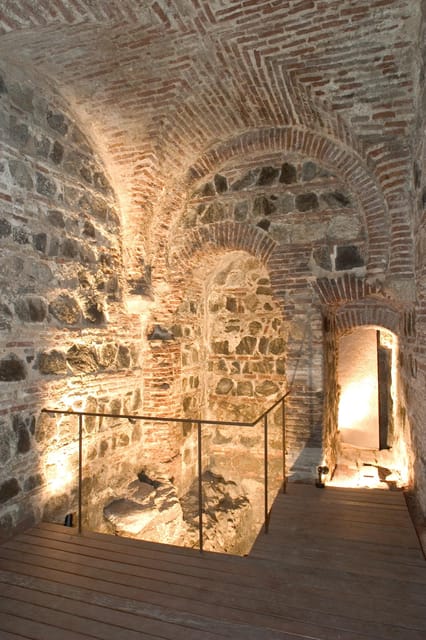
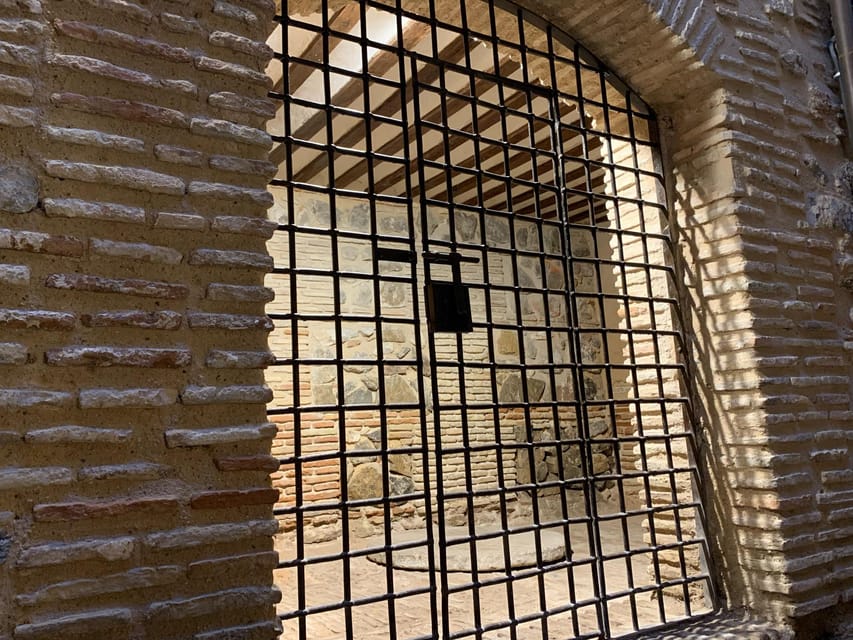
The first stop is the Posada de la Hermandad, where you visit the dungeons of the Holy Brotherhood. These are described as the only Holy Brotherhood dungeons still preserved in Toledo, giving the opening stop a strong connection to the city’s medieval justice system.
You will hear about the prisoners who were held there and the jailers known as the Mangas Verdes. That detail gives the place a name and a human face. A dungeon can otherwise become just a dark room with thick walls. Here, the guide connects the space to the people who worked and suffered inside it.
I find this a useful beginning because it quickly moves you away from Toledo’s postcard image. The city was not only a center of faith, art, and power. It was also a place where authorities guarded prisoners and enforced order.
The visit here lasts about 20 minutes. That is long enough to set the scene without allowing the first stop to take over the whole route. You should expect a historical explanation rather than a theatrical performance. The value comes from understanding what the dungeon was and how medieval institutions operated.
The Cenizal baths and Muslim Tulaytula
The next stop takes you into the Baños árabes del Cenizal, the Arab baths associated with Muslim Toledo, known in that period as Tulaytula. The site dates to the 10th century and offers a direct look at the hammam as a place connected to cleanliness, faith, and social life.
This is one of the strongest stops for anyone who wants to understand daily life under Muslim rule. The guide explains hygiene practices and religious rituals, while also showing that a bathhouse had a social role. You are not just seeing an old bathing room. You are considering how people met, prepared for prayer, and cared for their bodies.
The word hammam can bring to mind a modern spa, but the historical setting had a wider role. The explanations here help you connect a physical space with the customs of the people who used it. That makes the stop more useful than a simple architectural visit.
Allow about 20 minutes. The visit is short, so listen closely when the guide explains the function of the baths. If Spanish is not your strong language, this is a point where you may need a translation app or a Spanish-speaking companion, since the live tour guide speaks Spanish.
The Well of the Savior and Toledo’s water problem
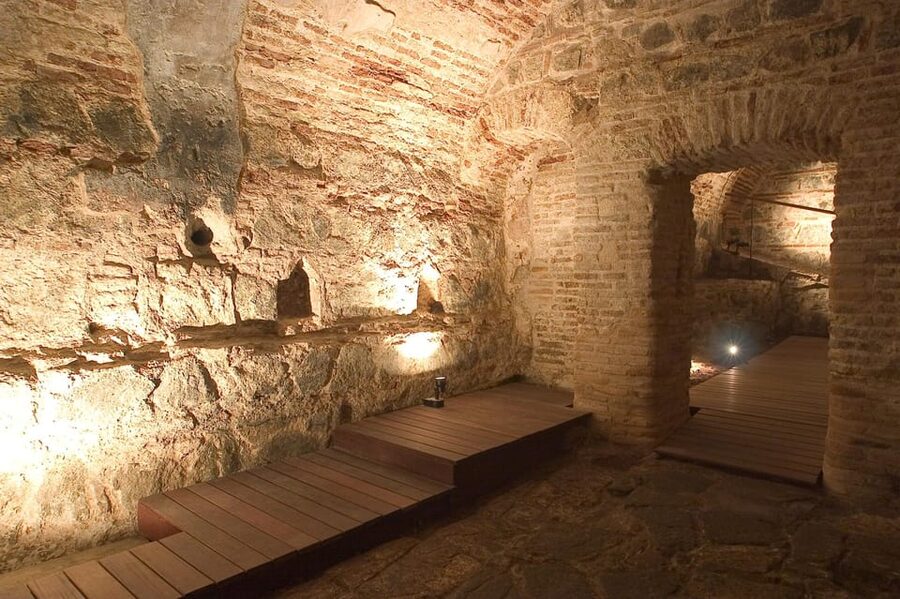
At Plaza del Salvador, the route goes below ground again to the Pozo del Salvador. This stop deals with one of the least glamorous but most important challenges in Toledo: getting drinking water to the top of the city’s rocky site.
The guide explains the difference between a well and a cistern. Those terms can seem interchangeable, but they describe different ways of obtaining and storing water. Understanding that distinction helps you see how the city managed supply, especially during drought.
This is the kind of stop I appreciate on an urban tour. Water systems tell you about engineering, weather, settlement, and survival all at once. Toledo’s hilltop position may have helped defend the city, but it also made water access difficult. The Pozo del Salvador shows how people dealt with that problem.
The visit lasts about 20 minutes. Do not expect a huge underground complex. The interest lies in the practical story and in the way the guide explains the site’s purpose. It gives the tour a needed change of pace after the dungeon and baths.
A few more Toledo days to weigh up
- Madrid: Full-Day Guided Tour of Toledo with Cathedral Visit
★ 4.6 · 647 reviews - Night Guided Tour of Magical Toledo
★ 4.5 · 459 reviews - Toledo: Cathedral Tour with a Local Guide
★ 4.4 · 390 reviews - Toledo Private Tour with Local Guide. Pick up in Madrid optional
★ 5.0 · 277 reviews
The Casa del Judío and a 14th-century miqvé
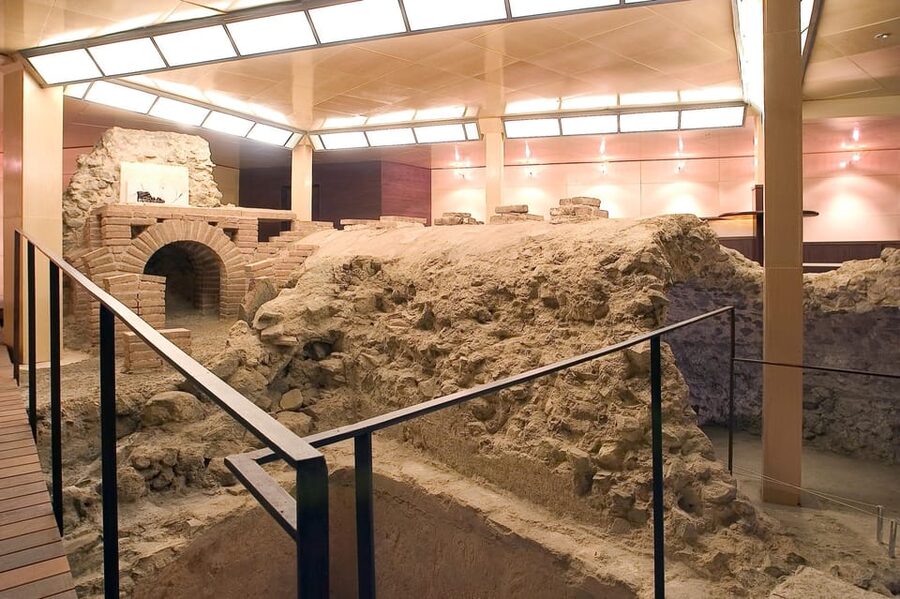
The Jewish quarter brings you to the Casa del Judío, home to a miqvé dating from the 14th century. A miqvé is a Jewish ritual bath, so this stop adds a religious and cultural dimension that is distinct from the Arab baths.
The site is connected with legends as well as documented history. That combination can be appealing, but it also means you should listen for the difference between what can be established and what belongs to local storytelling. A good guide can help you enjoy both without treating every legend as proven fact.
This is an important stop for understanding Toledo’s Jewish community. The underground setting helps you think about ritual spaces within the medieval city, while the discussion places the bath in the wider life of the quarter.
The guide spends about 20 minutes here. Compared with the Arab baths, the miqvé allows you to compare two different bathing traditions without assuming they served the same purpose. That contrast is one of the tour’s best features.
If you have limited time in Toledo, this stop also adds something that a standard cathedral or synagogue visit may not. You are seeing a less obvious part of community life, not just a major monument.
The Roman baths of ancient Toletum
The final underground stop is the Roman baths of Toletum. The site is presented as one of the largest Roman bath complexes in Hispania, which gives the last stop a sense of scale and historical reach.
Here, the route moves back before the medieval period to Roman Toledo. The baths show that public bathing was also part of Roman urban life, with architecture and shared spaces built around water, cleanliness, and social activity.
I like ending with the Roman remains because it reminds you that Toledo’s story did not begin in the Middle Ages. The city’s later cultures built over an older Roman foundation. Going underground makes that layering especially clear: modern streets sit above medieval spaces, which in turn can cover Roman construction.
The guided visit lasts about 20 minutes. The guide helps you picture how the baths worked and what life in ancient Toletum may have involved. Since the site is archaeological rather than fully restored, your imagination does some of the work. That is part of the appeal, though anyone seeking large, fully reconstructed ruins may find the visit more restrained.
The route finishes at Plaza Amador de los Ríos. The supplied activity details also say the tour ends back at the meeting point, so I would confirm the exact finishing arrangement when booking. Either way, the route remains within Toledo’s central historic area.
What the $15 price really includes
At about $15 per person, this is one of the more affordable guided ways to see Toledo’s lesser-known historic spaces. The price includes the accredited guide and entry to all five underground sites, not just a walk past their entrances.
That matters because access is part of the experience. Several locations are described as available only with an official guide, so you are paying for entry, interpretation, and the chance to visit places you may not be able to enter independently.
The tour also gives you variety for a modest cost. You see a prison, a hammam, a water installation, a Jewish ritual bath, and Roman baths. If you paid separate entrance fees for several small archaeological sites, the total could easily become less convenient, even if the sites are close together.
The value is strongest for visitors who enjoy context. If you only want to photograph Toledo’s major monuments, you may not find the underground stops essential. If you want to understand how people actually lived in the city, the price is fair.
Free cancellation up to 24 hours before the activity and the option to reserve now and pay later add flexibility. Those policies are useful when your Toledo schedule is still changing, though the main decision should be whether the Spanish-language format and physical demands suit you.
Language, pace, and access
The live guide speaks Spanish. That is the clearest practical limitation. You do not need perfect Spanish to appreciate the spaces, but the tour depends on spoken explanation, and much of the value comes from details about customs, water use, ritual, and medieval life.
One traveler joined with limited Spanish and still enjoyed the visit, while the guide, Mónica, took care with the group and paid attention to a husband using a cane. That gives you a useful picture of her manner: friendly, personable, and willing to adapt when possible.
Still, do not treat that example as a promise that every physical need can be accommodated. The activity is specifically not suitable for people with mobility impairments or wheelchair users. Underground archaeological sites can be demanding, and the booking information makes the restriction clear.
Audio recording is not allowed. You can listen and take mental notes, but you should not plan to record the guide’s explanations. No group size is given, so you should not assume a private or very small tour.
The pace is fairly brisk. Each stop gets about 20 minutes, and the route also includes walking through Toledo’s historic streets. Wear comfortable shoes and consider the route as both an indoor archaeological visit and a city walk.
Who will enjoy this Toledo underground tour?
I would recommend this tour most strongly if you have already seen Toledo’s headline monuments and want a different angle. It works especially well for people interested in archaeology, urban history, religious practice, Roman Spain, and the practical details of medieval life.
It also suits a first-time visitor who wants a clear introduction to the city’s layered past. The route does not focus on only one culture or period. Instead, it moves from Roman Toletum to medieval Muslim, Jewish, and Christian settings.
Families with older children may find the dungeons and underground rooms more memorable than a long lecture in a church. The short stops help maintain variety. The Spanish-only format remains the key question for families who do not speak the language.
I would be more cautious if your schedule is tight and you want only Toledo’s biggest sights. Two hours is not a huge commitment, but the tour takes you away from the usual monument checklist. That is its purpose, not a flaw.
You should also skip it if you use a wheelchair or have a mobility impairment. The activity is not designed for those needs, and the provider states that directly.
Should you book the Underground Toledo tour?
Book it if you want to see the city from below and understand more than its famous facades. For $15, you get five archaeological spaces, an accredited guide, and a route that links Roman engineering with Muslim bathing, Jewish ritual, Christian justice, and Toledo’s struggle for water.
I especially like the range of stops. The Roman baths and Arab baths make a natural comparison, the miqvé adds a distinct Jewish perspective, and the well-cistern explains a practical problem that shaped life on the hill.
Do not book it casually if you need English commentary or fully accessible sites. Confirm the meeting and finish details, arrive at Plaza de Zocodover looking for the green umbrella, and remember that the tour is Spanish only.
For the right visitor, this is a smart addition to a Toledo stay. It is affordable, focused, and full of the small details that turn an old city into a place where real people once washed, prayed, stored water, and waited behind dungeon walls.
FAQ
How long does the Underground Toledo tour last?
The tour lasts two hours. It includes guided visits of about 20 minutes at each of the five underground sites, along with walking between locations.
Where does the tour begin?
The meeting point is Plaza de Zocodover. Look for the guide in the center of the square with a green umbrella.
Which underground sites are included?
The tour includes the dungeons of the Holy Brotherhood at Posada de la Hermandad, the Cenizal Arab baths, the Pozo del Salvador, the miqvé at Casa del Judío, and the Roman baths of Toletum.
What language is the tour conducted in?
The live tour guide speaks Spanish. No other tour language is specified.
Is the tour suitable for wheelchair users?
No. The activity is not suitable for wheelchair users or people with mobility impairments.
Can I cancel for a full refund?
Yes. You can cancel up to 24 hours in advance for a full refund. You can also reserve now and pay later.
Just added around Toledo
- Toledo: Private tour with an official guide★ 5.0 · 3 reviews
- Toledo Scavenger Hunt and Highlights Self-Guided Tour★ 4.5 · 3 reviews
- Toledo: Marzipan Convent Route with Tasting and Wine★ 3.7 · 3 reviews
- Toledo: Private Minivan tour from Madrid★ 5.0 · 4 reviews
- Toledo : Private Walking Tour with a Pro guide★ 4.6 · 4 reviews
- Private Walking History Tour in Toledo★ 5.0 · 4 reviews
- Toledo: 3-Hour Private Walking Tour★ 5.0 · 5 reviews
- Toledo: Private Walking Tour with a Local Guide★ 5.0 · 5 reviews
Toledo Day Trips, compared.

Three Cities in One Day: Segovia, Avila and Toledo from Madrid
Read our review →
Segovia and Toledo Tour, Alcazar, and Cathedral
Read our review →
Toledo Tour from Madrid: Cathedral, Synagogue & St. Tome’s Church
Read our review →
Toledo Half or Full Day Tour with Optional Lunch from Madrid
Read our review →
Toledo & Segovia Full Day Guided Tour with Alcázar
Read our review →

Toledo Tour & Vineyard Walk with Wine Tasting from Madrid
Read our review →Browse the lists this tour appears in