Review · TOURS
Secrets of Madrid Small Group Tour
Madrid reveals its best stories in the narrow lanes between the grand monuments. This 2.5-hour walk with Juan moves from medieval squares and secret convent corners to the Royal Palace, linking Madrid’s architecture with its darker tales of taxation, royal power, and the Inquisition.
I like the small group limit of 10, which gives you room to ask questions and hear the guide without headphones. I also like the mix of famous sights and overlooked places, especially the convent window selling galletas de las Carboneras and the quiet garden of El Huerto de las Monjas.
The main drawback is pace. Seventeen stops in about two and a half hours means many visits last only five minutes, and the tour is a serious walk over old streets and some stairs. Bring comfortable shoes, water, and realistic expectations about seeing interiors.
In This Review
- Key points to know before you book
- A walking tour built around Madrid’s quiet stories
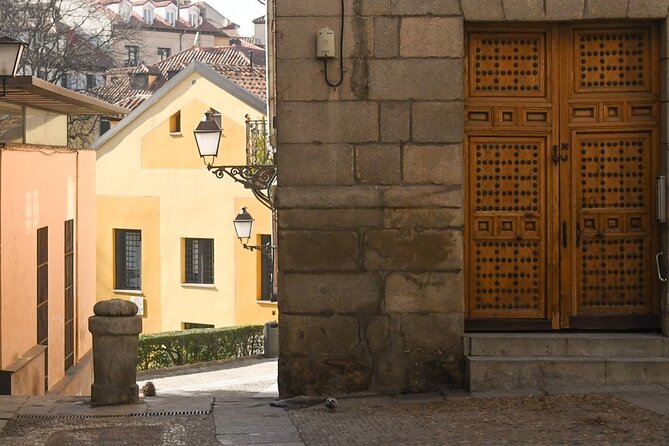
- Plaza de la Villa and the crooked medieval lanes
- Convent cookies and a garden behind walls
- Baroque churches and old Madrid’s uneasy past
- Gardens, churches, and the power behind Plaza de la Paja
- The Vistillas view opens the city to the sky
- Calle Mayor, Almudena, and the Royal Palace from outside
- Philip IV and the final stop at Plaza de Isabel II
- Juan’s style and the right expectations
- Who should book this Madrid walk?
- Should you book Secrets of Madrid?
- FAQ
- How long is the Secrets of Madrid tour?
- What time does the tour start?
- Where does the tour begin?
- Is the tour offered in English?
- How many people can join the tour?
- Is admission to the Royal Palace included?
- Can I cancel for a full refund?
Key points to know before you book
- Juan’s storytelling style: Expect history, humor, questions, and occasional side topics such as Spanish politics, culture, and film.
- A small-group walk: The maximum is 10 people, though private-feeling groups can be smaller.
- Madrid’s oldest quarters: The route covers Plaza de la Villa, medieval lanes, old walls, churches, convent spaces, and royal landmarks.
- A memorable local detail: At Corpus Christi convent, you may buy traditional cookies through a revolving window, subject to the convent’s opening hours.
- The Royal Palace is viewed from outside: Palace admission is not part of the $32.53 tour price.
- A lot of ground in 150 minutes: The route is rewarding but brisk, with short stops and little time for long interior visits.
A walking tour built around Madrid’s quiet stories
The appeal here is not a long inspection of one monument. It is the way Juan threads together small clues across old Madrid. A carved royal coat of arms, a crooked lane, a convent garden, and a palace view each get a short explanation. By the end, you have a useful mental map of how Madrid grew from a medieval settlement into a royal capital.
This is especially helpful early in a Madrid visit. You see the famous Royal Palace and Plaza de Oriente, but you also learn where the city’s older character survives. I like that balance. Madrid can sometimes feel like a city of grand boulevards and major museums, yet this route spends much of its time in the less obvious spaces between them.
The advertised start is at 10:30 a.m. at Plaza de Puerta Cerrada. The tour is offered in English, uses a mobile ticket, and includes all fees and taxes. Admission to the Royal Palace is not included because the walk treats it as an exterior landmark and viewing point rather than an indoor visit.
At $32.53 per person, the value depends on what you want. If you mainly need transportation or timed entry to attractions, this is not that sort of tour. If you want a local guide to explain the old center, point out details you could easily miss, and answer questions in a small group, the price is reasonable for 150 minutes.
Other Madrid days people book alongside this one:
- Madrid: Tour Bernabéu Entry Ticket
★ 4.5 · 21,573 reviews - Madrid: Prado Museum Entry Ticket
★ 4.6 · 17,509 reviews - Madrid: Royal Palace Fast-Access Admission Ticket
★ 4.6 · 13,856 reviews
Plaza de la Villa and the crooked medieval lanes
The walk begins at Plaza de la Villa, one of Madrid’s oldest squares. It is a good opening because the façades compress several periods of the city into one view: Mudéjar influence, Plateresque decoration, and the more severe Habsburg style.
Look for the stone coat of arms connected with Charles II, the last Habsburg monarch. That small detail gives the square a political edge. You are not just looking at handsome old buildings. You are seeing a marker of a dynasty nearing its end.
Calle del Codo follows, a very short street that bends sharply like an elbow. Its irregular stones and tight walls offer a quick sense of medieval Madrid. The stop lasts about five minutes, so this is a glance and explanation, not a long photographic session.
That pattern continues through Calle de Madrid and Calle de los Mancebos later in the walk. The names carry old stories, including the account of two young men accused of killing a prince who died in 1217. Their guilt was never settled, which lets Juan show you how fact and legend overlap in Madrid’s oldest quarter.
You will also hear about a 15th-century house and surviving pieces of the Christian wall. These fragments are easy to pass without a guide. The value is in knowing what to look for.
Convent cookies and a garden behind walls
One of the tour’s most distinctive stops is the Monasterio del Corpus Christi. The entrance is not marked in a grand way, and the convent’s cloistered nuns preserve a life that has changed little over roughly four centuries.
The practical treat is the chance to buy galletas de las Carboneras, traditional biscuits sold through a small revolving window. This is not a standard pastry stop with a shop counter and display cases. It is a quiet exchange that connects a working convent with present-day Madrid.
Timing matters here. The stop is scheduled for about 10 minutes, and the experience depends on the convent being able to sell the biscuits at that time. One French-speaking participant specifically appreciated arriving at suitable hours for the convent and being shown where to buy the pastries. If this detail matters to you, ask Juan about timing when the tour begins.
El Huerto de las Monjas offers a different kind of pause. This former convent garden is enclosed by high walls and is open to visitors from Monday through Friday, while the gate remains closed on weekends. It is a small, calm space rather than a major sight, and the scheduled visit is only eight minutes.
That weekday restriction is important. If your tour falls on a weekend, you should expect to see the setting from outside or miss entry to the garden. The tour still has plenty of other stops, but this is one of the places where the day of the week affects the experience.
Baroque churches and old Madrid’s uneasy past
Basilica de San Miguel appears suddenly among the narrow streets. Its curved façade and theatrical Baroque shape offer a sharp contrast to the sober brick and stone buildings around it.
The explanation here focuses on the Bourbons and their different visual language. Habsburg Madrid often projects restraint, slate, and Counter-Reformation seriousness. San Miguel brings more movement and drama. The five-minute stop is brief, but the contrast is easy to understand once it is pointed out.
At Plaza de la Cruz Verde, the mood changes. The square was associated with public executions held by the Inquisition before those events moved to Plaza Mayor. The green cross was the Inquisition’s emblem and led solemn processions.
Today, the square is quiet, which makes the history feel even more distant and unsettling. This is also a practical break in the walk. Nearby cafés offer a chance to get coffee and use a restroom before continuing.
The subject is not treated as a decorative anecdote. Juan’s discussion of the Spanish Inquisition and its long effect on the Spanish empire has been a meaningful part of the tour for visitors interested in politics and history. Still, if you want an academic lecture with detailed chronology, this fast-moving walk may feel too broad. Its goal is to explain the city’s story in a clear, accessible way.
A different sort of afternoon around Madrid:
- Madrid: “Emociones” Live Flamenco Performance
★ 4.8 · 12,866 reviews - Madrid: Panoramic Route City Tour
★ 4.1 · 12,259 reviews - Madrid: Live Flamenco Show with Food and Drinks Options
★ 4.5 · 9,901 reviews - Avila & Segovia Tour with Tickets to Monuments from Madrid
★ 5.0 · 9,762 reviews
Gardens, churches, and the power behind Plaza de la Paja
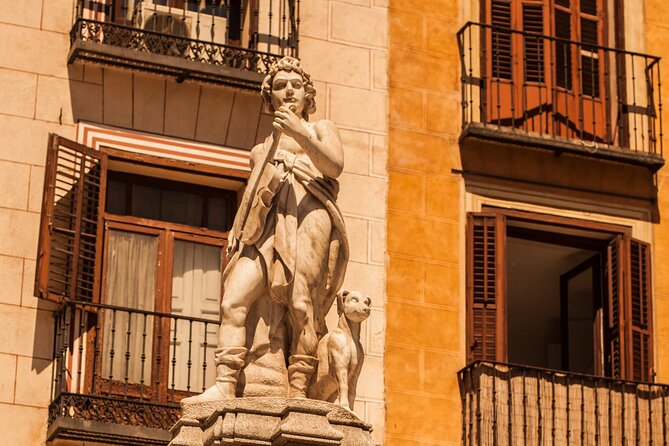
Jardín del Príncipe de Anglona gives you five minutes of shade, benches, and formal design. The garden once belonged to the palace of the Prince of Anglona and later inspired poets and lovers during Madrid’s Romantic period.
It is worth seeing because it shows how much of old Madrid is tucked behind walls. You are close to busy streets, yet the garden offers a quieter view of the city. The stop is short, so you will not have time for a slow garden visit or long rest.
At Iglesia de San Pedro el Viejo, the focus shifts to architecture. The church dates from the 14th century and is described as the second-oldest building in Madrid. Its brick tower has Mudéjar features, showing Islamic influence in a Christian building.
This is a useful reminder that Madrid’s past is not divided into neat boxes. Architectural styles crossed religious and political boundaries. The church itself is modest, so the explanation matters more than a dramatic interior.
Plaza de la Paja brings in the Vargas family, powerful lords of Madrid before the city became the royal capital. You will see the Vargas Palace and hear about the family’s role in the conquest and administration of the Americas.
The story also connects the palace with San Isidro, Madrid’s patron saint, who tradition says worked there as a servant. That contrast between a humble saint and an influential family gives the square a human angle. Madrid’s story is not only kings and councils. It also includes servants, workers, religious figures, and families competing for influence.
The Vistillas view opens the city to the sky
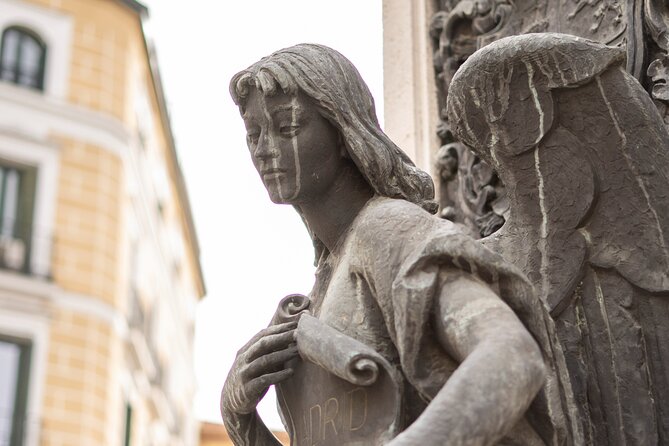
After the narrow streets, Jardines de las Vistillas is a welcome change. This open terrace looks toward the Manzanares River and distant mountains, giving you room to breathe and take in Madrid from above.
The Vistillas are also tied to local celebrations, music, and sunsets. The scheduled stop is only five minutes, but the view gives the route a natural pause. I would have your camera ready here, and I would not spend the whole stop looking at your phone.
This is one of the tour’s strongest transitions. The first part keeps you close to walls, doorways, and small squares. Vistillas lets you see the city as a whole before the route returns to royal power and major monuments.
The walking is not difficult in a technical sense, but it is substantial. The route covers many sites, and one of the walking-tour reviews specifically advises comfortable shoes, hydration, and food. Warm Madrid weather can make the distance feel longer, especially if you are not used to walking on old stone streets.
Calle Mayor, Almudena, and the Royal Palace from outside
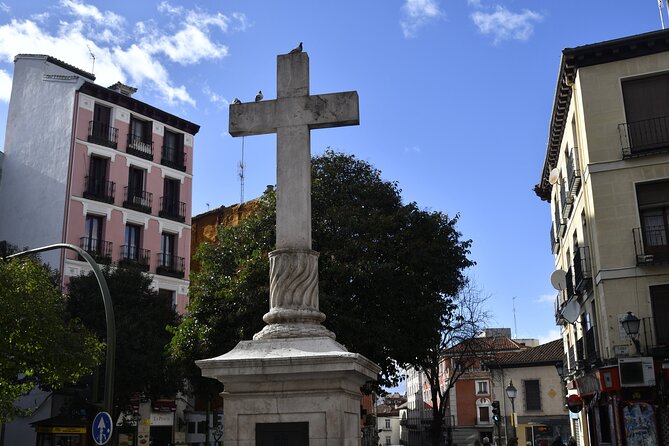
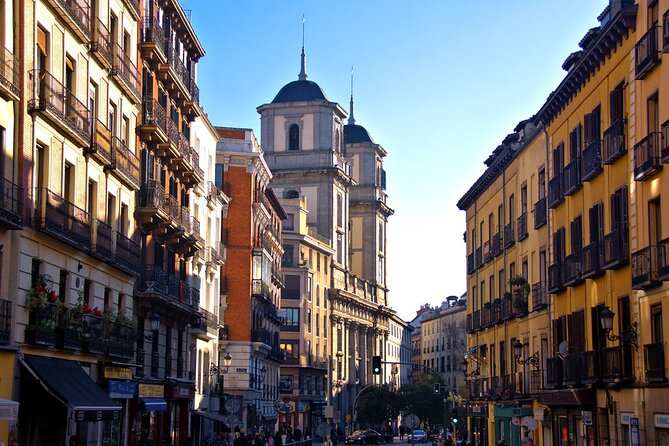
Calle Mayor brings the route back toward the center of political Madrid. The Palacio de Consejos reflects the austere Habsburg style of the early 17th century, with brick walls and slate spires.
The building’s former role adds weight to the view. Royal councils administered an empire from this part of the city, combining government, religion, and royal authority. It is a compact lesson in how architecture can signal power without being covered in gold.
The Museo de la Catedral de la Almudena is another reminder that appearance can mislead. The cathedral looks old, but construction finished only in the late 20th century. Its neo-Habsburg façade, designed during the Franco era, imitates the sober architecture of the 17th century.
That contrast is useful for anyone trying to read Madrid by its buildings. Old-looking does not always mean old. Juan’s route repeatedly asks you to look past the surface and consider who designed a place, when it was built, and what message it was meant to send.
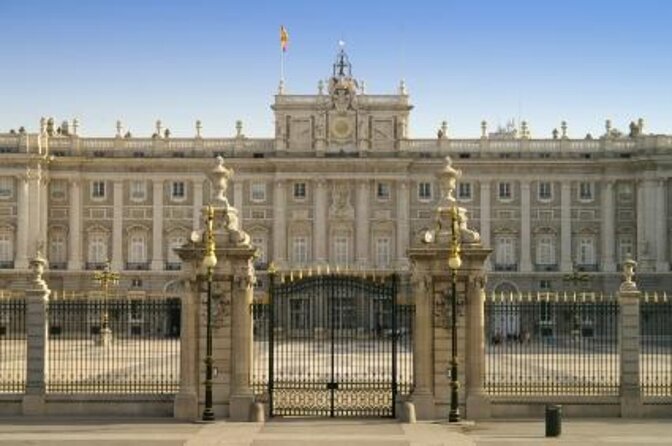
The Royal Palace is viewed from a small hill, where its white stone mass comes into full view above the Manzanares valley. The palace replaced the Habsburg Alcázar after a fire in 1734 and was built by the Bourbons in the 18th century.
This is a fine exterior viewpoint, but be clear about what you are buying. The Royal Palace entrance ticket is not included, and the walk does not provide a palace tour. If you want the state rooms and collections inside, plan that as a separate visit.
Philip IV and the final stop at Plaza de Isabel II
At Plaza de Oriente, the statue of Philip IV provides one of the tour’s best art stories. The bronze equestrian figure balances on the horse’s rear legs, a technical feat associated with calculations by Galileo.
The statue captures the Baroque taste for controlled spectacle. Philip IV appears calm and commanding, while the unusual balance makes the sculpture seem almost impossible. The stop lasts about five minutes, so you will get the story and a chance to examine the monument, not a full art lecture.
The route finishes at Plaza de Isabel II, between the Royal Theatre and modern Madrid. It is a fitting place to end because the square joins old royal Madrid with the city’s present-day cultural life.
The tour description says the activity ends back at the meeting point, while the listed route finishes at Plaza de Isabel II. That detail is worth confirming when you receive your booking information, especially if you have a timed reservation afterward.
A final review of the route is part of the experience. Juan has used a stone map to recap the places you have seen, giving you an overhead sense of Madrid’s old center. This is more useful than it may sound. After 17 stops, a map helps turn scattered stories into a clear route you can follow later on your own.
Juan’s style and the right expectations
Juan is the named guide, and the strongest part of his approach is personal storytelling. He asks for names, welcomes questions, and adjusts the conversation when the group wants more on Spain’s monarchy, politics, economy, art, or film.
His background in film journalism can add an unusual cultural angle. He also has connections to the Spanish film industry, so you may hear material beyond standard dates and dynasties.
His delivery is not perfectly suited to everyone. One distinctive habit is emphasizing key points with a cha-ching exclamation. Some people may find that playful and memorable, while others may prefer a quieter, more formal style. English ability and the level of historical detail can also feel different depending on your expectations.
The tour works best if you want a lively introduction rather than specialist research. It covers a wide span, from medieval Madrid through the Habsburgs, Bourbons, Franco-era design, and modern city life. If you already have advanced knowledge of Spanish history, some explanations may feel basic. If you are new to Madrid, the structure should help you get oriented quickly.
Who should book this Madrid walk?
I would choose this tour for a first or second day in Madrid, especially if you want a city overview before deciding which places deserve more of your time. It suits history fans, curious walkers, couples, families, and anyone who prefers small details to a parade of major monuments.
The small group is a real advantage. With a maximum of 10 people, you can ask about a coat of arms, a street name, or a restaurant recommendation without trying to speak over a crowd. No headphones are required, which makes the walk feel more direct.
You should think twice if you dislike extended walking, need frequent indoor stops, or want entry to the Royal Palace included. The itinerary is full, and several stops last only five minutes. Mobility needs should also be considered carefully, since the route includes old streets and stairs and is described as requiring good walking shoes.
The tour is recommended by 96 percent of participants and carries a 4.8 rating from 24 reviews. That is a strong signal, though the smaller number of ratings means I would still match the tour to your interests rather than treat the score as a guarantee.
Free cancellation is available up to 24 hours before the 10:30 a.m. start for a full refund. Poor weather or failure to reach the minimum number of travelers can lead to a new date or full refund. Service animals are allowed, public transportation is nearby, and most people can participate.
Should you book Secrets of Madrid?
Book it if you want a brisk, story-led introduction to old Madrid at a modest price. The best moments are not just the Royal Palace view. They are the convent cookie window, the crooked medieval streets, Mudéjar details, the quiet garden, and the way Juan connects these places to larger questions about power and daily life.
Skip it if you want long museum visits, extensive palace interiors, or a slow photography walk. For everyone else, $32.53 buys a useful city orientation, a compact group, and access to corners you might otherwise walk past without noticing. Wear good shoes, check the weekday timing for the convent garden, and leave room in your schedule for lunch afterward, since Juan may have a few local suggestions worth following.
FAQ
How long is the Secrets of Madrid tour?
The walk lasts approximately 2 hours and 30 minutes.
What time does the tour start?
The scheduled start time is 10:30 a.m.
Where does the tour begin?
The meeting point is Plaza de Puerta Cerrada, Pl. de Prta Cerrada, Centro, 28005 Madrid, Spain.
Is the tour offered in English?
Yes. The activity is offered in English.
How many people can join the tour?
The group has a maximum of 10 travelers.
Is admission to the Royal Palace included?
No. The Royal Palace admission ticket is not included in the tour price.
Can I cancel for a full refund?
Yes, if you cancel at least 24 hours before the scheduled start time. Cancellations made less than 24 hours before the start are not refunded.
Just added around Madrid
- Private Vacation Photography Session with Photographer in Madrid★ 5.0 · 3 reviews
- Arrival Private Transfer from MAD Airport to Madrid in a Minibus★ 5.0 · 3 reviews
- Segovia: 3-Hour Private Walking Tour★ 5.0 · 3 reviews
- Tour Segovia and La Granja de San Ildefonso from Madrid★ 5.0 · 3 reviews
- Total Reboot and Renew with top wellnes 3 hours couple experience★ 5.0 · 3 reviews
- Madrid: Prado & Reina Sofia Museum Skip-the-Line Guided Tour★ 5.0 · 3 reviews
- Salamanca: Private Guided Customizable Walking Tour★ 5.0 · 3 reviews
- Madrid: Prado Museum Private Tour★ 5.0 · 3 reviews
Tours, compared.

Avila & Segovia Tour with Tickets to Monuments from Madrid
Read our review →
Segovia and Toledo Tour, Alcazar, and Cathedral
Read our review →
Royal Palace Expert Guided Tour with Skip-the-Line
Read our review →
Toledo Tour from Madrid: Cathedral, Synagogue & St. Tome’s Church
Read our review →
Toledo Half or Full Day Tour with Optional Lunch from Madrid
Read our review →
Toledo & Segovia Full Day Guided Tour with Alcázar
Read our review →