
Review · SEGOVIA DAY TRIPS
Skip the Line Admission Ticket to Cathedral of Segovia
Segovia Cathedral is the kind of building that can surprise you after the Roman aqueduct and Alcázar have taken the spotlight. This ticket lets you explore the last Gothic cathedral built in Spain, from its bright Flemish windows to its quiet cloister and small religious-art museum.
I like the freedom to move at your own speed, especially since the interior has more than 20 chapels and enough detail for a quick look or a thoughtful hour. I also like the low price, $5.15 per person, and the included visit to the Episcopal Palace. The main drawback is that skip the line may not mean walking straight inside: some ticket holders still had to queue briefly to have the QR code scanned, and the advertised 7:00 p.m. closing time may not guarantee entry at 6:00 p.m.
In This Review
- Key points before you book
- Why Segovia Cathedral deserves time
- Entering through the north transept
- The chapels worth seeking out
- The choir, altar, and changing styles
- Juan Guas’s cloister and the old cathedral
- The small museum above the cloister
- What the $5.15 price really buys you
- Opening hours and the risk of arriving late
- The tower is a separate decision
- How to plan your visit
- Who should book this cathedral ticket?
- Should you book it?
- FAQ
- How much does admission to Segovia Cathedral cost?
- How long does the cathedral visit take?
- Is the ticket available on a mobile phone?
- What are the listed opening hours?
- Can I enter right up to 7:00 p.m.?
- Is transportation included?
- Is a guided tour included?
- Is the bell tower included?
- Is the Episcopal Palace included?
- Can I cancel for a full refund?
Key points before you book

- A bright Gothic interior: Flemish stained-glass windows give the vast, uncluttered nave a lighter feel than many Spanish cathedrals.
- A strong art stop: Look for Gregorio Fernández’s Baroque Lamentation group, Juan de Juni’s reredos, paintings, jewelry, and rare manuscripts.
- A relocated cloister: The late-Gothic cloister and its elaborate doorway came from Segovia’s old cathedral and were made by Juan Guas.
- A flexible one to two hours: You can make a fast visit or spend longer with the chapels, museum, and cloister.
- A useful mobile ticket: Booking ahead can save time on busy days, though QR validation may still require a short queue.
- The tower costs extra: The bell tower is not part of this admission and involves 190 narrow steps.
Why Segovia Cathedral deserves time
Segovia is often treated as a quick stop: photograph the aqueduct, walk up to the Alcázar, then move on. That is a mistake if you enjoy architecture or religious art. The cathedral fills the city’s main square with a scale that is easy to miss from outside, and its interior rewards a slower pace.
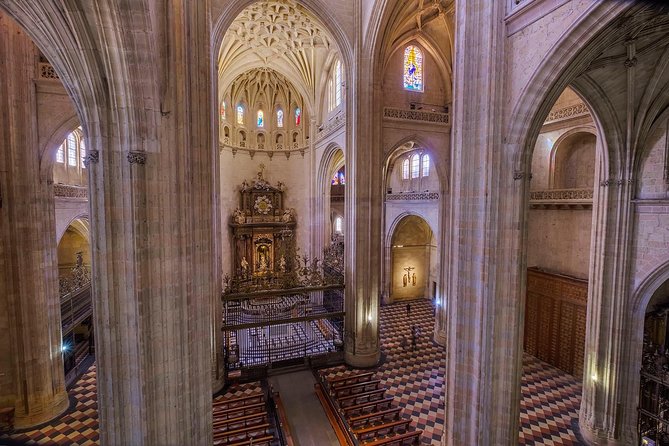
This is a late Gothic building, but it does not feel dark or overloaded. The 16th-century Flemish windows bring in a soft wash of color, while the broad interior remains fairly simple and open. You get a strong sense of the building’s size without having to fight through a forest of columns, signs, or display cases.
The ticket is best understood as a self-guided visit, not a guided tour. You receive admission and can explore without being tied to a set route. A map with a QR code links to a self-guided guide with room descriptions and photographs of objects, which is useful if you want more context than the labels provide.
Plan on one to two hours. An hour works for the main nave, several chapels, the cloister, and a quick look at the museum. Give yourself closer to two hours if you want to read the material, study the art, or add the free Episcopal Palace visit.
More Segovia day trips:
- Hot-Air Balloon Ride over Segovia with Optional Transport from Madrid
★ 5.0 · 582 reviews - Hot Air Balloon Flight Over Segovia or Toledo
★ 5.0 · 507 reviews - Hot Air Balloon over Segovia with Optional Transfers from Madrid
★ 5.0 · 388 reviews
Entering through the north transept
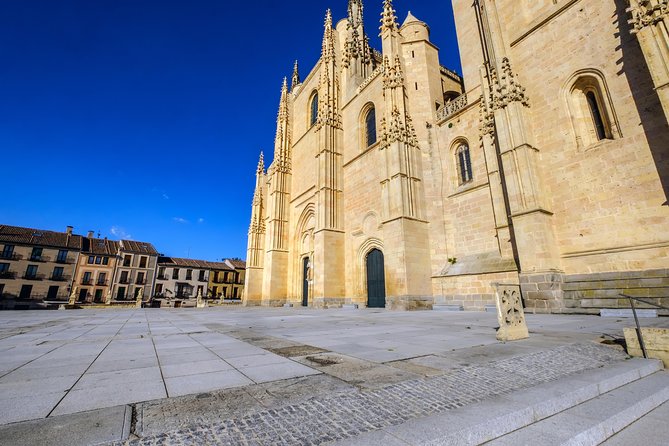
The stated entrance is through the north transept. Once inside, take a moment before heading toward the chapels. The cathedral’s scale is the first thing you notice, but its light is the more unusual feature.
The interior is described as light, bare, and uncluttered. That simplicity helps the details register. Instead of trying to see everything at once, I suggest beginning with the central Gothic choir, then moving around the side chapels before crossing toward the high altar.
The choir dates from the 15th century, before the present cathedral, and sits in the center of the building. Its position can seem unusual if you expect an unobstructed view toward the altar. It also gives you a clear reminder that the cathedral was built in stages and incorporates older work.
Across from the choir, at the east end, the high altar has an 18th-century altarpiece by Sabatini. It is a good stopping point for understanding the cathedral’s later decorative layer, after you have taken in the Gothic structure.
The chapels worth seeking out
More than 20 chapels line the walls and apse. You do not need to inspect every one to enjoy the visit, but a few deserve a deliberate stop.
The third chapel on your right from the entrance is the Capilla de San Cosme y San Damian. Its main draw is a wooden Lamentation group by the 17th-century Baroque sculptor Gregorio Fernández. The work has the emotional intensity you expect from Spanish Baroque sculpture, and it provides a strong contrast to the cathedral’s open, restrained central space.
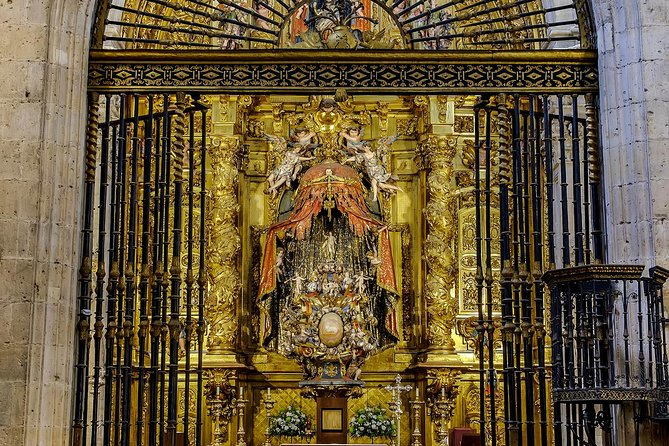
The Blessed Sacrament Chapel is another key stop. Created by the flamboyant Churriguera, it is more ornate than the main interior. Look for stained-glass windows, carved choir stalls, and paintings from the 16th and 17th centuries.
The chapel’s reredos portrays the deposition of Christ from the cross and is attributed to Juan de Juni. Even if you are not familiar with the artists, the contrast is clear: the main cathedral gives you space and proportion, while this chapel pulls you close to carved detail and layered decoration.
You might find the chapels more rewarding with the QR guide than with a simple walk-through. The map lets you select rooms and view photographs and descriptions, so you can choose where to spend your limited time.
The choir, altar, and changing styles
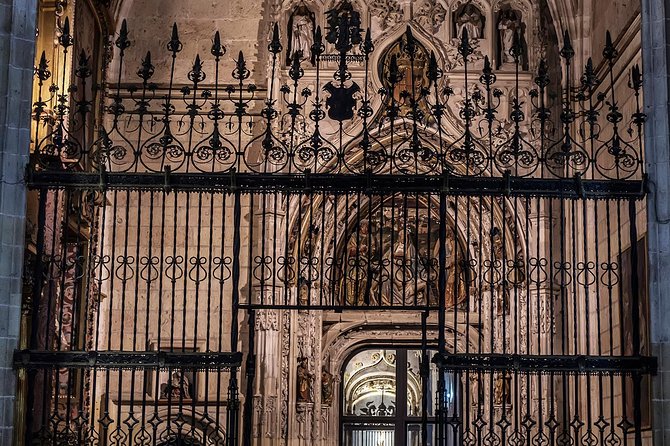
The central Gothic choir is one of the cathedral’s most important visual anchors. Because it predates the cathedral, it also helps explain why the building does not read as one perfectly uniform design.
The high altar, with Sabatini’s 18th-century altarpiece, brings a later period into the picture. This mix is part of the appeal. You are not looking at a single frozen moment in Spanish art, but at a building where Gothic structure, Flemish glass, Baroque sculpture, and later altar design share the same space.
I would not rush through the center simply because the chapels seem more colorful. The cathedral’s large, relatively clear interior is one of its best qualities. Walk far enough to see how the choir divides the space, then turn back toward the entrance to appreciate the full width.
A few more Segovia days to weigh up
- Madrid: Royal Palace Expert Guided Tour with Skip-the-Line
★ 4.7 · 6,986 reviews - Madrid: Royal Palace Skip-the-line Guided Tour
★ 4.9 · 3,146 reviews - Madrid: Royal Palace Skip-the-Line Guided Tour
★ 4.5 · 2,140 reviews - Madrid: Prado Museum Guided Tour with Skip-the-Line Ticket
★ 4.5 · 2,018 reviews
Juan Guas’s cloister and the old cathedral
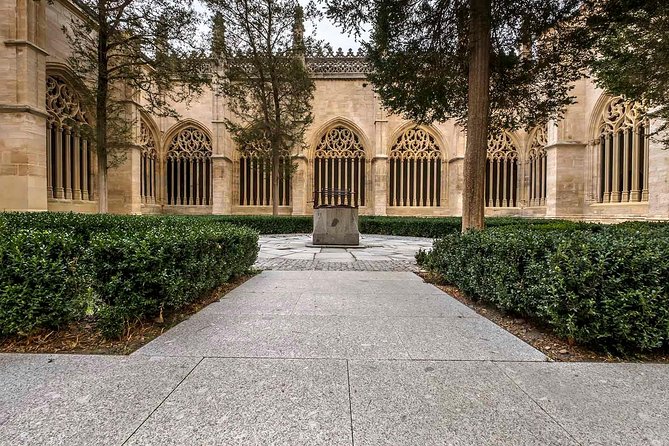
Across from the entrance, a door in the southern transept leads to the late-Gothic cloister. This is not just a pleasant side room. The cloister is older than the present cathedral, and both it and the elaborate doorway were moved from Segovia’s old cathedral.
The work is associated with Juan Guas, one of the leading architects of Spain’s final Gothic period. The cloister gives you a more intimate setting after the grand scale of the nave. Its enclosed form also changes the pace of the visit. Instead of looking upward and outward, you can focus on stonework, door details, and the quieter arrangement around the open center.
Under the pavement just inside the cloisters are the tombs of Juan and Rodrigo Gil de Hontañón. The connection is fitting: Guas and the Gil de Hontañón family helped shape the last phase of Spanish Gothic architecture. This is the sort of detail that can pass unnoticed if you simply photograph the doorway and leave.
Allow extra time here if architecture interests you. The cloister is a major reason this admission offers more than a standard nave visit.
The small museum above the cloister
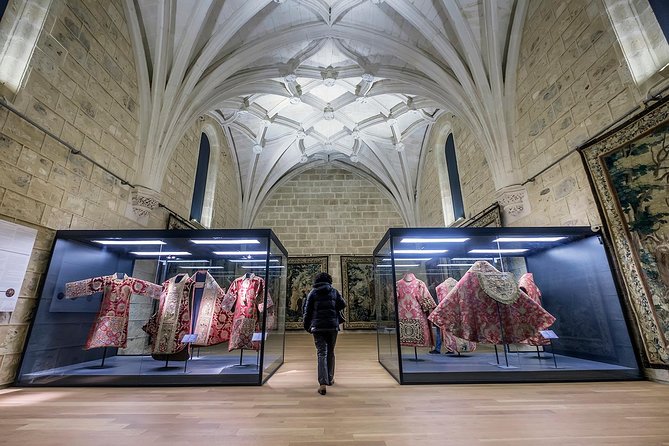
Off the cloister, the cathedral’s museum of religious art occupies part of the first-floor chapter house. It is not a huge collection, so do not expect a full afternoon museum. Instead, think of it as a compact final chapter to your cathedral visit.
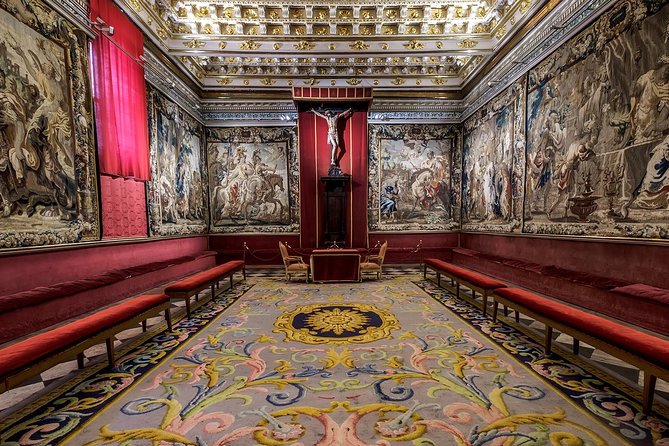
The chapter house has a white-and-gold 17th-century ceiling. It is a late example of Mudéjar artesonado work, a style of decorative wooden ceiling associated with Spain’s long exchange of Christian and Islamic artistic traditions.
The collection includes jewelry, paintings, and rare antique manuscripts. The museum is particularly useful if you want to see smaller objects after spending time with the cathedral’s large-scale architecture. You can inspect craftsmanship at close range rather than taking in another enormous room.
The art museum earned strong marks from people who enjoyed the cathedral, though one visitor found the castle and artifacts only average. That is fair guidance. The cathedral itself is the main event. The museum adds value, but you should not book this ticket solely for a major art collection.
What the $5.15 price really buys you
At $5.15, this is a modest admission cost for a major landmark. You are paying for entry to the cathedral, cloister, and museum, plus free admission to the Episcopal Palace. The low price makes the ticket easy to justify if you already plan to spend time in Segovia.
The value of booking ahead depends on your date. Some visitors found the cathedral quiet enough that advance tickets were unnecessary, particularly outside the busiest periods. If you are visiting when the city is crowded, prebooking gives you a confirmed place and avoids having to decide at the door.
Do not assume the phrase skip the line means zero waiting. Several ticket holders still had to visit the purchase or validation line so staff could scan or validate the QR code. The wait was sometimes short, but it was still a queue.
That makes the ticket most useful as a time-planning tool, not a promise of instant entry. It can be worthwhile when your day is tightly scheduled, but less important if you are visiting in a quiet period and can buy admission without delay.
Opening hours and the risk of arriving late
The listed opening hours for September 15, 2025, through September 14, 2026, are Monday through Sunday, 9:30 a.m. to 7:00 p.m. Those hours appear generous, but you should not plan to arrive near closing.
A serious problem occurred when a ticket holder reached the cathedral at 6:00 p.m. and found the entry doors already closed, despite the stated 7:00 p.m. closing time. This is the clearest practical warning attached to the visit: arrive well before the final hour.
I would aim for the morning or early afternoon. That gives you time to deal with QR validation, locate the entrance through the north transept, and visit the cloister and museum without watching the clock. Opening times can also shift for religious services or local operations, so checking the current details before setting out is sensible.
The cathedral is near public transportation, but transportation to and from the attraction is not included. You make your own way there.
The tower is a separate decision
The standard cathedral admission does not include the bell tower. Some people add a tower visit, and the climb involves 190 steps that become very narrow. You should treat it as a separate activity, not part of this ticket.
The tower can provide memorable views over Segovia, but the climb is not for everyone. If you have limited time, decide first if the cathedral interior is your priority. If you choose the tower, leave enough room in your schedule and be prepared to climb slowly.
The positive reports about the tower include praise for the staff and the guide, but no guide name is provided. The important practical point is that tower access must be arranged separately and should not be assumed to come with this $5.15 admission.
How to plan your visit
For a one-hour visit, follow this order:
- Start in the main interior and take in the choir and high altar.
- Visit the Capilla de San Cosme y San Damian.
- Stop at the Blessed Sacrament Chapel.
- Cross to the southern transept and enter the cloister.
- Finish with the museum if time allows.
For a two-hour visit, use the QR-linked self-guided material. Select the rooms that interest you instead of trying to read every description. Spend extra time with the cloister, the chapter-house ceiling, and the manuscripts.
Children must be accompanied by an adult. Most people can take part, and the activity is listed for a maximum of one traveler, which appears to refer to an individual admission rather than a group tour. Since this is not a guided walking group, you control the pace and can keep the visit short if younger family members lose interest.
The ticket is mobile, so keep the booking available on your phone. A mobile voucher is convenient, but you still need to allow time for the QR code to be checked at entry.
Who should book this cathedral ticket?
I would choose it if you want a self-guided visit, prefer to set your own pace, or have a busy Segovia schedule. It works especially well for architecture fans, visitors interested in Spanish religious art, and anyone who wants a quiet break from the city’s outdoor sights.
It is also a sensible choice if you want more than the cathedral nave. The cloister, the old doorway by Juan Guas, the museum, and the free Episcopal Palace visit give the ticket more substance than a simple entrance fee.
I would hesitate if you are visiting during a quiet period and do not mind buying at the door. In that case, the advance purchase may offer little practical benefit, and the QR validation queue can cancel out some of the promised time savings.
I would also avoid arriving late in the day. The early door closure at 6:00 p.m. is a warning worth taking seriously. Book the ticket, then arrive early enough to enjoy the building without pressure.
Cancellation is flexible if your plans change: you can receive a full refund when you cancel at least 24 hours before the scheduled start time. Changes or cancellations inside that window are not accepted for a refund.
Should you book it?
Book this ticket if Segovia Cathedral is on your must-see list and you value a simple, independent visit for a low price. The cathedral’s scale, Flemish glass, art-filled chapels, relocated cloister, and compact museum make it a strong one to two-hour stop.
Skip the advance ticket if you are visiting in a quiet season, have plenty of time, and prefer to buy at the door. Either way, arrive early, do not count on instant QR entry, and remember that the 190-step tower climb is separate. For most visitors, the interior and cloister are enough to make this a worthwhile addition to a day in Segovia.
FAQ
How much does admission to Segovia Cathedral cost?
The listed price is $5.15 per person.
How long does the cathedral visit take?
The visit takes approximately one to two hours, depending on how closely you view the chapels, cloister, and museum.
Is the ticket available on a mobile phone?
Yes. The admission ticket is mobile.
What are the listed opening hours?
The listed hours are 9:30 a.m. to 7:00 p.m., Monday through Sunday, for September 15, 2025, through September 14, 2026.
Can I enter right up to 7:00 p.m.?
You should not assume that. Entry doors were reported closed at 6:00 p.m. despite the listed 7:00 p.m. closing time, so arrive well before the final hour.
Is transportation included?
No. Transportation to and from the cathedral is not included.
Is a guided tour included?
No guided tour is listed. You can explore at your own pace, and a QR code on the map links to self-guided information.
Is the bell tower included?
No. The tower is a separate option. The climb involves 190 narrow steps.
Is the Episcopal Palace included?
Yes. Free entry to Segovia’s Episcopal Palace is included.
Can I cancel for a full refund?
Yes, if you cancel at least 24 hours before the experience start time. Cancellations or changes made less than 24 hours in advance are not accepted for a refund.
Just added around Segovia
- Segovia: 3-Hour Private Walking Tour★ 5.0 · 3 reviews
- Segovia: Private Balloon Ride for 2 with Cava and Breakfast★ 5.0 · 3 reviews
- Madrid: Private Segovia Day Trip with Local Guide★ 3.7 · 3 reviews
- Segovia: DYC Distillery guided visit with whiskey tasting★ 3.7 · 3 reviews
- Segovia: private tour with Alcazar, Cathedral and wine tasting★ 5.0 · 4 reviews
- Private 3-hour Walking Tour of Avila with official tour guide★ 5.0 · 4 reviews
- Segovia – Old Town tour including Castle visit★ 5.0 · 5 reviews
- Segovia: Hot Air Balloon Ride with Picnic and Activity Video★ 4.6 · 5 reviews
Segovia Day Trips, compared.
Avila & Segovia Tour with Tickets to Monuments from Madrid
Read our review →
Three Cities in One Day: Segovia, Avila and Toledo from Madrid
Read our review →
Segovia and Toledo Tour, Alcazar, and Cathedral
Read our review →
Avila and Segovia Day Trip with Tickets to Monuments
Read our review →
Toledo & Segovia Full Day Guided Tour with Alcázar
Read our review →
Avila with Walls and Segovia with Alcazar from Madrid
Read our review →
Segovia & Avila Day Trip with Optional Tickets
Read our review →
Segovia and Toledo Day Tour from Madrid with Optional Alcazar
Read our review →Browse the lists this tour appears in