
Review · MADRID
Spanish Civil War start of 2 World War, Guernica Franco
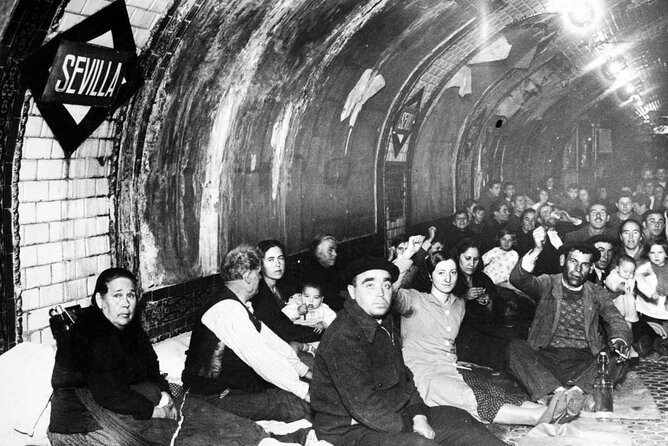
Madrid’s Spanish Civil War story is written into ordinary streets, grand plazas, damaged buildings, monuments, and the long road toward the Victory Arch. This walking tour connects those places to the conflict’s larger story, including Franco’s rise, Madrid’s 900-day siege, and the way the war helped set the stage for World War II.
I like the way the tour links big political questions to real city sights, and I like the use of maps, images, audio, and video to make a difficult subject easier to follow. The main drawback is its serious subject matter and brisk walking route, which may feel demanding if you want a light sightseeing outing.
In This Review
- Key points to know before you book
- Why this Madrid walking tour matters
- Plaza del Callao and the war in the city center
- Palacio del Senado and the question of two Spains
- Plaza de España, Franco, and the 900-day siege
- Templo de Debod, money, and propaganda
- Paseo del Pintor Rosales and Picasso’s Guernica
- Cuartel General del Ejército del Aire and life-saving medicine
- The Victory Arch and the difficult meaning of victory
- The guides and the teaching style
- Who should book this experience?
- Is the $3.62 price good value?
- My verdict: book it for context, not just sights
- FAQ
- Where does the Spanish Civil War walking tour start?
- Where does the tour finish?
- How long does the experience last?
- What language is the tour offered in?
- How much does the tour cost?
- Are entrance tickets included?
- What is included with the experience?
- Can I cancel for a full refund?
Key points to know before you book
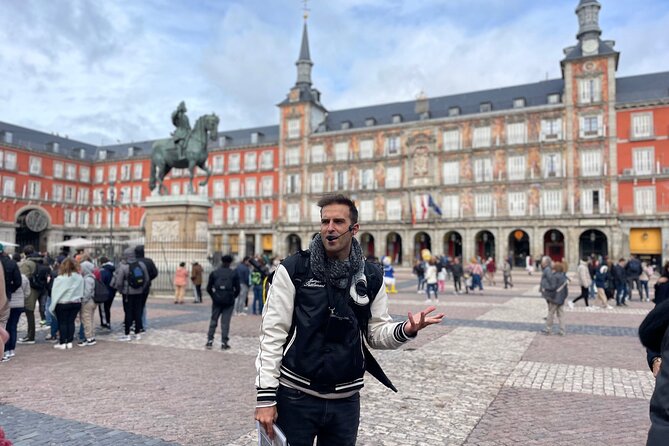
- Seven stops across Madrid: The route begins near Plaza del Callao and finishes at the Victory Arch in Moncloa.
- A street-level view of the war: You see sites tied to bombing, the defense of Madrid, propaganda, Picasso’s Guernica, and the war’s aftermath.
- Local guides shape the experience: Victor, Maikel, Adria, Guillermo, and Chato are among the guides praised for clear, warm, and engaging presentations.
- Helpful visual material: Maps, photographs, audio, and video support the explanation at each stop.
- Good value at the listed price: The advertised price is $3.62 per group of up to 15, with no admission fees needed for the route.
- Plan for the finish: The walk ends at Arco de Moncloa, near Metro Moncloa, not back in central Madrid.
Why this Madrid walking tour matters
The Spanish Civil War can be hard to understand from a museum label or a quick internet search. It involved competing political visions, foreign involvement, social unrest, military rebellion, and a sharp split between two visions of Spain. Madrid was not just a backdrop. It became a symbol of resistance and a working city under siege.
This route helps you place those events on a map. You move from central Madrid toward Moncloa, seeing how the war touched daily life, public buildings, art, music, medicine, and memory. I find that approach more useful than a tour that only names generals and battles.
The experience is offered in English and lasts about two hours and 30 minutes. The group limit is given as up to 30 people, while the listed price is for a group of up to 15. That detail is worth checking when you book, especially if you care about a small group and easy access to the guide.
The price is unusually low at $3.62 per group. Since no paid entries are required, most of what you are buying is the guide’s time, preparation, and supporting material. Tips are not included, and the operator asks you to consider the effort of the guide at the end. At this price, even a modest tip can make the experience good value.
Other Madrid days people book alongside this one:
- Madrid: Tour Bernabéu Entry Ticket
★ 4.5 · 21,573 reviews - Madrid: Prado Museum Entry Ticket
★ 4.6 · 17,509 reviews - Madrid: Royal Palace Fast-Access Admission Ticket
★ 4.6 · 13,856 reviews
Plaza del Callao and the war in the city center
The walk starts at C. del Postigo de San Martín, near Plaza del Callao. The opening section looks at bombing in central Madrid and the scars left on buildings. This is a strong beginning because it brings the war down to street level almost at once.
You are not simply hearing that Madrid was attacked. You are asked to look at the built city and consider what it meant to live with danger overhead. The stop also raises a surprisingly human question: would you still go to the movies during wartime?
That detail gives the tour a social angle. War did not erase every routine. People still had to work, eat, move around, and make choices about how much normal life to preserve. I like this kind of question because it avoids treating civilians as background figures.
The stop lasts about 15 minutes, with no entry ticket needed. Plaza del Callao is central and easy to reach, so it works well as a starting point if you are already sightseeing in Madrid’s Centro area.
Palacio del Senado and the question of two Spains
At Palacio del Senado, the guide explains how the Spanish Civil War began and why Spain became divided. This is one of the most important stops for anyone who knows the war mainly through names such as Franco, Picasso, or Guernica.
The phrase two divided Spains captures the central problem, but the explanation needs care. The conflict was not a simple two-team sporting match. Political groups on the left and right had different aims, and the wider struggle involved social class, military power, ideology, religion, and competing ideas about the country’s future.
The tour also presents Spain as a kind of test range for World War II. That framing helps you understand why this conflict matters beyond Spanish borders. The Spanish Civil War became a place where military tactics, political alliances, propaganda, and outside support shaped events before the larger European war began.
You get about 20 minutes here. Since the tour stays outside and does not require entry, the value comes from the explanation and visual aids rather than access to the Senate itself. If your main goal is an interior visit, this is not that sort of experience. If you want the political groundwork, it is essential.
Plaza de España, Franco, and the 900-day siege
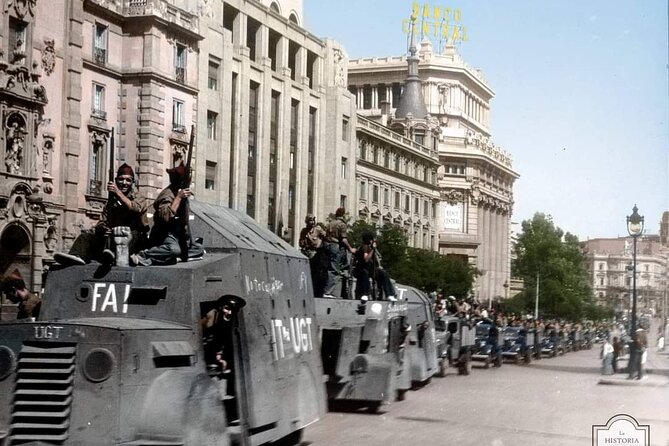
Plaza de España introduces Francisco Franco and the defense of Madrid. The tour describes the capital’s 900-day siege and the strain placed on the city. That length of time is important. It shifts your understanding from a short battle to a prolonged crisis that affected food, transport, housing, morale, and daily routines.
The stop also covers wartime sayings and Madrid under bombardment. These small pieces of language can be more memorable than a list of dates. They show how people made sense of fear and uncertainty, and how a city’s speech changes during a crisis.
The guide’s job here is to keep the political and personal stories connected. The tour’s strongest presentations, based on the available guide feedback, come from people who explain clearly without making the subject dry. Victor is singled out for making the material both informative and fun, while Maikel is praised for presenting the causes, events, and social impact with sensitivity.
That balance matters. A war tour should not turn suffering into entertainment, but a clear and lively guide helps you stay focused for two and a half hours. This 15-minute stop is brief, so expect a compact explanation rather than a full battle lecture.
A different sort of afternoon around Madrid:
- Madrid: “Emociones” Live Flamenco Performance
★ 4.8 · 12,866 reviews - Madrid: Panoramic Route City Tour
★ 4.1 · 12,259 reviews - Madrid: Live Flamenco Show with Food and Drinks Options
★ 4.5 · 9,901 reviews - Avila & Segovia Tour with Tickets to Monuments from Madrid
★ 5.0 · 9,762 reviews
Templo de Debod, money, and propaganda
The Templo de Debod is one of Madrid’s most unusual public sights, and it gives the tour a memorable setting for two central questions: who paid for the war, and how was the war sold to the public?
The temple itself is not a Civil War monument. Its presence adds variety to the route, but you should not expect the ancient Egyptian structure to reveal battlefield history. Instead, the stop uses the surrounding area to discuss financing and propaganda, two forces that helped sustain the conflict.
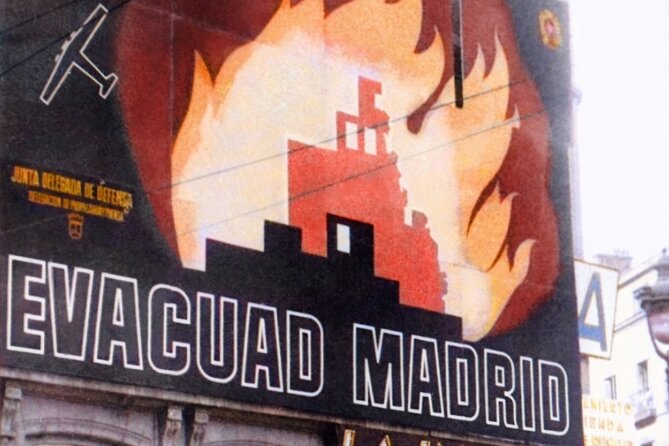
The idea of a war of ideas is especially useful. Armed conflict is fought with weapons, but it is also fought through posters, slogans, speeches, symbols, music, and competing stories about patriotism. Seeing those subjects alongside a major Madrid landmark gives the walk a pause from military chronology.
This stop also includes the Sculpture to the Fallen of the Civil War. That brings the discussion back to memory and mourning. Monuments do not only record what happened. They show how later generations choose to remember, honor, or argue about the past.
The stop lasts about 20 minutes. You will want to give the guide room to explain the symbols rather than rushing through for photographs. The temple is a popular place to visit in its own right, so the route also gives you an easy way to connect a history walk with regular Madrid sightseeing.
Paseo del Pintor Rosales and Picasso’s Guernica
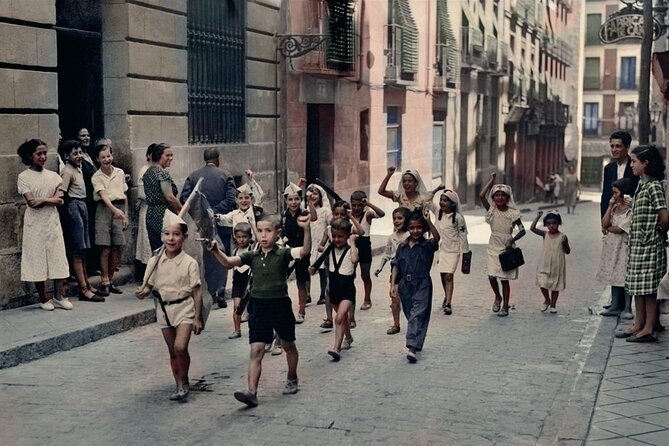
The section along Paseo del Pintor Rosales focuses on the bombing of civilians and Picasso’s Guernica. This is likely to be one of the tour’s most emotional moments because it links a particular kind of wartime attack to one of the best-known antiwar works in modern art.
The key point is not simply that Picasso painted Guernica. The guide explains the bombing of civilians and the way the event became a symbol far beyond the town itself. That helps you read the painting as a response to modern warfare, public outrage, and the use of art as political communication.
The stop also turns to the Prado Museum and art under fire. Madrid’s museums and artworks were not separate from the conflict. Protecting cultural objects became part of protecting the city’s identity. That idea adds useful depth to a familiar art story.
A brief section on Christmas during a truce offers a change of pace. A pause in fighting does not end a war, but it can show how people search for a moment of relief. The inclusion of a truce keeps the tour from becoming a sequence of attacks and political speeches. It reminds you that ordinary human needs continue even in violent times.
This stop takes about 20 minutes. If you want to visit the Prado or see Guernica in person, plan a separate visit. The walking tour explains the subjects, but the route does not include museum admission.
Cuartel General del Ejército del Aire and life-saving medicine
At Cuartel General del Ejército del Aire, the focus shifts to music, medicine, and the war’s final phase. The references to They Won’t Happen and Sun Face show how songs can carry political messages and shape group identity.
Music is an effective way to understand the emotional side of the conflict. A political movement needs more than military orders. It needs language, symbols, and shared sounds that help people feel part of a cause. This stop places those cultural tools alongside the more familiar story of armies and leaders.
The tour also covers the first remote blood transfusion. That subject brings the discussion to medical care in the middle of mass death. It is a striking example of how wartime pressure can produce urgent advances while exposing doctors, nurses, and patients to terrible conditions.
The final part of the stop explains how the end of the Spanish Civil War led into World War II and dictatorship. The war did not close the story. Its outcome shaped Spain for decades, while the wider international conflict was already approaching.
This is a 15-minute stop, so you should expect a clear overview rather than a technical medical history or a full account of Spain under dictatorship. Still, the mix of music, medicine, and politics gives the walk a broad human range.
The Victory Arch and the difficult meaning of victory
The final stop is the Victory Arch, or Arco de la Victoria, near Moncloa. The route ends here after moving through central Madrid, the Senate area, Plaza de España, the Templo de Debod, Paseo del Pintor Rosales, and the Ejército del Aire headquarters.
The arch raises a question that remains uncomfortable: should it be destroyed or preserved? That is not a simple preservation debate. A monument built to celebrate victory can also remind people of division, repression, and the cost paid by those who lost.
Ending at the arch is a smart choice because it leaves you thinking about memory rather than giving you a tidy final answer. The tour also asks you to reflect on war more broadly. Madrid’s monuments are not only scenic stops. They are arguments in stone.
The walk finishes at Av. de la Memoria, 32, close to Metro Moncloa. That is practical if you plan to continue toward western Madrid or return by subway. It is less convenient if you expect to finish near the starting point in Centro, so check your evening plans before booking.
The guides and the teaching style
The guide can make or break a history walk, and the strongest names attached to this experience are Victor, Maikel, Adria, Guillermo, and Chato. Their styles may differ, but the qualities repeatedly associated with them are clarity, warmth, authenticity, and strong command of the subject.
Victor is described as making the tour educational and fun. Maikel is noted for using visual aids to explain fascists, anarchists, and socialists and for handling the social impact of the war with sensitivity. Adria is praised for a clear and personal presentation, while Guillermo is credited with helping visitors learn both the war and Madrid itself.
Chato is noted for giving extra time and continuing beyond the expected two hours and 30 minutes. You should not assume every departure will run long, but the example shows that the guide may adjust the pace when the group has questions.
The supplied material does not guarantee which guide you will receive. I would book this for the subject and format, not for one specific person. Still, those names give you a useful sense of the teaching style to expect.
Who should book this experience?
I would recommend it to you if you want historical context before visiting Madrid’s museums, monuments, and central neighborhoods. It suits first-time visitors who want to understand why certain public spaces carry political weight, as well as repeat visitors looking for a less polished and more serious side of the city.
It is also a good choice if you learn best through place. Dates and ideologies can blur together, but walking from a bombed city center to the Victory Arch gives the story a physical shape.
You should think twice if you want a relaxed stroll with mostly cheerful sightseeing. The subject includes civilian deaths, dictatorship, bombing, political division, and social suffering. The route is also point-to-point, not a loop, and lasts around two and a half hours.
Most people can take part, service animals are allowed, and the meeting point is near public transport. Confirmation arrives when you book. Free cancellation is available up to 24 hours before the start time, but changes or cancellations inside that period are not accepted for a refund.
Is the $3.62 price good value?
At the advertised $3.62 per group, the experience is excellent value if the booking details apply to your party. You receive a local guide, supporting maps and media, and a route that covers seven carefully chosen locations without entrance fees.
The low price also means you should judge the tour fairly. You are not paying for museum access, transport, food, or a private vehicle. You are paying for interpretation, organization, and the guide’s work in connecting places that you could technically visit on your own.
The route is listed for groups of up to 15 at the stated price, while the activity maximum is given as 30 participants. I would confirm the group arrangement before finalizing the booking if a quiet, intimate walk is important to you.
My verdict: book it for context, not just sights
Book this tour if you want Madrid to make more sense. Its best feature is the connection between ordinary streets and large historical forces: bombings, ideology, art, medicine, propaganda, Franco, and the memory of victory.
I especially like the Guernica section, the discussion of civilians, and the final stop at the Victory Arch. The use of images, maps, audio, and video should help you follow a complex subject, while the guides’ clear and human presentations keep the walk from becoming a dry lecture.
Skip it if you are looking only for famous monuments, museum interiors, or a gentle introduction to Madrid. For everyone else, the low listed price, no entry fees, English format, and strong guide focus make this a useful way to spend a morning or afternoon, provided you are ready for a serious story and a one-way walk to Moncloa.
FAQ
Where does the Spanish Civil War walking tour start?
It starts at C. del Postigo de San Martín, 26, Centro, 28013 Madrid, Spain.
Where does the tour finish?
It finishes at the Arco de la Victoria, at Av. de la Memoria, 32, Moncloa, Madrid. The nearest listed metro station is Moncloa.
How long does the experience last?
The tour lasts approximately two hours and 30 minutes.
What language is the tour offered in?
The experience is offered in English.
How much does the tour cost?
The listed price is $3.62 per group of up to 15 people.
Are entrance tickets included?
There are no entry tickets required for the stops described, so paid site admission is not included or needed for this route.
What is included with the experience?
You receive a local guide, maps, images, audio, videos, and other exclusive material. You also receive a link to personalized Madrid recommendations and ongoing personalized attention from the guide after the tour.
Can I cancel for a full refund?
Yes. You can cancel at least 24 hours before the experience start time for a full refund. Cancellations or changes made less than 24 hours before the start time are not accepted for a refund.
Just added around Madrid
- Private Vacation Photography Session with Photographer in Madrid★ 5.0 · 3 reviews
- Arrival Private Transfer from MAD Airport to Madrid in a Minibus★ 5.0 · 3 reviews
- Segovia: 3-Hour Private Walking Tour★ 5.0 · 3 reviews
- Tour Segovia and La Granja de San Ildefonso from Madrid★ 5.0 · 3 reviews
- Madrid: Prado & Reina Sofia Museum Skip-the-Line Guided Tour★ 5.0 · 3 reviews
- Salamanca: Private Guided Customizable Walking Tour★ 5.0 · 3 reviews
- Total Reboot and Renew with top wellnes 3 hours couple experience★ 5.0 · 3 reviews
- Madrid: Prado Museum Private Tour★ 5.0 · 3 reviews