
Review · 2-HOUR EXPERIENCES
Tour Madrid in 2 hours! Electric Tuk – Fast, Fun, and Exclusive
Madrid is a big city with a compact historic core and a long list of famous sights. This private electric tuk-tuk tour gives you a quick orientation, from Plaza de Santa Ana and the Royal Palace to Las Ventas, the Bernabéu stadium, and Gran Vía, without asking you to cover the whole route on foot.
I like the small-group format, which keeps the ride personal for up to four people, and I like the sheer range of places covered in two hours. You get royal Madrid, literary streets, grand boulevards, football, government buildings, and modern business districts in one outing. The main catch is pace: most stops last only five to ten minutes, so this is a sightseeing sweep rather than a series of in-depth visits.
In This Review
- Key things to know before you book
- What this two-hour Madrid ride really offers
- Starting at Plaza de Santa Ana
- The Royal Palace, Almudena Cathedral, and Sabatini Gardens
- Debod Temple and the old Madrid core
- Churches, writers, and the literary quarter
- Plaza de las Cortes, Neptune, and the Prado district
- Puerta de Alcalá and the east side of Madrid
- Salamanca, Bernabéu, and Paseo de la Castellana
- Columbus, Cibeles, and Gran Vía
- Price, pace, and practical value
- Should you book this Madrid tuk-tuk tour?
- FAQ
- How long does the Madrid electric tuk-tuk tour last?
- How many people can join the private tour?
- What language is offered?
- Where does the tour start and end?
- Is Royal Palace admission included?
- Are meals included?
- Can I cancel for a full refund?
Key things to know before you book
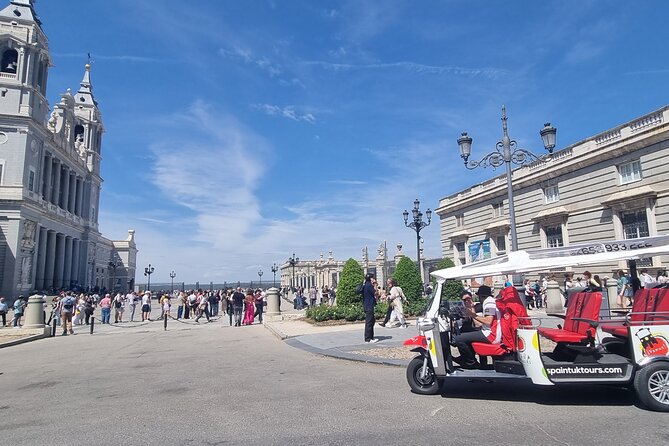
- Up to four people share one private tuk-tuk: The price is per group, not per seat, so the value improves sharply with four passengers.
- You cover both old and modern Madrid: The route links Plaza Mayor and the Royal Palace with Salamanca, Paseo de la Castellana, and Santiago Bernabéu.
- Most stops are for views and photographs: Palace, museum, cathedral, market, and stadium admission is not part of the two-hour ride unless specifically stated otherwise.
- The guide adds local context: English is offered, and guides such as Tadeo and Angel have been praised for history, photography help, and food advice.
- Timing matters: One booking experienced a 40-minute delay, while another had a 20-minute wait, so avoid scheduling a tight connection afterward.
- The tour returns to its starting point: You meet at Pl. de la Lealtad, 1, near the Retiro area, and finish there.
What this two-hour Madrid ride really offers
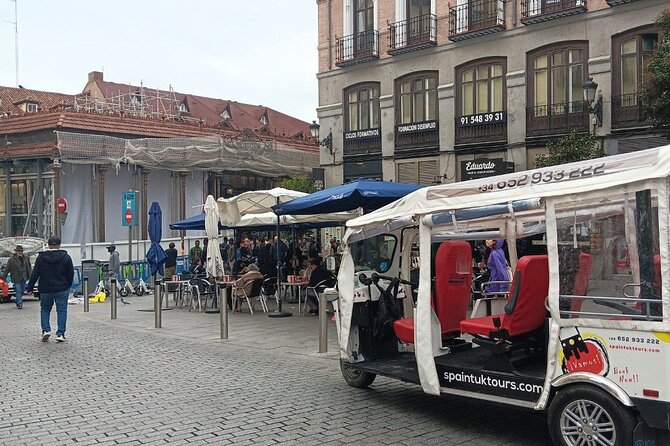
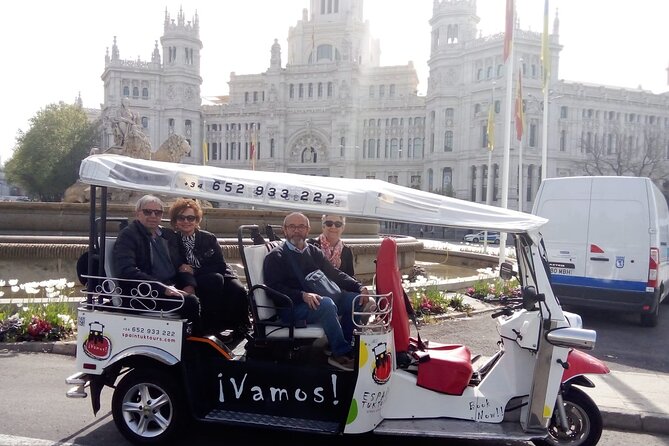
Think of this experience as a moving introduction to Madrid. You sit in an electric tuk-tuk while your guide points out the city’s landmarks, explains their place in Spanish history, and pauses for photographs. The vehicle is especially useful for a first day, when you want to understand how the neighborhoods fit together before choosing where to return on foot.
The route is unusually broad. In the old center, you see the literary quarter, royal buildings, Catholic monuments, and food halls. Then you move toward the Prado area, Puerta de Alcalá, Salamanca, the bullring, the football stadium, the financial district, and the grand civic monuments around Cibeles.
That range is the strength of the tour, but it also sets the limit. A two-hour route with this many points cannot give you meaningful time inside the Royal Palace, Prado Museum, Almudena Cathedral Museum, or Bernabéu Stadium. I would book it for orientation and sightseeing, not as a replacement for Madrid’s major museums and palace visits.
A few more Madrid days to weigh up
- Madrid: 2-Hour Sightseeing Segway Tour
★ 4.7 · 217 reviews - 2-Hour Tour of the Madrid of Mysteries
★ 4.5 · 75 reviews - Axe Throwing 2 Hour Session
★ 5.0 · 49 reviews
Starting at Plaza de Santa Ana
The meeting point is at Pl. de la Lealtad, 1, near Retiro. The first listed sightseeing stop is Plaza de Santa Ana, a pleasant open space in the Cortes neighborhood. It dates from 1810 and has changed shape several times as Madrid grew around it.
This is a useful opening stop because it places you near the old center and the literary quarter. The plaza connects naturally with Madrid’s café life and with the streets associated with Spain’s Golden Age writers. You get about five minutes here, enough for a quick look and a few photographs rather than a long pause.
The guide’s role matters from the beginning. A good explanation can turn a simple square into a map of Madrid’s changing neighborhoods. The experience has been especially well served by guides who mix historical information with practical local suggestions, including food advice.
The Royal Palace, Almudena Cathedral, and Sabatini Gardens
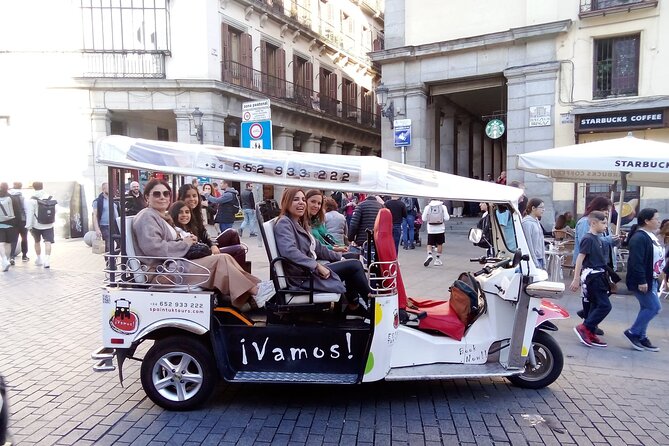
The Royal Palace is one of Madrid’s headline sights. Construction began in 1738 and lasted seventeen years, after fire destroyed the earlier Habsburg palace on Christmas Eve in 1734. Carlos III moved in as his usual residence in 1764. Spain’s royal family now lives at the Palacio de la Zarzuela, so the palace is used for receptions, ceremonies, and official events.
You receive only about five minutes at the palace, and the entrance fee is not included. That makes the stop a chance to admire the exterior and hear the story, not a palace tour. If you want the grand rooms, paintings, armor, and formal halls, plan a separate visit and check its admission arrangements independently.
Nearby, the Almudena Cathedral represents a very different chapter of Madrid. It was consecrated by Pope John Paul II on June 15, 1993, making it the first cathedral consecrated by a pope outside Rome. The cathedral museum has twelve rooms with mosaics, episcopal shields, and other objects connected with the Madrid diocese.
The listed museum stop lasts ten minutes and is marked as free, but you should not assume that this brief tuk-tuk visit replaces a full museum visit. The practical benefit is location and context. You can see how the cathedral sits beside the palace and how royal and religious Madrid share this part of the city.
The Sabatini Gardens lie along the north side of the palace, between Bailén Street and the San Vicente slope. Their formal design gives you a good contrast with Madrid’s dense streets. Ten minutes is enough to appreciate the palace-facing view and take photographs, especially if you want a quieter pause in the middle of the route.
Debod Temple and the old Madrid core
The route also passes the Temple of Debod, an ancient Egyptian building now located west of Plaza de España beside Paseo del Pintor Rosales. Its setting on a hill makes it one of Madrid’s more unexpected sights. You might find this stop particularly memorable because it breaks the pattern of Spanish royal, religious, and civic architecture.
Plaza Mayor then brings you back into the heart of Madrid de los Austrias, the old Habsburg quarter. The square began on the site of the former Plaza del Arrabal, once the city’s popular market. In the early seventeenth century, architect Juan Gómez de Mora regularized the buildings into the grand porticoed square you see today.
Only ten minutes are allowed here. I would use that time to study the arcades, look across the wide space, and note the many side streets leading into the old quarter. Plaza Mayor has hosted celebrations, bullfights, beatifications, coronations, and religious events, so it is more than a pretty square. It is a stage for Madrid’s public life.
A short ride brings you to Mercado de San Miguel, a covered market dating from around 1916. It now focuses on local food, delicatessen products, and events in an elegant setting. The market is included as a sightseeing stop, but lunch is not included. Do not count on having time for a proper meal during the tour. If you want to eat here, return later with more time and a separate budget.
A different sort of afternoon around Madrid:
- Madrid: Tour Bernabéu Entry Ticket
★ 4.5 · 21,573 reviews - Madrid: Prado Museum Entry Ticket
★ 4.6 · 17,509 reviews - Madrid: Royal Palace Fast-Access Admission Ticket
★ 4.6 · 13,856 reviews - Madrid: “Emociones” Live Flamenco Performance
★ 4.8 · 12,866 reviews
Churches, writers, and the literary quarter
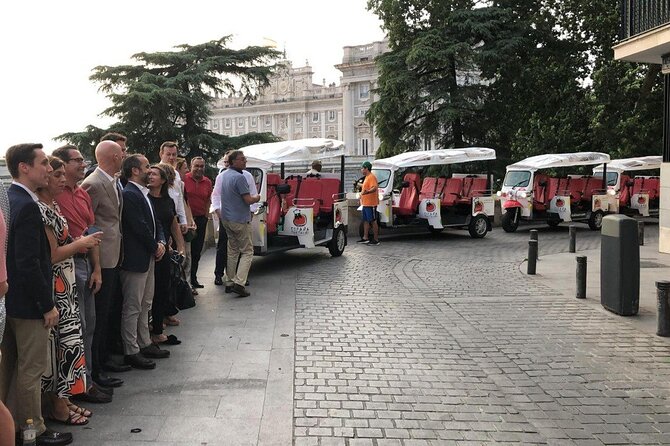
Several additional sights connect the route to Madrid’s religious and literary identity. The Royal Basilica of San Francisco el Grande is an important Catholic church in the historic center, in the Palacio neighborhood. The route gives you a look at the building, but not an extended interior visit.
You also pass the former residence of Miguel de Cervantes, the author of Don Quijote. It offers guided visits, making it a worthwhile return stop for readers and anyone interested in Spanish literature. Nearby, the House of Lope de Vega occupies a sixteenth-century building on Cervantes Street. Lope de Vega bought it in 1610 and lived there until his death in 1635.
These literary stops are easy to miss if you only follow Madrid’s major postcard sights. I like that they give the route some character. The drawback is the same as elsewhere: the tuk-tuk can introduce you to the locations, but you need a separate visit to explore the houses properly.
Plaza de las Cortes, Neptune, and the Prado district
Plaza de las Cortes brings the route into Madrid’s political center. The Palace of the Spanish Courts was built on the site of a former convent used as the seat of Congress from 1834 to 1841. Its neoclassical facade has six fluted Corinthian columns, a decorated triangular pediment, and the famous iron lions cast from cannons captured during the war in Africa.
You get about ten minutes here. That is enough to examine the facade and hear why the bronze door opens only for important occasions. Interior visits are not part of this activity, so you will need another arrangement to see the Session Room, library, or Conference Room.
The nearby Neptune Fountain dates from the late eighteenth century. The marble figure of Neptune sits in a chariot drawn by sea creatures, creating one of the classic views along Madrid’s grand central avenue. The fountain occupies Plaza de Cánovas del Castillo and lies close to the Prado Museum.
The Prado itself receives only a pass-by mention on this route. Its collection includes major works by Velázquez, El Greco, Goya, Titian, Rubens, and Bosch, along with many other European masters. I would not try to squeeze the museum into the tuk-tuk schedule. Treat this part of the tour as a useful preview, then return for at least a few focused hours if art is important to you.
The nearby church of San Jerónimo el Real, often called Los Jerónimos, dates in part to the early sixteenth century and has long links with Spain’s monarchy. It was connected with royal retreats, investitures, and the wedding of Alfonso XIII. The church’s grand staircase was built for that wedding in 1906.
Puerta de Alcalá and the east side of Madrid
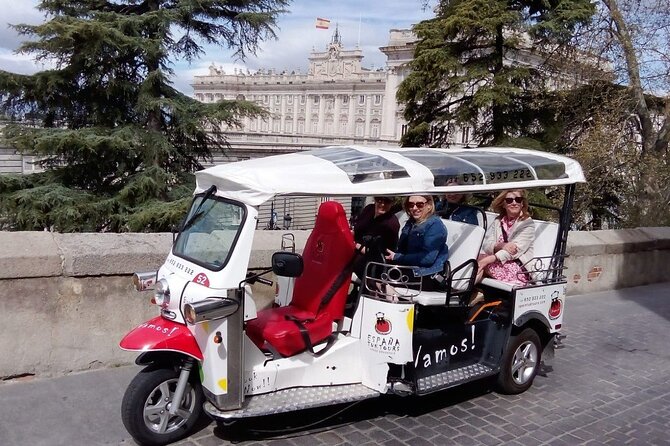
Puerta de Alcalá is one of Madrid’s most recognizable monuments. Carlos III ordered it to replace an earlier gate, and the new neoclassical arch opened in 1778. Architect Francesco Sabatini gave it five openings rather than the more usual three, and the two facades use different decoration.
The side facing out of Madrid has the heavier royal decoration, while the inner side carries representations of Prudence, Justice, Temperance, and Fortitude. You have about five minutes here, which works well for photographs. The gate also helps you understand how Madrid expanded beyond its historic core.
The route continues to Las Ventas Bullring, Spain’s largest bullring by capacity, with room for 23,798 spectators. Its red brick and ceramic decoration make it an imposing sight even if you have no interest in bullfighting. The stop is exterior-focused, with about ten minutes for a look.
Salamanca, Bernabéu, and Paseo de la Castellana
The tuk-tuk then reaches the Barrio de Salamanca, one of Madrid’s more polished districts. The route includes Velázquez, Ortega y Gasset, and Serrano streets. These broad streets give you a different picture of the capital, with upscale shopping and orderly blocks replacing the tight lanes of the old center.
From Salamanca, the route follows Paseo de la Castellana toward Santiago Bernabéu Stadium. The stadium opened on December 14, 1947, and now holds 81,044 people. Football fans will appreciate seeing the home ground of Real Madrid, while others can treat it as a useful landmark in the city’s northern half.
The visit lasts about five minutes and does not include stadium admission. If you want the museum, pitch, changing rooms, or stadium tour, arrange that separately. The tuk-tuk stop is best for a quick exterior view and a sense of the stadium’s scale.
Paseo de la Castellana also introduces Madrid’s financial district. This long north-south route links older central neighborhoods with office towers and newer commercial areas. The contrast helps you see that Madrid is not only a city of palaces and plazas.
Columbus, Cibeles, and Gran Vía
Plaza de Colón features a seventeen-meter Christopher Columbus monument built in 1885 by Jerónimo Suñol. The square also includes the Gardens of Discovery and the Fernán Gómez Cultural Center below ground. The five-minute pause is brief, but the area is easy to recognize and close to the National Library of Spain.
The library safeguards Spain’s published and documentary heritage, with around thirty million books, magazines, maps, prints, drawings, scores, and pamphlets produced in Spain since the early eighteenth century. The building is not part of the tuk-tuk visit, and its interior access is limited, so this is another place to note for a future stop.
Cibeles Fountain is one of Madrid’s great symbols. The Roman goddess Cibeles rides a chariot drawn by two lions, representing the earth, farming, and fertility. The fountain is framed by the Army Headquarters, Linares Palace, the former post office palace now used by Madrid’s city government, and the Bank of Spain.
Real Madrid supporters celebrate major titles at Cibeles, giving the monument a modern football role alongside its classical meaning. You get ten minutes here, enough to take in the whole setting and photograph the fountain with the surrounding buildings.
The route also passes the Bank of Spain and Gran Vía. The bank’s ornate building was created to match the importance of its national role, while Gran Vía runs from Alcalá Street to Plaza de España and remains one of Madrid’s main commercial, tourist, and entertainment streets. Seeing it from a tuk-tuk is handy because the traffic and long blocks can make a walking visit feel scattered.
Price, pace, and practical value
The price is $215.07 per group of up to four people. With four passengers, that works out to about $53.77 each for two hours of private transport and a guide. For a couple, the per-person price is much higher, so the value depends on how much you care about privacy and convenience.
I see the best value for a family or small group arriving in Madrid for the first time. You cover a remarkable number of districts without arranging taxis, studying a map, or tiring yourself out before a museum day. The electric tuk-tuk also keeps the experience quieter and more personal than a large sightseeing bus.
The route is not ideal if you want long stops, museum entry, or a relaxed meal. Lunch and dinner are not included, and the Royal Palace admission fee is extra. Since many pauses last five or ten minutes, you should keep your expectations clear: this is a fast city overview with guided commentary and photo opportunities.
English is offered. One booking made for an Italian-speaking guide resulted in a Spanish-speaking guide instead, so I would confirm the language carefully if English is not suitable for you. A separate booking had a 40-minute delay after arranging two tuk-tuks, and another had a 20-minute wait. I would leave a generous buffer before an airport transfer, restaurant reservation, train, or timed museum entry.
Confirmation arrives at booking, mobile tickets are accepted, service animals are allowed, and the activity is near public transportation. Most people can participate. Free cancellation is available up to 24 hours before the start time, but changes or cancellations inside that window are not refunded.
Should you book this Madrid tuk-tuk tour?
I would book it if you have only a short time in Madrid, want a private ride, or prefer to get your bearings before exploring on foot. It is also a strong choice for families and groups of four, especially if the main goal is to see the city’s major sights in one compact outing.
I would skip it if your priority is the Royal Palace, Prado Museum, Almudena Cathedral Museum, or Bernabéu interior. Those places deserve dedicated visits. Book this ride as a lively introduction to Madrid, then return to the landmarks that catch your eye.
FAQ
How long does the Madrid electric tuk-tuk tour last?
The tour lasts approximately two hours.
How many people can join the private tour?
One private group of up to four people can participate.
What language is offered?
The tour is offered in English.
Where does the tour start and end?
It starts at Pl. de la Lealtad, 1, Retiro, Madrid, and ends back at the same meeting point.
Is Royal Palace admission included?
No. The Royal Palace admission fee is not included in the tour price.
Are meals included?
No. Lunch and dinner are not included.
Can I cancel for a full refund?
Yes. You can cancel at least 24 hours before the experience start time for a full refund. Cancellations or changes made less than 24 hours in advance are not accepted for a refund.
Just added around Madrid
- Private Vacation Photography Session with Photographer in Madrid★ 5.0 · 3 reviews
- Arrival Private Transfer from MAD Airport to Madrid in a Minibus★ 5.0 · 3 reviews
- Segovia: 3-Hour Private Walking Tour★ 5.0 · 3 reviews
- Tour Segovia and La Granja de San Ildefonso from Madrid★ 5.0 · 3 reviews
- Madrid: Prado & Reina Sofia Museum Skip-the-Line Guided Tour★ 5.0 · 3 reviews
- Salamanca: Private Guided Customizable Walking Tour★ 5.0 · 3 reviews
- Total Reboot and Renew with top wellnes 3 hours couple experience★ 5.0 · 3 reviews
- Madrid: Prado Museum Private Tour★ 5.0 · 3 reviews
2-Hour Experiences, compared.
2-Hour Private Off-Road Segway Tour of Casa de Campo
Read our review →Browse the lists this tour appears in