
Review · CITY TOURS
Madrid City Guided Bike/E-Bike Tour for Small Groups
Madrid is a city made for covering ground, and this three-hour bike tour does exactly that. You pedal from the Egyptian Temple of Debod through the Royal Palace area, old Madrid, Retiro Park, Salamanca, Chueca, and Malasaña, seeing far more than you could on foot in the same time.
I like the route’s mix of famous sights and ordinary city life. You get the grand plazas, palace, cathedral, and parliament, then roll through café streets, market districts, and leafy Retiro. I also like the guide’s role: guides such as Kaspar, Alex, Sebastian, and Remi have been praised for clear history, good pacing, and a calm approach to city riding.
The catch is simple: this is not a beginner’s ride. The route can cover about 15 kilometers and includes gentle uphill sections, so you need to be comfortable cycling in traffic and across uneven city streets. If you are unsure about your stamina, pay the extra €10 for the pedal-assist e-bike.
In This Review
- Key points to know before you book
- Starting near Plaza de España
- Debod Temple and the first view of Madrid
- The Royal Palace, Almudena Cathedral, and old Madrid
- Puerta del Sol and the literary quarter
- The climb to Retiro Park
- Alcalá Gate and Salamanca’s polished streets
- San Antón Market, Chueca, and Malasaña
- What the guides add
- Regular bike or e-bike?
- Practical preparation for a comfortable ride
- Who gets the most from this tour?
- Should you book the Madrid bike tour?
- FAQ
- Where does the Madrid bike tour start?
- How long is the bike tour?
- Which sights are included?
- Is an electric bike available?
- What languages are offered?
- Is the tour suitable for children?
- What happens if it rains?
Key points to know before you book
- About 15 kilometers in three hours: You cover a large part of central Madrid at a steady sightseeing pace.
- Debod to Retiro and Malasaña: The route links Madrid’s headline sights with districts you might skip on a walking tour.
- English and Spanish are standard: Other languages can be arranged for a private departure.
- An e-bike costs €10 extra: This is useful for the uphill stretch toward Retiro and for keeping your energy for sightseeing.
- Photos are sent afterward: The guide takes pictures during the ride and sends a digital album by email.
- Best for confident city cyclists: Children should generally be at least 13 and able to handle a bicycle well.
Starting near Plaza de España
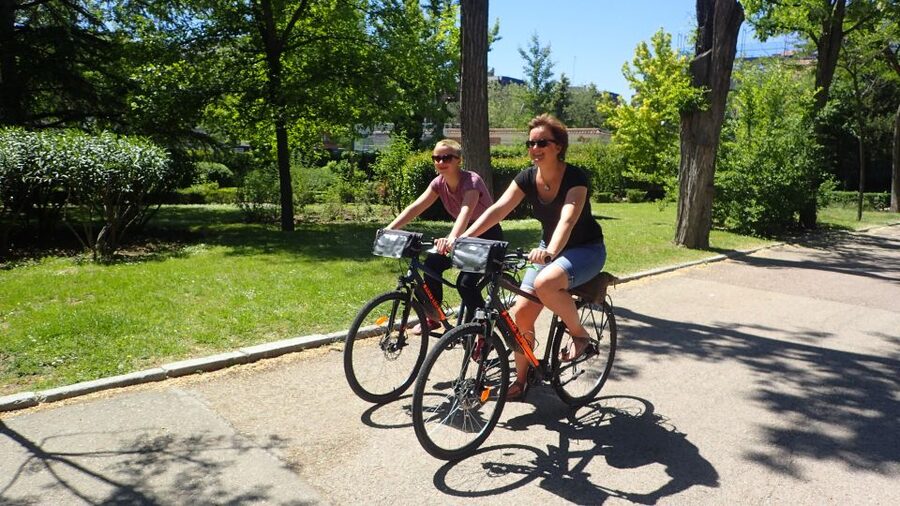
The tour begins at the Bravo Bike office, about a three-minute walk from Plaza de España. The easiest access is by Plaza de España metro station on Lines 3 and 10, which makes this a handy first-day activity if you are staying near the central districts.
Allow a little time before departure to get fitted to your bicycle. The standard bike has multiple gears, and the optional electric model uses eight-speed pedal assistance. Helmets are optional for adults but required for children up to age 16.
The shop provides a small front handlebar bag for a water bottle or personal items. You can also leave luggage at the premises, with lockers available. That is useful if you are joining the tour after checking out, although I would still keep passports, wallets, and other important items with you.
The advertised price is $41 per person. For a three-hour guided ride with a bike, guide, and access to a wide sweep of central Madrid, that is a fair price. You are paying less for museum entry and more for orientation, local context, and the chance to connect separate sights without repeatedly finding your way through city traffic.
More bike days around Madrid:
- Madrid Highlights Bike Tour
★ 5.0 · 1,731 reviews - Best of Madrid: 3-Hour Guided Bike Tour in Small Groups
★ 4.8 · 1,417 reviews - Madrid: Highlights Guided Vintage Bike Tour and Tapas Option
★ 4.9 · 962 reviews
Debod Temple and the first view of Madrid
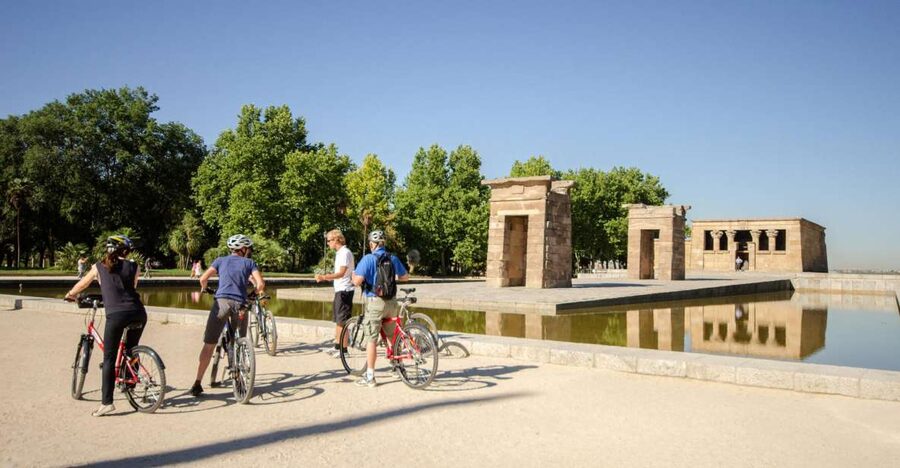
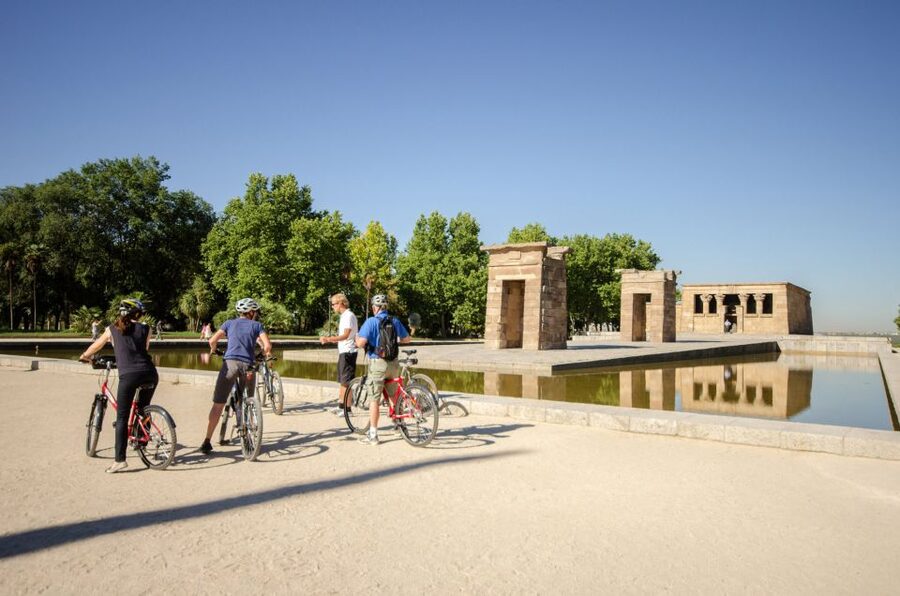
The first stop is the Temple of Debod, an ancient Egyptian temple set in a park near Plaza de España. Its setting gives you a broad opening view toward western Madrid and makes a good introduction to the city’s layers of history.
The temple was given to Spain by Egypt, and the guide uses the stop to explain both the monument and its place in modern Madrid. You do not enter attractions on this outing, so think of Debod as a photo and orientation stop rather than a temple visit.
From here, the group cycles toward the Royal Palace. The first section takes about ten minutes by bike, with the guide controlling the pace and stopping to explain key points. You get a sense of Madrid’s ceremonial center without spending the whole morning inside one building.
The Royal Palace, Almudena Cathedral, and old Madrid
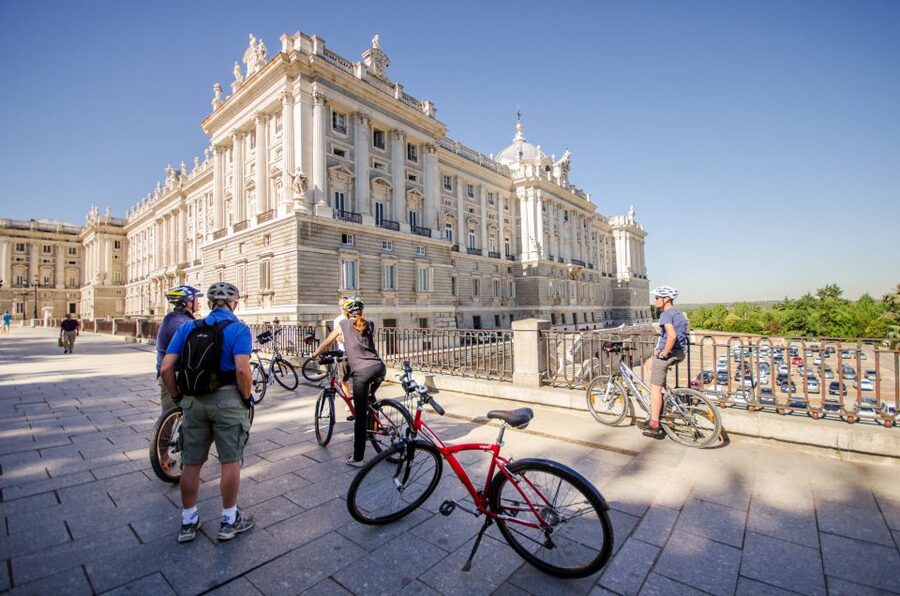
The Royal Palace is one of the route’s major visual highlights. Its scale is hard to appreciate from a quick passing glance, so the guide’s explanation helps you understand why this part of Madrid feels so formal and grand.
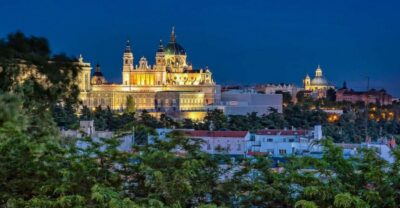
The tour continues to Almudena Cathedral, opposite the palace. The cathedral’s architecture differs from the older buildings around it, and that contrast gives the guide an easy way to explain how Madrid changed over time.
Next comes Plaza de la Villa, one of the old city’s compact historic squares. From there, you ride toward the San Miguel Market before reaching Plaza Mayor. The market is not an included tasting stop, but it is a useful place to note for later. You can return on foot for food after the tour.
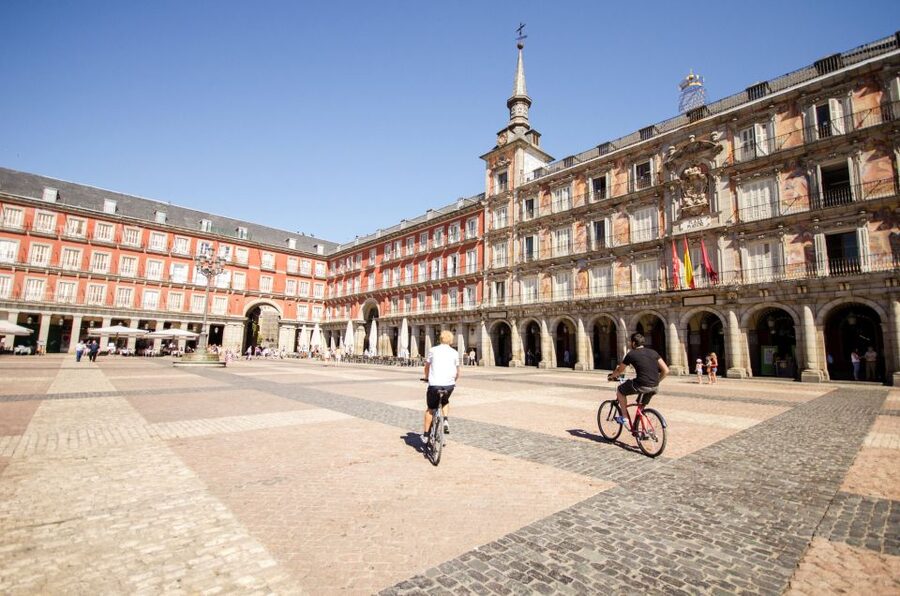
Plaza Mayor is one of Madrid’s essential landmarks, but it can feel crowded and confusing when you first arrive alone. Seeing it by bike gives you a quick sense of its position within the old center. The guide pauses here, so you can look up at the surrounding façades and hear the story behind the square rather than simply pass through.
Puerta del Sol and the literary quarter
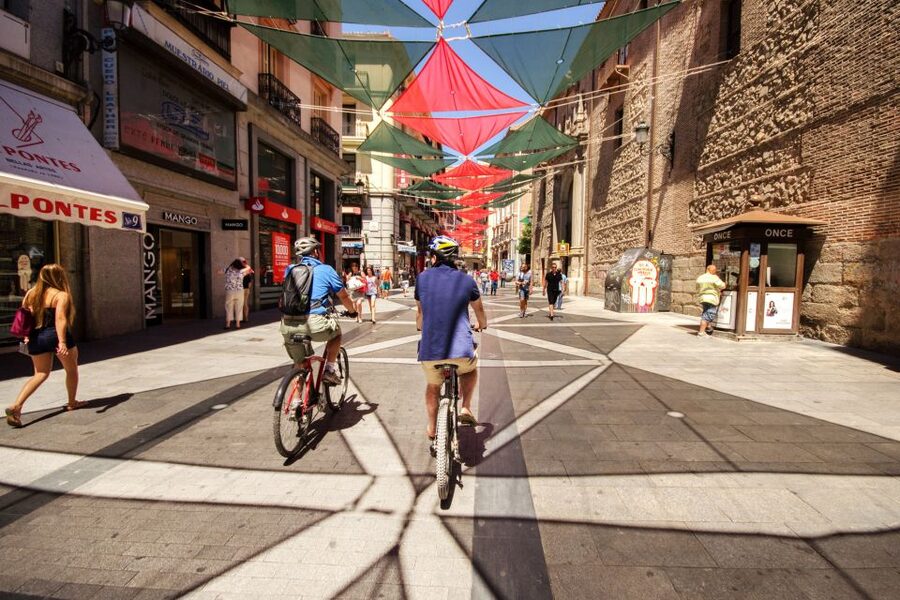
The short ride to Puerta del Sol takes about five minutes. This is Madrid’s central meeting point, marked by the famous bear and strawberry tree symbol and the city’s kilometer zero marker.
You will not have a long free period at every stop, and that is worth understanding. The strength of this outing is breadth, not extended visits. If you want detailed time at Sol, Plaza Mayor, or the palace interior, return later on foot.
The route then reaches Plaza de Santa Ana and the Las Letras quarter, Madrid’s literary district. Streets here connect the city with writers such as Cervantes and Lope de Vega, and the guide can add context about Madrid’s cultural life. This part of the ride feels less like a checklist of monuments and more like a look at how the historic center functions today.
The route continues toward Las Cortes, home of Spain’s lower house of parliament. The building provides another strong architectural stop, while the surrounding streets offer a change from the narrow lanes around Plaza Mayor.
A few more Madrid days to weigh up
- Madrid: 3-Hour Sightseeing Tour by Electric Bike
★ 4.6 · 192 reviews - Madrid E-Bike Small Group Tour
★ 5.0 · 155 reviews - Madrid Electric Bike Private Tour: Highlights & Parks
★ 5.0 · 152 reviews - Madrid: Highlights & Parks with Electric Bike Private Tour
★ 4.8 · 115 reviews
The climb to Retiro Park
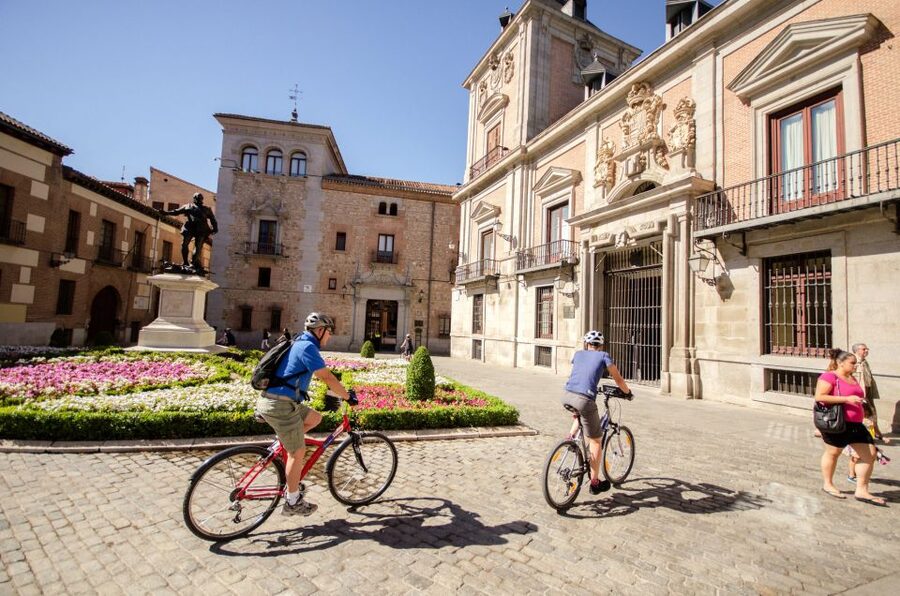
After Las Cortes, the route heads uphill toward Retiro Park. The climb is described as gentle, but it is still the section most likely to affect your enjoyment if you are not a regular cyclist.
This is where I would choose the e-bike if I had any doubts. The electric bicycle does not remove the need to pedal, but it makes the ascent easier and helps you stay with the group without arriving winded. Several guides have also recommended the electric option to riders who wanted a more relaxed outing.
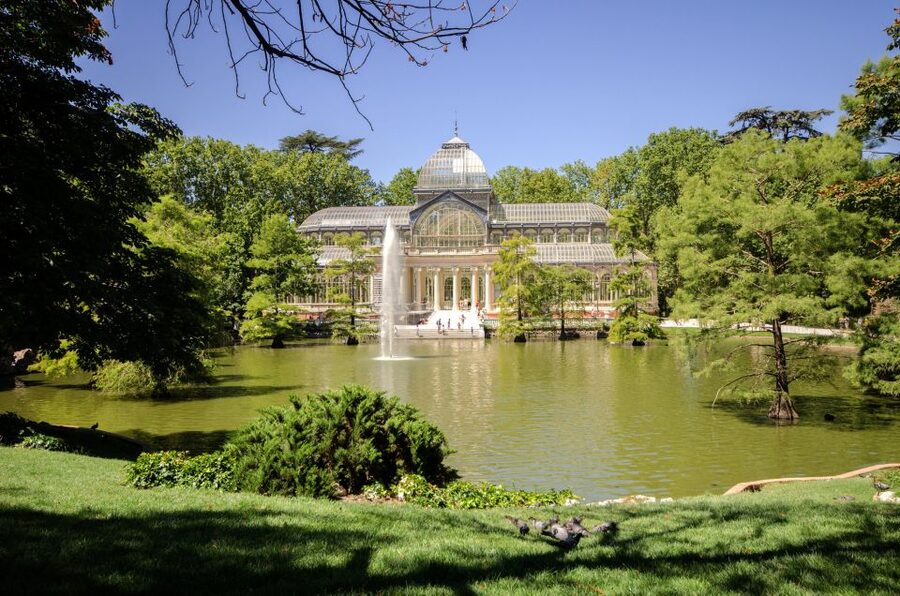
Retiro is the tour’s longest stop, with roughly 30 minutes of riding through the park. You see the boating lake, the Crystal Palace, and the Rose Garden when it is in season. These are not rushed roadside glances. The park gives you room to slow down, look around, and enjoy a greener side of Madrid.
The lake is one of Retiro’s most recognizable points, while the Crystal Palace provides a striking glass-and-metal structure in a wooded setting. The Rose Garden is seasonal, so its appearance depends on the time of year. You should expect the guide to adjust the exact focus to the group and the conditions.
Retiro also gives the ride a welcome change of pace. Until this point, you have been working through plazas and busy central streets. Inside the park, the experience becomes quieter and more open, though you still need to watch for pedestrians and other cyclists.
Alcalá Gate and Salamanca’s polished streets
The group exits Retiro by the monumental Alcalá Gate. This is one of Madrid’s classic photo stops and a good place to appreciate the scale of the city’s old entrances.
From there, the route follows Calle Serrano and crosses Recoletos Avenue. Calle Serrano runs through Salamanca, one of Madrid’s more polished shopping and residential districts. Boutiques and smart façades replace the older lanes of the city center.
The route does not turn into a shopping tour, and you will not have time to browse. Still, cycling through Salamanca helps you see a different side of Madrid. It also breaks up the historic sights with a look at the city’s modern style and everyday rhythm.
San Antón Market, Chueca, and Malasaña
The next major area is Chueca, reached around the lively San Antón Market. As with San Miguel, the market is mainly a visual and orientation stop during the ride rather than an included meal.
Chueca’s streets are active and central, so this is another point where confident handling matters. The guide generally chooses quieter streets when possible, and past guides have been praised for keeping riders comfortable and avoiding major roads when they could.
The route then winds through Malasaña. This district is known for its independent boutiques, cafés, and lively streets. It feels more local and less ceremonial than the palace quarter, giving the final part of the ride a useful sense of variety.
After Malasaña, you return to Plaza de España and the Bravo Bike office. The route has taken you through royal Madrid, medieval Madrid, literary Madrid, parkland, Salamanca, Chueca, and Malasaña. That range is the main reason to choose a bicycle instead of a conventional walking route.
What the guides add
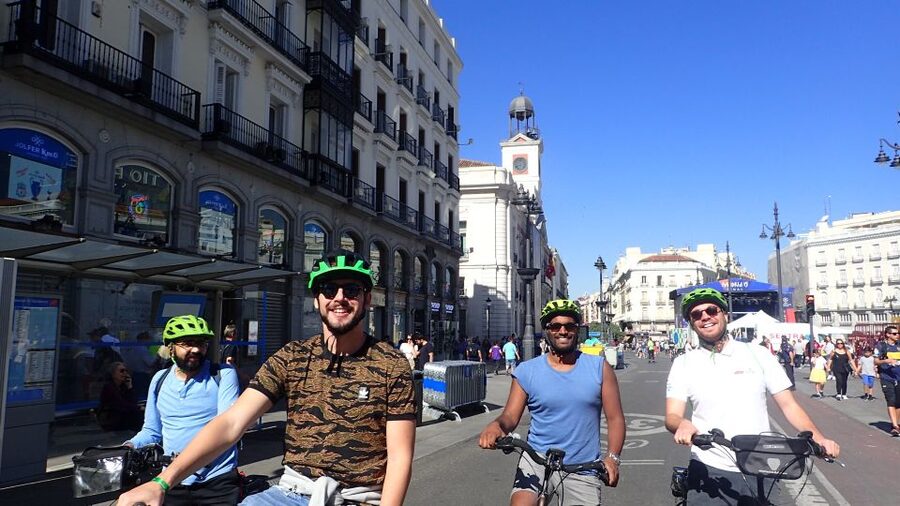
The guide is central to the value of this experience. You are not simply following a line on a map. At each stop, the guide provides historical background and explains how the districts fit together.
The team works in English and Spanish for the standard tour. Dutch, French, German, and Italian are available for private arrangements. If language is important to you, confirm the private option when booking rather than assuming every public departure will run in your preferred language.
Several guide names appear repeatedly in the tour’s history, including Kaspar, Alex, Sebastian, Remi, David, Alfredo, Amanda, Javier, and Anthony. The consistent qualities to look for are clear explanations, good humor, safe pacing, and the willingness to adjust the ride to the group.
The guides also take photographs during the tour and send them by email as a digital album. I consider this a useful extra. You can enjoy the ride instead of stopping every few minutes to photograph yourself, and cycling photos are much harder to take well on your own.
Regular bike or e-bike?
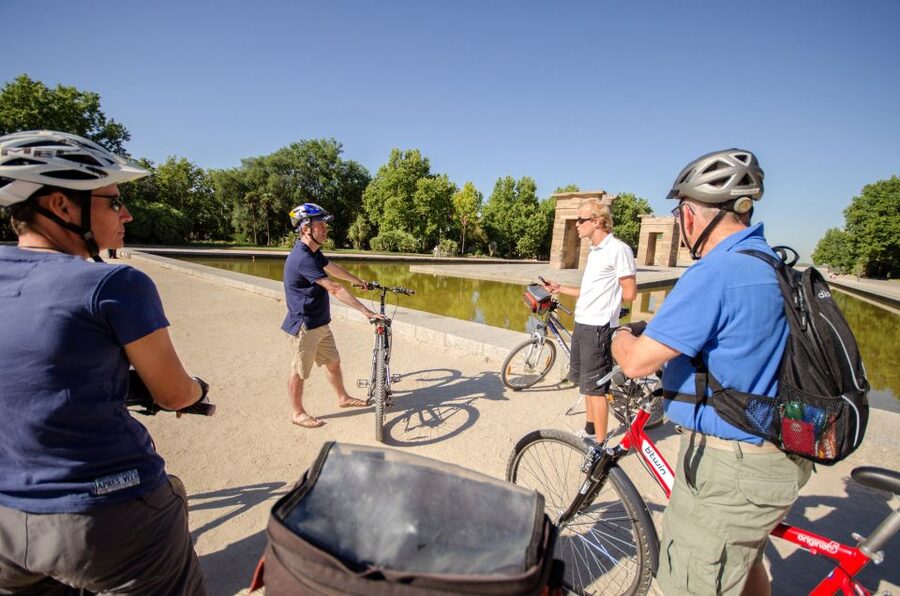
The regular multigear bike is suitable if you cycle often and feel comfortable riding in an urban setting. The route is not described as heavily strenuous, but it is not flat, and the distance adds up.
Choose the e-bike for €10 more if you are worried about the Retiro climb, visiting Madrid in hot weather, or simply want to concentrate on the guide and scenery. One rider described the full ride as about 15 kilometers and specifically recommended electric assistance. That is sensible advice for many holiday cyclists.
The e-bike is not a shortcut. You still need to balance, steer, brake, and ride around other people. It only reduces the effort needed on climbs and longer stretches.
The tour is not suitable for people without cycling experience, people with mobility impairments, people over 275 pounds or 125 kilograms, or people with high blood pressure. Children should generally be at least 13 and have a good command of the bicycle. For younger children, the operator lists a baby carrier, baby seat up to 22 kilograms, or FollowMe tandem for children aged five to seven, but you should confirm the arrangement before booking this particular city route.
Practical preparation for a comfortable ride
Wear closed-toe sports shoes and comfortable outdoor clothing. High heels are not allowed, and ordinary sightseeing clothes can become uncomfortable after several hours in the saddle.
Bring sunglasses, sunscreen, and weather-appropriate layers. The tour runs in rain or shine. Rain ponchos cost €2, and bottled water costs €1, so bring your own if you want to avoid those extra charges.
Adults may choose whether to wear a helmet, while children up to age 16 must wear one. The handlebar bag can hold small personal items, but I would avoid bringing a large daypack or anything loose that could interfere with riding.
The activity allows free cancellation up to 24 hours before departure for a full refund. You can also reserve now and pay later, which helps if your Madrid schedule is still taking shape. Starting times vary, so check the available departure when you book.
Who gets the most from this tour?
I would recommend this ride early in a Madrid visit. It gives you a city-wide orientation, then lets you decide which places deserve a longer return visit. The route also helps you understand how the palace quarter connects with Sol, Las Letras, Retiro, Salamanca, Chueca, and Malasaña.
It suits couples, families with capable older children, and active visitors who prefer movement to a bus seat. It is also useful if you have only a short stay and want to see the main sights without spending hours walking between them.
I would not choose it if your cycling experience is limited to quiet paths, if you dislike city riding, or if you want long interior visits at the palace, cathedral, or museums. The outing is about seeing many places from the outside, stopping for explanations, and building a mental map of Madrid.
Should you book the Madrid bike tour?
Book it if you want a fast, friendly introduction to Madrid and feel comfortable on a bicycle. The route covers an impressive amount in three hours, the guides add useful historical detail, the bikes are well maintained, and the photo album is a thoughtful extra.
For most visitors, I would seriously consider the €10 e-bike upgrade. It costs little compared with the total tour price and removes the main physical concern, the uphill section and the cumulative effort of a roughly 15-kilometer ride.
Skip it if you need a fully flat route, have mobility limitations, or prefer to explore at a slower museum-by-museum pace. For confident cyclists, though, this is one of the most efficient ways to get your bearings in Madrid while still seeing the city at street level.
FAQ
Where does the Madrid bike tour start?
The tour starts at the Bravo Bike office, about a three-minute walk from Plaza de España. Plaza de España metro station is served by Lines 3 and 10.
How long is the bike tour?
The guided ride lasts three hours. The route may cover about 15 kilometers, depending on the group and the exact pacing.
Which sights are included?
The route includes the Temple of Debod, Royal Palace, Almudena Cathedral, Plaza de la Villa, San Miguel Market, Plaza Mayor, Puerta del Sol, Plaza de Santa Ana, Las Letras, Las Cortes, Retiro Park, Alcalá Gate, Calle Serrano, San Antón Market, Chueca, and Malasaña.
Is an electric bike available?
Yes. You can select an eight-speed pedal-assist e-bike for a €10 supplement. The e-bike is useful for the gentle uphill sections and longer distance.
What languages are offered?
The standard tour is offered in English and Spanish. Private tours can be arranged in Dutch, French, German, Italian, and other listed languages, subject to availability.
Is the tour suitable for children?
The suggested minimum age for younger participants is 13, with a good command of the bicycle. Helmets are obligatory for children up to age 16. Baby carriers, baby seats up to 22 kilograms, and a FollowMe tandem for children aged five to seven may be available, but confirm the setup before booking.
What happens if it rains?
The tour operates in rain or shine. Weather-appropriate clothing is recommended, and rain ponchos are available for €2.
Just added around Madrid
- Private Vacation Photography Session with Photographer in Madrid★ 5.0 · 3 reviews
- Arrival Private Transfer from MAD Airport to Madrid in a Minibus★ 5.0 · 3 reviews
- Segovia: 3-Hour Private Walking Tour★ 5.0 · 3 reviews
- Tour Segovia and La Granja de San Ildefonso from Madrid★ 5.0 · 3 reviews
- Madrid: Prado & Reina Sofia Museum Skip-the-Line Guided Tour★ 5.0 · 3 reviews
- Salamanca: Private Guided Customizable Walking Tour★ 5.0 · 3 reviews
- Total Reboot and Renew with top wellnes 3 hours couple experience★ 5.0 · 3 reviews
- Madrid: Prado Museum Private Tour★ 5.0 · 3 reviews
City Tours, compared.

Paella and Sangria Workshop in the City Center
Read our review →
City Sightseeing Hop-On Hop-Off Bus Tour & Extras
Read our review →
Madrid Old City Guided Exclusive Guided Walking Tour
Read our review →
City Sightseeing Toledo Hop-On Hop-Off Bus Tour
Read our review →

Madrid Barajas Airport Private Transfer To Madrid City
Read our review →
Browse the lists this tour appears in