

Review · ROYAL PALACE TOURS
Madrid: Royal Palace Guided Tour with Entry Ticket
The grandest sight here is not a single painting or room, but the sheer scale of Madrid’s Royal Palace. This is Europe’s largest royal palace, and the route takes you from the main staircase through royal apartments, ceremonial halls, chapels, dining rooms, and collections of crowns, weapons, and Stradivarius violins.
I like the small group limit of eight, which gives the guide room to answer questions and keep the tour moving at a human pace. I also like the practical combination of a skip-the-ticket-line entry and free luggage storage, especially if you are carrying bags on a busy sightseeing day.
The main consideration is that two hours goes by quickly inside a palace this large. The guide provides useful context, but you will not have unlimited time to linger in every room, and one past participant wished for headphones when the guide was speaking in a larger space.
In This Review
- Key points
- Starting at Calle de la Independencia 2
- Approaching the palace through Plaza de la Armería
- The main staircase and ceremonial halls
- Charles III’s rooms and the Gasparini Room
- The triple dining room still used today
- Silver, porcelain, and the Prince’s Courtyard
- The royal collections, crown, and scepter
- What the guide adds to the palace
- Is $38 a fair price?
- Timing, bags, and accessibility
- Who should book this palace tour?
- Should you book it?
- FAQ
- Where does the Royal Palace tour start?
- How long does the activity last?
- Is entry to the Royal Palace included?
- Is this a skip-the-line tour?
- Which languages are available?
- How large is the tour group?
- Can I bring a large suitcase or backpack?
Key points
- See Charles III’s private rooms, including the ornate Gasparini Room and dressing room.
- Walk through the grand dining room, one of the few palace spaces still used for official events.
- Admire the throne room and royal collections, including Stradivarius violins, the crown, scepter, and royal armory.
- Begin with views from Plaza de la Armería, facing Almudena Cathedral, Campo del Moro Gardens, and Casa de Campo.
- Travel in a group of no more than eight, with a live guide in English or Spanish.
- Store large bags for free, since suitcases and large backpacks are not allowed inside.
Starting at Calle de la Independencia 2
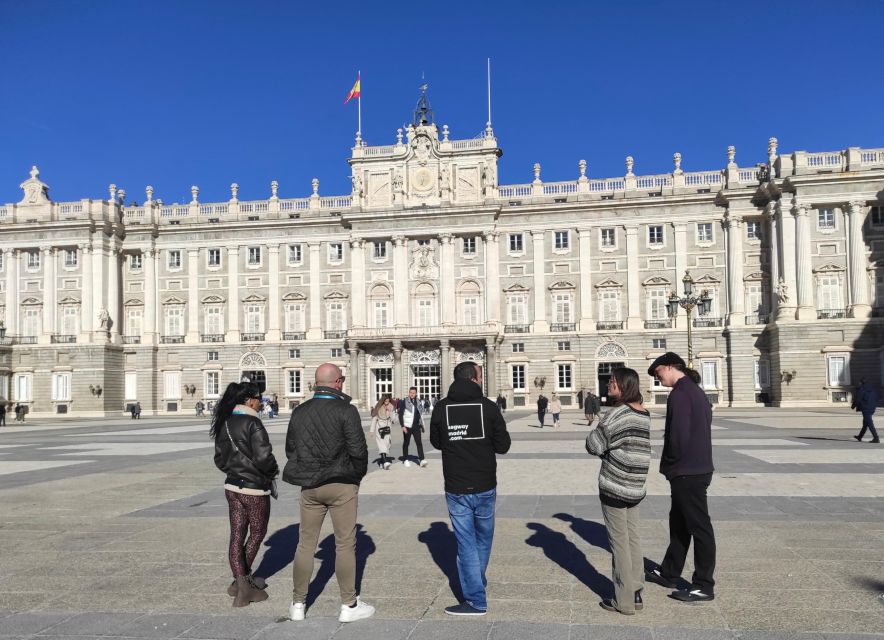
Your meeting point is the Segway Madrid store at Calle de la Independencia 2. This is not the palace entrance itself, so allow enough time to find the shop, check in, and meet your guide before the palace visit begins.
The route includes a short pass through Plaza de Ópera, listed at about 10 minutes, before reaching Plaza de Oriente. That opening walk helps connect the palace to central Madrid, rather than dropping you straight at the security entrance with no sense of place.
The Plaza de Oriente stop lasts about 15 minutes and works as a useful introduction. You can take photographs, get your first view of the palace setting, and hear about the monarchy before entering. It is a compact start, but it gives you a moment to look up and take in the grand proportions of the area.
The tour returns to the same Segway Madrid meeting point at the end. Food and drinks are not included, so plan a snack or meal before or after the activity rather than expecting a refreshment break during the palace visit.
More Royal Palace visits:
- Madrid: Royal Palace Fast-Access Admission Ticket
★ 4.6 · 13,856 reviews - Madrid: Royal Palace Expert Guided Tour with Skip-the-Line
★ 4.7 · 6,986 reviews - Madrid Essential: Historic Center, Plaza Mayor & Royal Palace
★ 5.0 · 6,416 reviews
Approaching the palace through Plaza de la Armería

The palace visit begins through Plaza de la Armería. This approach is one of the strongest parts of the experience because it gives you more than an interior tour. From here, you can appreciate views toward Almudena Cathedral, Campo del Moro Gardens, and Casa de Campo.
The setting also helps explain the palace’s role in Madrid. This is not simply a collection of decorated rooms. It is a working symbol of the Spanish monarchy, built for ceremony, residence, state occasions, and display.
A guide is useful at this point because the building can feel almost too large to read on your own. The introduction covers the monarchy and the kings who lived here, giving the rooms a human thread. The palace contains a great deal of decoration, and without some direction it would be easy to remember only gold, velvet, paintings, and enormous ceilings.
With skip-the-ticket-line entry included, you avoid waiting in the standard ticket queue. You still need to meet the guide at the correct place and follow the palace’s entry procedures, but the timed group format makes the start more orderly.
The main staircase and ceremonial halls
The main staircase is an immediate lesson in palace scale. It leads into the formal part of the visit, where the building’s architecture and decoration were designed to impress visitors before a word was spoken.
The route continues through rooms once used for leisure and banquets. Here, look beyond the large paintings. Notice the tapestries, painted ceilings, and vaults. The guide’s job is to explain how these spaces functioned, not just to identify what hangs on the walls.
The Alabarderos Hall and Hall of Columns are among the major areas on the route. Their size and formal design show how the palace handled public events and court ceremony. These are spaces meant to control movement and attention, with every architectural detail reinforcing royal authority.
I would listen closely during this section, even if you are normally tempted to rush toward the most famous rooms. The early halls give you the vocabulary for the rest of the visit: ceremony, private life, state dining, religious devotion, and royal display.
Charles III’s rooms and the Gasparini Room

The tour then shifts from public grandeur to the private rooms of Charles III. This change is valuable because you see a more personal side of palace life, even though the rooms remain lavish.
The route stops at Charles III’s dressing room and Gasparini’s Room. The Gasparini Room is especially memorable for its chinoiserie style and rococo touches. Its decorative approach differs from the more formal halls, giving the palace a mix of French and Italian influences without making every room feel identical.
The guide also takes you through Charles III’s main room. These spaces help you understand that palace life was not all throne rooms and state banquets. Kings had private chambers, dressing areas, and rooms arranged around daily routines, even when those routines unfolded amid exceptional decoration.
This is a good part of the tour for questions. Several guides, including Jesús and David, have been praised for explaining the rooms clearly and adding entertaining details about Spanish history. Their style may vary by date, but the small group format should make it easier to ask about a particular object or room.
A few more Madrid days to weigh up
- Madrid: Tour Bernabéu Entry Ticket
★ 4.5 · 21,573 reviews - Madrid: Prado Museum Entry Ticket
★ 4.6 · 17,509 reviews - Avila & Segovia Tour with Tickets to Monuments from Madrid
★ 5.0 · 9,762 reviews - Madrid: Reina Sofía Museum Entrance Ticket
★ 4.5 · 6,889 reviews
The triple dining room still used today
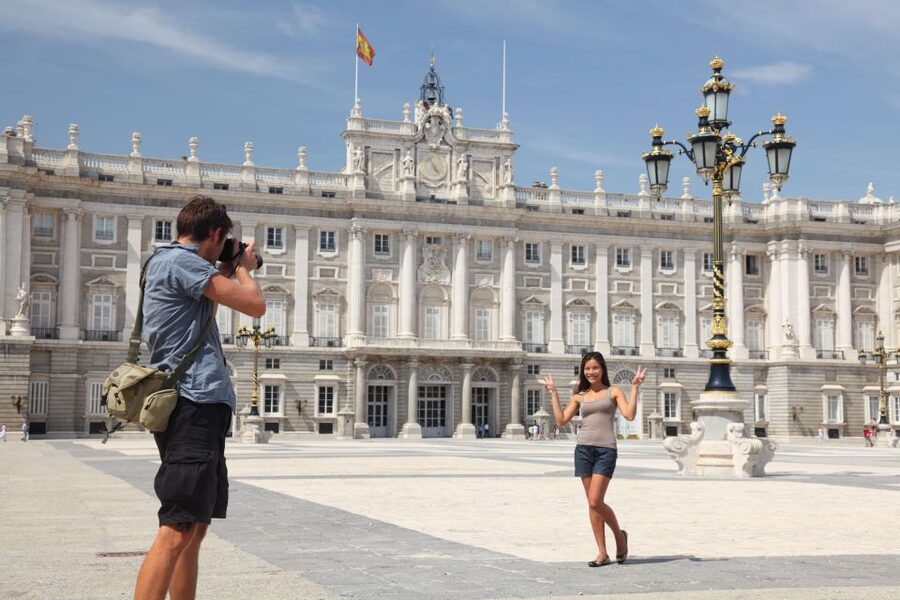
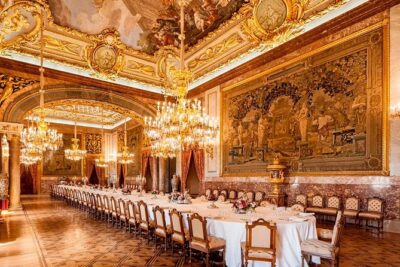
The royal dining room is one of the most practical and impressive stops. It is a massive triple room, created by combining spaces into one large dining area. Unlike many historic palace rooms, it is still used for special events.
That present-day use gives the room more meaning. You are not looking at a frozen museum display alone. The table, decoration, and scale still serve a ceremonial purpose when important occasions require it.
The dining room also provides a useful contrast with Charles III’s private chambers. One section shows the monarch’s personal surroundings. The other shows how the monarchy presents itself to large groups and official guests.
The guide can help you notice how the room is arranged, from the length of the dining space to the decoration overhead. Since the group is limited to eight, you should have a better chance of hearing the explanation than you would in a large, crowded tour.
Silver, porcelain, and the Prince’s Courtyard
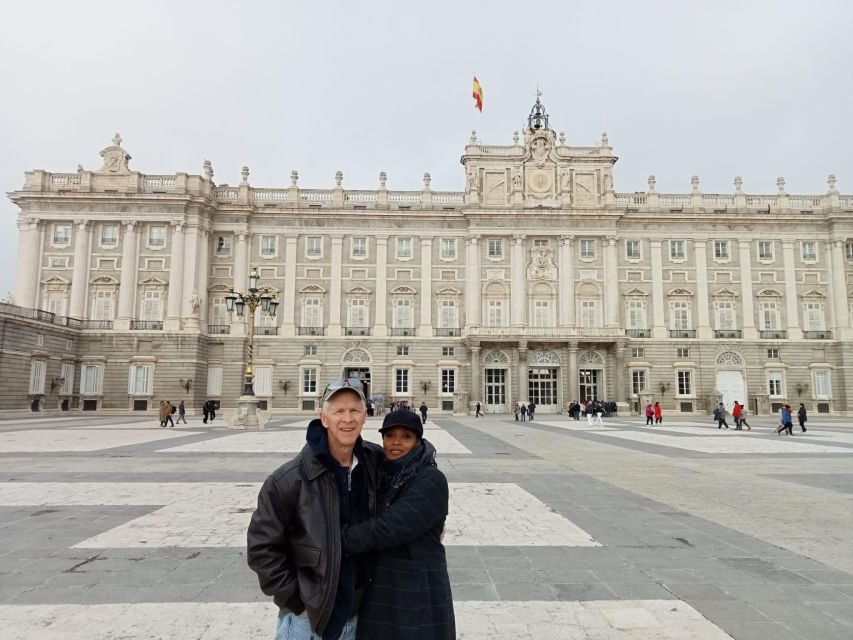
The silver and porcelain rooms bring the palace’s daily operation into view. Their collections include crockery and silverware, objects that can seem secondary beside the grand paintings but reveal how court life was supplied and staged.
I like this part because it adds texture to the palace experience. Royal residences require enormous systems of dining, entertaining, worship, dressing, and ceremony. The tableware makes that practical side visible.
The route continues to the Prince’s Courtyard. From there, you see the precious reliquary and the grand chapel. The chapel is guarded at its entrance by figures associated with the Catholic Monarchs, linking the palace visit to an earlier period of Spanish royal power.
This portion may appeal most to visitors interested in religious art and royal ritual. If your main goal is architecture, it is still worth seeing, but you may want to use the guide’s explanation to understand why these objects mattered rather than simply passing through them.
The royal collections, crown, and scepter
Near the end, the route reaches the royal collections. This final section gathers some of the most immediately recognizable objects from the monarchy.
Among the highlights are Stradivarius violins. These instruments add a musical dimension to the visit and remind you that royal collections were not limited to weapons, furniture, and jewelry. They also include the crown room, the royal scepter, and the table of sphinxes.
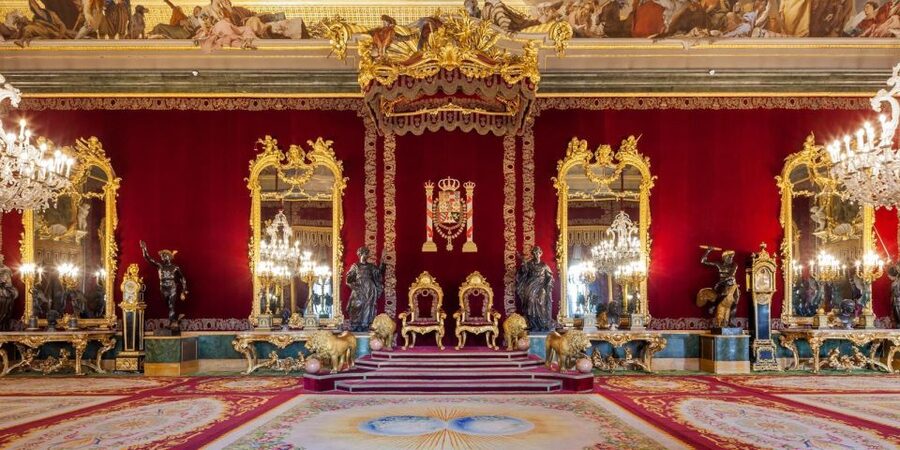
The throne room is another major stop. Its 12 mirrors and armchairs create a highly formal setting, with Velázquez’s lions guarding the thrones. The mirrors multiply the decoration and make the room feel even larger than it is.
The royal armory provides a strong finish for visitors who enjoy military objects and historical equipment. It also broadens the tour beyond interiors. You see how the monarchy represented power through ceremony, art, music, religion, and arms.
Because this is the final portion of the tour, pay attention to the guide’s pacing. Two hours is enough to cover the main rooms, but you may want extra time afterward if you prefer to study individual pieces closely.
What the guide adds to the palace
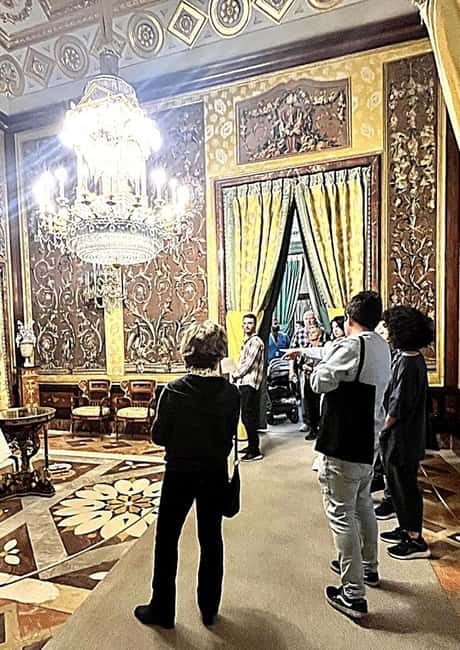
A guided visit makes the most sense here if you want explanation rather than simple admission. The palace is full of details, but the meaning of those details is not always obvious from the room itself.
The strongest guide feedback centers on clear English, a good sense of humor, patience, and enthusiasm for Spanish history. Jesús is often singled out for an entertaining and interactive style. David is praised for explaining the rooms clearly while allowing time to look around. Other guides, including Natalie and Louis, have also led tours described as friendly and well informed.
That does not mean every guide will have the same personality. It does suggest that the experience depends heavily on who leads your group. The tour is offered in English or Spanish, and you should choose the language in which you can comfortably follow a fast explanation of dates, names, and royal customs.
A small group is a real advantage. With no more than eight participants, the guide can respond to questions and adjust the pace more easily than on a large coach-style tour. A wheelchair has also been accommodated with care on a past tour, and the activity is listed as wheelchair accessible.
One practical limitation is sound. A participant noted that headphones would have helped in a larger room. If the guide is speaking while people are moving around, stay near the group and ask for repetition if you miss a point.
Is $38 a fair price?

At $38 per person, the price is reasonable if you value guided context and fast entry. Your fee includes the Royal Palace admission, a live guide, and luggage storage, but not food or drinks.
The value is strongest when the ticket line is long or when your visit falls during a busy period. You are also paying for the guide’s selection of rooms and explanations, which can save you from wandering through a huge building without a clear plan.
If you prefer to move at your own pace, stop for long periods, or focus on a few favorite objects, a guided two-hour visit may feel restrictive. You will see the main areas, but the schedule is built around coverage and explanation rather than extended independent viewing.
For a first visit to Madrid, I think the price makes sense. The palace is too important to treat as a quick photo stop, and the guide helps connect the public rooms, private chambers, collections, and monarchy into one story.
Timing, bags, and accessibility
The activity lasts two hours, with starting times depending on availability. The palace portion itself is also listed as two hours, while the Plaza de Ópera and Plaza de Oriente portions are short parts of the overall route.
Large suitcases and backpacks are not allowed inside. Free luggage storage is available for clients at the meeting point, which is helpful if you are visiting between hotel check-out and a train or flight. Do not arrive assuming you can take a large bag into the palace.
The tour is wheelchair accessible, but the palace is a large historic monument with several major rooms and busy transition points. If you use a wheelchair, mention your needs when booking and stay in contact with the guide at the meeting point.
Free cancellation is available up to 24 hours before the tour for a full refund. You can also reserve now and pay later, a useful option if your Madrid schedule is still changing.
Who should book this palace tour?
I would choose this tour if you are visiting the Royal Palace for the first time and want the main rooms explained in a compact format. It suits families, couples, and solo visitors who prefer a live guide to reading room panels.
It is also a good match for anyone interested in royal ceremony, decorative arts, Spanish monarchy, historic weapons, or musical instruments. The mix of Charles III’s rooms, the dining room, crown room, throne room, and armory gives the visit more range than a simple architecture tour.
You may want a different arrangement if you are a serious palace enthusiast who needs hours for independent study. You might also prefer a self-guided visit if you dislike fixed pacing or want to photograph every detail.
Should you book it?
Book this tour if you want efficient entry, a small group, and a human explanation of Madrid’s most important royal building. The route covers the palace’s essential rooms and adds valuable details about how the monarchy lived, entertained, worshipped, and displayed power.
I would especially consider it for a first Madrid visit, a family group, or anyone carrying luggage who can use the included storage. Just remember that two hours is an introduction, not an exhaustive museum day. Arrive at Calle de la Independencia 2 with a light bag, stay close enough to hear the guide, and be ready to look up often.
FAQ
Where does the Royal Palace tour start?
Check in at the Segway Madrid store at Calle de la Independencia 2. The activity ends back at the same meeting point.
How long does the activity last?
The activity lasts two hours. Starting times depend on availability when you book.
Is entry to the Royal Palace included?
Yes. The Royal Palace entry ticket is included in the price.
Is this a skip-the-line tour?
Yes. Skip-the-ticket-line entry is included.
Which languages are available?
The live tour guide is available in English or Spanish.
How large is the tour group?
The tour is limited to eight participants.
Can I bring a large suitcase or backpack?
No. Large suitcases and backpacks are not allowed inside the palace, but free luggage storage is available for clients through the meeting point.
Just added around Madrid
- Private Vacation Photography Session with Photographer in Madrid★ 5.0 · 3 reviews
- Arrival Private Transfer from MAD Airport to Madrid in a Minibus★ 5.0 · 3 reviews
- Segovia: 3-Hour Private Walking Tour★ 5.0 · 3 reviews
- Tour Segovia and La Granja de San Ildefonso from Madrid★ 5.0 · 3 reviews
- Madrid: Prado & Reina Sofia Museum Skip-the-Line Guided Tour★ 5.0 · 3 reviews
- Salamanca: Private Guided Customizable Walking Tour★ 5.0 · 3 reviews
- Total Reboot and Renew with top wellnes 3 hours couple experience★ 5.0 · 3 reviews
- Madrid: Prado Museum Private Tour★ 5.0 · 3 reviews
Royal Palace Tours, compared.

Royal Palace Expert Guided Tour with Skip-the-Line
Read our review →
Madrid Old Town & Royal Palace Walking Tour Skip the Line Ticket
Read our review →
Royal Palace Guided Tour with Skip the Line Ticket
Read our review →
Royal Palace & Prado Museum Skip the Line Guided Tour
Read our review →
Guided Tour of the Royal Palace with Fast Access
Read our review →Browse the lists this tour appears in