
Review · ROYAL PALACE TOURS
Madrid: Royal Palace Private Tour with Entry Ticket
The most striking part of this tour is the chance to stand inside a room covered in porcelain, then move through the grand apartments of Charles III, the Throne Room, and the Gasparini Room. You’re not simply walking through a palace; you’re following the tastes of several Spanish monarchs through rooms filled with art, clocks, chandeliers, woven wall hangings, and polished decoration.
I like the small group format, limited to four people, because a palace this ornate is much easier to understand when you can ask questions. I also like the skip-the-ticket-line entry, especially for a wheelchair user or anyone working with a tight Madrid schedule.
The main thing to consider is the price: $211 per group of up to two people is a serious cost for a two-hour visit. The value depends on how much you want personal explanation and help inside the palace, rather than simply entering with an audio guide or exploring at your own pace.
In This Review
- Key points to know before booking
- Starting beside the San Peter statue
- Why Charles III’s rooms matter
- The Throne Room and Gasparini Room
- Art, clocks, jewelry, and woven wall hangings
- The monarchy and Madrid connection
- The Royal Armory and the tour’s final stop
- What Rubén adds to the experience
- Is $211 good value for two people?
- Who should book this palace tour?
- FAQ
- Where does the Royal Palace tour meet?
- How long does the tour last?
- What is included in the price?
- How much does the tour cost?
- What languages are available?
- How many people can join the small group?
- Does the tour skip the ticket line?
- Is the tour wheelchair accessible?
- Can I visit the Royal Armory?
- Should you book it?
Key points to know before booking
- The tour covers 25 major rooms: You’ll see some of the palace’s most important interiors rather than wandering without direction.
- Charles III’s apartments are the main prize: His rooms preserve a unified decorative scheme directed by Sabatini.
- A room covered in porcelain adds a memorable surprise: This is one of the tour’s most unusual visual details.
- Rubén receives especially strong praise: He is described as warm, well prepared, attentive, and good at answering questions about both the palace and Madrid life.
- The group is capped at four people: The listed price is for up to two, but the tour format remains intentionally small.
- The Royal Armory may be closed: You finish near it and can visit on your own if it is open.
Starting beside the San Peter statue
Your meeting point is next to the San Peter statue in Plaza de la Armería. Look for the guide carrying a light blue umbrella. That clear marker matters in a busy palace square, where several entrances and open spaces can make a first meeting less obvious than expected.
The tour begins with your guide leading you inside using the included entry ticket. You do not need to arrange a separate palace ticket, and the skip-the-ticket-line benefit can save useful time. Palace opening hours can change, so check the start time and operating schedule close to your visit.
The tour lasts two hours. That is long enough for a focused route through the key rooms, but not long enough to inspect every object at leisure. I would think of this as a guided introduction to the palace’s finest interiors, followed by extra independent time if you want to visit the Royal Armory or linger over details.
The guide speaks English or Spanish. The small format should make it easier to hear explanations and pause for questions, though the palace can still have larger groups moving through the same rooms.
More Royal Palace visits:
- Madrid: Royal Palace Fast-Access Admission Ticket
★ 4.6 · 13,856 reviews - Madrid: Royal Palace Expert Guided Tour with Skip-the-Line
★ 4.7 · 6,986 reviews - Madrid Essential: Historic Center, Plaza Mayor & Royal Palace
★ 5.0 · 6,416 reviews
Why Charles III’s rooms matter
The apartments of Charles III are the heart of this experience. Charles III is presented here as the Illustrated King, and his rooms show a strong concern with design, order, and display. The main floor preserves decoration directed by Sabatini, giving the rooms a shared visual character instead of a collection of unrelated furnishings.
This is where a guide adds real value. Without context, you may notice stuccoed walls, furniture, chandeliers, and decorative objects without seeing how they fit together. Your guide can connect the rooms to the monarch who commissioned or used them, helping you read the palace as a record of changing royal taste.
Pay close attention to the stucco work. It is not just background decoration. The molded surfaces help create the formal effect of the apartments and show how much attention went into every part of the royal setting.
The room covered in porcelain is another high point. It provides a sharp change from more conventional painted, gilded, or stuccoed interiors. You’ll want to give yourself a moment to take in the walls as a whole rather than focusing only on individual details.
The Throne Room and Gasparini Room

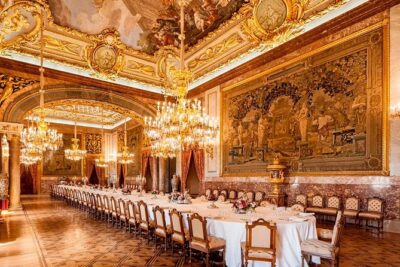
The Throne Room and the Gasparini Room are identified as the most representative expressions of Charles III’s taste. Both are tied to an exuberant Italian form of Rococo decoration, so expect a strong visual impact rather than restrained simplicity.
The Throne Room is the kind of space where the overall arrangement matters as much as any one object. Its purpose was ceremonial, and the decoration supports that role. Your guide can help explain how mythology, monarchy, furniture, and decoration work together to create a royal statement.
The Gasparini Room gives you another view of the same taste. The name may mean little before you enter, but the room becomes easier to remember once you connect its ornate style with Charles III’s preferences.
The palace also includes important neoclassical interiors and French furniture connected with Charles IV and Ferdinand VII. This gives the tour a useful chronological thread. Instead of treating the palace as one frozen period, you can see later monarchs changing its decoration and furnishings.
The French bronze and crystal chandeliers are part of this later decorative story. They offer a good reminder that royal interiors were updated over time. The current historic appearance also reflects a renovation ordered by Alfonso XII in 1879.
Art, clocks, jewelry, and woven wall hangings
The tour includes more than rooms and walls. You’ll stop to look at pictorial works, tapestries, jewelry, and luxurious clocks. These objects help show how the palace functioned as both a home and a display of royal status.
The clocks deserve special attention because they are easy to overlook in a room packed with decoration. Their presence points to the level of craftsmanship and expense found throughout the palace. A guide can also help you avoid spending the whole visit looking only at the largest objects.
The jewelry and artworks add another layer. They are not presented as isolated museum pieces, but as part of the royal setting. You see how decoration, personal possessions, ceremony, and political image fit together.
I would keep your pace flexible here. Two hours passes quickly, and you may want to pause for photographs or a closer look. The tradeoff is that every extra pause can reduce the time available for later rooms. A small group helps because your guide can adjust the pace more easily than a large organized party.
A few more Madrid days to weigh up
- Madrid: Tour Bernabéu Entry Ticket
★ 4.5 · 21,573 reviews - Madrid: Prado Museum Entry Ticket
★ 4.6 · 17,509 reviews - Avila & Segovia Tour with Tickets to Monuments from Madrid
★ 5.0 · 9,762 reviews - Madrid: Reina Sofía Museum Entrance Ticket
★ 4.5 · 6,889 reviews
The monarchy and Madrid connection
This tour is not only about palace decoration. It also explains the Spanish monarchy and the connection between the palace and Madrid. The palace’s rooms become more interesting when you understand who lived there, which monarch changed the interiors, and how the building fits the story of the city.
The eastern façade contains the apartments of Charles IV and María Luisa. Successive sovereigns lived there until 1931. That detail gives the palace a clear sense of continuity, with royal households using and adapting the same setting over generations.
The guide also discusses mythological elements and their connection to monarchy. These references can be difficult to interpret on your own. A figure or scene that looks like decoration may have been chosen to support an idea about royal power, virtue, ancestry, or authority.
This kind of explanation is one reason to choose a live guide instead of entering independently. You are paying for interpretation, not only admission. If you already have a strong background in Spanish royal history, you may prefer more independent time. If the subject is new to you, the connections can make the palace far easier to remember.
The Royal Armory and the tour’s final stop
The guided portion ends in the courtyard near the Royal Armory. The armory is described as one of Europe’s most important collections, alongside Vienna’s, and its origins reach back to the Habsburgs. Philip II first installed the collection next to the old Alcázar before it moved to the current pavilion in 1891.
That history makes the armory a natural extension of the palace visit. It is not merely a room of weapons. It represents another side of royal power, ceremony, and dynastic history.
The armory is sometimes closed for repairs. If it is open, you can visit it independently after the guided tour. Since it is not guaranteed to be available, do not make it the sole reason for booking this experience. The palace rooms remain the main program.
Ending near the armory gives you a practical choice. You can continue exploring on your own, or leave after the two-hour tour if your schedule is full. That flexibility is useful on a day when you also want time for Madrid’s other sights.
What Rubén adds to the experience
Rubén receives particularly strong praise for his command of the palace and Spanish history, his courtesy, and his friendly manner. He is also described as someone who welcomes questions about everyday life in Madrid, not only royal architecture.
One especially useful detail is his handling of crowded rooms. He has been praised for finding the right moments to stop and explain things between larger groups. That is the sort of practical guiding that can make a difference inside a popular palace, where simply hearing the guide may be difficult.
He also receives credit for adapting the tour to a wheelchair user. On one visit, he helped the group enter at the front of the opening line, which made the experience easier. He also recommended wheelchair-friendly restaurants afterward. This does not guarantee the same timing or restaurant advice for every booking, but it shows the kind of personal attention you can request.
If you want Rubén, ask whether he is available when you book. The tour is offered by madzguía freelance, and the guide assigned to your date may vary.
Is $211 good value for two people?
At $211 for a group of up to two, the cost works out to $105.50 per person when two people share the booking. That is expensive compared with entering the palace independently, so the value rests on the guide, the skip-the-line access, and the private or very small-group attention.
The price makes more sense if you want to ask questions, need help moving through the palace, or have limited time in Madrid. A wheelchair user may also place a higher value on a guide who can watch the pace and help the group manage the visit.
The value is less clear if you prefer to move slowly, read every label, or spend extra time in the armory. A two-hour guided visit gives you structure, but the schedule may not suit someone who wants an unhurried museum-style afternoon.
Free cancellation up to 24 hours before the tour and the option to reserve now and pay later reduce some booking risk. Still, I would check the palace hours before settling on a time, since opening schedules can change.
Who should book this palace tour?
I would recommend it most strongly to:
- First-time visitors who want the palace explained clearly
- Couples who want a private booking for two
- Families or small groups that value questions and a flexible pace
- People interested in Spanish royal history, decorative arts, and architecture
- Anyone who wants skip-the-line entry
- Wheelchair users who would benefit from extra attention and practical help
I would hesitate if you are mainly looking for the lowest possible admission price. I would also think twice if the Royal Armory is your top priority, since it can close for repairs and is visited independently after the main tour.
The strongest reason to choose this experience is not simply that it gets you inside. It gives you a framework for understanding Charles III’s apartments, the later changes made by Charles IV, Ferdinand VII, and Alfonso XII, and the symbols placed around the palace.
FAQ
Where does the Royal Palace tour meet?
Meet your guide next to the San Peter statue in Plaza de la Armería. The guide will carry a light blue umbrella.
How long does the tour last?
The guided tour lasts two hours.
What is included in the price?
The price includes entry tickets to the Royal Palace and a guide.
How much does the tour cost?
The listed price is $211 per group of up to two people.
What languages are available?
The live tour guide is available in English or Spanish.
How many people can join the small group?
The small-group format is limited to four participants. The listed price covers a group of up to two people.
Does the tour skip the ticket line?
Yes. Skip-the-ticket-line entry is included.
Is the tour wheelchair accessible?
Yes, the activity is listed as wheelchair accessible. Rubén has also been described as attentive to the needs of a wheelchair user and helpful with timing and access.
Can I visit the Royal Armory?
You can visit the Royal Armory on your own after the guided tour, since the tour ends in the nearby courtyard. The armory is sometimes closed for repairs, so access is not guaranteed.
Should you book it?
Book this tour if you want the Royal Palace to make sense, not just look impressive. The two-hour route focuses on the palace’s most important rooms, and a strong guide such as Rubén can connect the decoration to Spanish monarchy, Madrid, and the changing tastes of several rulers.
The cost is high, but the small group, included entry, skip-the-line access, and personal explanation improve the value. I would choose it for a first visit, a short stay in Madrid, or a group that needs a more careful pace. If you are comfortable exploring alone and want the cheapest option, enter independently instead.
Just added around Madrid
- Private Vacation Photography Session with Photographer in Madrid★ 5.0 · 3 reviews
- Arrival Private Transfer from MAD Airport to Madrid in a Minibus★ 5.0 · 3 reviews
- Segovia: 3-Hour Private Walking Tour★ 5.0 · 3 reviews
- Tour Segovia and La Granja de San Ildefonso from Madrid★ 5.0 · 3 reviews
- Madrid: Prado & Reina Sofia Museum Skip-the-Line Guided Tour★ 5.0 · 3 reviews
- Salamanca: Private Guided Customizable Walking Tour★ 5.0 · 3 reviews
- Total Reboot and Renew with top wellnes 3 hours couple experience★ 5.0 · 3 reviews
- Toledo Private Guided fullday tour from Madrid★ 5.0 · 3 reviews
Royal Palace Tours, compared.

Royal Palace Expert Guided Tour with Skip-the-Line
Read our review →
Madrid Old Town & Royal Palace Walking Tour Skip the Line Ticket
Read our review →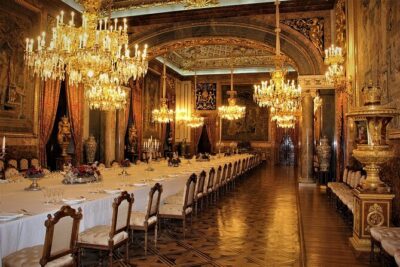
Royal Palace Guided Tour with Skip the Line Ticket
Read our review →
Royal Palace & Prado Museum Skip the Line Guided Tour
Read our review →
Guided Tour of the Royal Palace with Fast Access
Read our review →Browse the lists this tour appears in