
Review · PRADO MUSEUM TOURS
Prado Museum Small Group Tour Skip the Line 7 People Max
The best thing about this Prado tour is its scale: no more than seven people. In a museum with about 7,600 paintings, that small group lets you stay close to the guide, ask questions, and keep a sensible pace instead of trailing behind a large crowd. Guides such as Monroe bring art history down to earth with stories, humor, and clear explanations.
I especially like the priority admission and the focus on major works by Bosch, El Greco, Titian, Rubens, Velázquez, and Goya. I also like that the tour is built around meaning, not just names and dates. The main drawback is time: 90 minutes is enough for a strong first visit, but nowhere near enough to see a museum this large in full.
In This Review
- Key points at a glance
- Why a small group matters inside the Prado
- Meeting at the Goya monument
- Priority admission saves more than waiting time
- What the 90-minute route covers
- Bosch, El Greco, Titian, and Rubens
- Velázquez and the Prado’s Spanish focus
- Goya gets special attention
- A guide who teaches through stories and questions
- Is $50 a fair price?
- Who should book this Prado visit?
- Practical details before you book
- Should you book the Prado small-group tour?
- FAQ
- How long does the Prado Museum tour last?
- What is the maximum group size?
- Is Prado Museum admission included?
- Is the tour offered in English?
- Where does the tour begin?
- Where does the tour end?
- Which artists are covered?
- Can I stay in the museum after the guided tour?
- Can I cancel for a full refund?
Key points at a glance
- Seven-person limit: A small group makes it easier to hear, ask questions, and stay engaged with the guide.
- Major Prado artists: Expect attention to Bosch, El Greco, Titian, Rubens, Velázquez, and Goya.
- Meaning behind the paintings: The guide explains symbols, stories, historical setting, and small details you could easily miss.
- Priority admission: You avoid the usual uncertainty of waiting in a long entrance line.
- English-language tour: The experience is offered in English and lasts about 90 minutes.
- Flexible finish: The official tour ends back at the meeting point, and you may stay in the museum to continue looking around on your own.
Why a small group matters inside the Prado
The Prado is not a museum you casually finish in an hour. Its collection contains roughly 7,600 paintings, and even a carefully planned visit can feel like a march through names, dates, and grand galleries. A guide gives you a route and a reason to stop.
A maximum of seven people is a real advantage here. You are less likely to lose the guide in a busy room, and it is easier to ask about a painting that catches your eye. Several visitors have also found themselves in groups of only two, four, or five people, though you should plan on the stated maximum rather than count on a private tour.
That smaller setting also changes the tone. The guide can respond to your interests, explain a detail again, or spend a little longer on a work that has grabbed your attention. Monroe is repeatedly singled out for his humor, energy, and command of art history. He has been praised for answering questions, adjusting the route, and making the material accessible even to people who do not usually seek out art museums.
More ways to see the Prado:
- Madrid: Prado Museum Entry Ticket
★ 4.6 · 17,509 reviews - Madrid: Small Group of Prado Museum Tour & Optional Tapas
★ 4.6 · 2,437 reviews - Madrid: Prado Museum Guided Tour with Skip-the-Line Ticket
★ 4.5 · 2,018 reviews
Meeting at the Goya monument
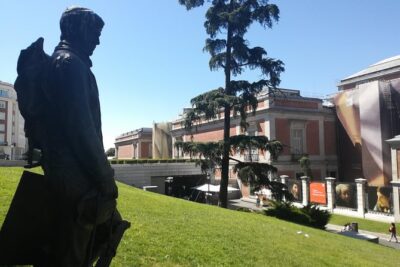
The tour begins at the Monument to Goya on Calle de Felipe IV, beside Madrid’s Retiro area and the Prado district. This is an outdoor meeting point, so give yourself enough time to identify the monument and arrive before the scheduled start.
The location fits the subject. Francisco de Goya is one of the central figures in the Prado, and the tour gives particular attention to his work. Starting near his monument provides a natural introduction before you enter the museum and begin looking at the paintings themselves.
Your booking confirmation is received at the time of purchase, and the ticket is mobile. The experience is offered in English. The tour ends back at the meeting point according to the stated plan, although the museum visit itself may continue after the guided portion if you want more time inside.
Priority admission saves more than waiting time
The skip-the-line ticket is not a minor extra in a major European museum. It gives the tour a cleaner start and protects a limited morning or afternoon in Madrid. Instead of spending part of your visit wondering how long the entrance queue will take, you can move toward the collection with your guide.
Priority entry does not mean you will see every room or every famous painting. It solves the entrance problem, not the size of the museum. That distinction matters because the Prado can easily occupy far more time than your schedule allows.
The tour lasts about 90 minutes. That is a sensible length for a guided introduction. You get a focused route through important works without trying to absorb an entire art collection in one sitting. Afterward, you can decide if you want to keep exploring, return to a favorite painting, or leave with a clear sense of what you have seen.
What the 90-minute route covers
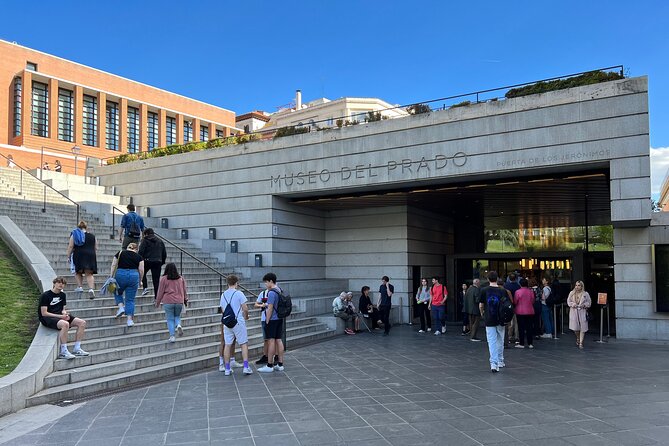
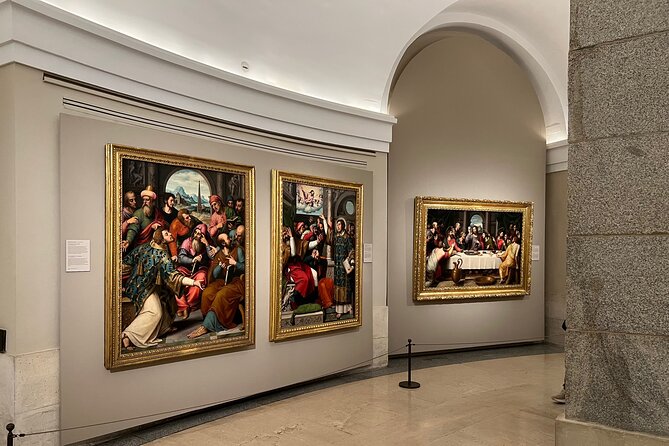
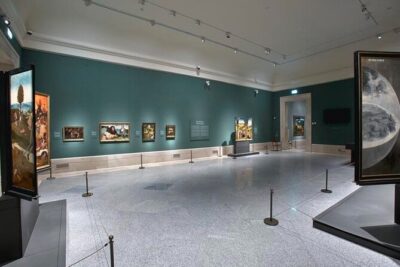
The central stop is the Museo Nacional del Prado. During the walk through its galleries, the guide introduces major artists and explains how to look at their work. The emphasis is not simply on finding a famous canvas and taking a quick photograph. It is on understanding what you are seeing.
You can expect discussion of Hieronymus Bosch, El Greco, Titian, Peter Paul Rubens, Diego Velázquez, and Francisco de Goya. These artists represent different periods and approaches, so the route gives you a broad introduction to European and Spanish painting.
The exact sequence of galleries and works can vary. Museum conditions, crowd levels, and the group’s questions may affect the pace. The useful promise is a focus on important highlights, not a fixed checklist of every painting.
The guide’s explanations are especially valuable with symbolism. A scene that looks simple at first may contain religious references, political clues, social comments, or objects chosen for a reason. With someone pointing out those details, you are more likely to notice why the painting mattered when it was made and why it remains important.
More museums in Madrid:
- Madrid: Reina Sofía Museum Entrance Ticket
★ 4.5 · 6,889 reviews - Madrid: Museum of Illusions Ticket
★ 4.1 · 1,909 reviews - Madrid: Prado Museum Guided Tour With Fast Access
★ 4.8 · 1,785 reviews - Prado Museum Small Group Tour with Skip the Line Ticket
★ 5.0 · 1,738 reviews
Bosch, El Greco, Titian, and Rubens
The Prado’s collection is broad enough that a first-time visitor can feel pulled in several directions. Bosch rewards close attention to strange figures and crowded scenes. El Greco offers a very different visual world, with expressive forms and a distinctive spiritual intensity. Titian and Rubens give the guide a chance to discuss color, movement, power, and the changing ideals of European painting.
You do not need a background in art to benefit from this section. A good guide gives you a way into the work without turning the visit into a lecture. Monroe has been praised for explaining difficult ideas in plain language and for using anecdotes to make artists and subjects easier to remember.
I like this approach because it turns a painting from a famous object into a human document. You begin to consider who commissioned it, what message it carried, how the artist shaped the viewer’s response, and which tiny details support the larger story.
Velázquez and the Prado’s Spanish focus
Diego Velázquez is one of the artists most visitors hope to see, and the tour places him among the museum’s essential names. His paintings can reward a slow look, especially when you pay attention to the relationship between the figures, the viewer, and the space around them.
A guide can help you stop at the right moment instead of walking past a celebrated work without knowing why it matters. You may find that the discussion moves beyond basic biography to questions of power, court life, perception, and artistic technique.
This is also where a short tour proves useful. You are not left to choose among dozens of Spanish masters without any direction. The guide selects representative works and gives you a framework for understanding them. If you already know Velázquez, you can use the small group to ask more specific questions.
Goya gets special attention
Goya receives particular emphasis, and that is a strong reason to choose this tour if his work interests you. The visit begins at his monument and later explores his paintings and perspective within the Prado.
Goya’s art can shift sharply in tone. His work connects to Spanish society, war, the court, personal experience, and darker views of human behavior. A guide can explain those changes and help you see how the artist’s concerns developed across different works.
The tour’s attention to context is useful here. Without background, a painting may seem like an isolated image. With the right explanation, you can connect the subject, the artist’s circumstances, and the period in which it was created.
Several visitors have found the Goya focus especially engaging, and the guide has been praised for offering a distinct perspective on both the artist and his work. If you want only a quick list of famous canvases, this may feel slower than an audio guide. If you want stories and interpretation, it is one of the strongest parts of the experience.
A guide who teaches through stories and questions
The most highly praised feature of this tour is the guide. Monroe is frequently described as funny, welcoming, attentive, and unusually well informed about the paintings. He has been compared to a walking art history podcast, which is a useful description of the experience’s conversational style.
You can expect a guide who does more than recite labels. Monroe has answered questions, adapted to group interests, and spent extra time finishing a discussion when circumstances allowed. One family with teenagers found the art easier to follow because he made the material engaging and welcomed questions from people with different levels of interest.
That said, the tour’s quality depends heavily on the person leading your particular departure. Monroe is the guide most often identified in the supplied information, but the booking details do not guarantee that he will lead every date. The advertised service is provided by Madridean Tours, with a professional guide included.
The interactive part is important. An audio guide can give you facts, but it cannot respond when you ask why a figure is looking in a certain direction or how two paintings relate. In a group of seven or fewer, that back-and-forth is practical rather than awkward.
Is $50 a fair price?
At $50 per person, this is not the cheapest way into the Prado. The value comes from combining admission, priority entry, and a guided route through a very large collection.
If you are visiting Madrid for only a short time, the price can make sense. You pay to reduce uncertainty and to use your limited museum time well. Instead of preparing a route through thousands of paintings, you arrive with a professional guide who knows which works deserve your attention.
The value is also stronger for first-time visitors, people who find art museums difficult to navigate, and anyone who wants context rather than a quick look. The price is less compelling if you prefer to wander alone, already know the Prado well, or plan to spend many hours studying individual rooms.
I would treat the tour as a first introduction, not a complete Prado visit. The 90-minute route gives you the foundation. If you have time, staying afterward to continue on your own makes the admission and guided portion feel more worthwhile.
Who should book this Prado visit?
This tour suits you if you want the main works explained without joining a large crowd. It is also a good match for families, couples, and small groups with mixed levels of interest. The guide’s humor and stories can help keep a reluctant museum companion involved.
Art beginners may get the most from it because the guide explains symbolism and historical setting instead of assuming prior study. Experienced museumgoers can still benefit from the chance to ask focused questions or hear a different interpretation.
The tour may be less suitable if you want a quiet, self-directed visit from the moment you enter. It may also feel too brief if your main goal is to examine a large number of paintings in detail. In that case, use the guided portion to get oriented, then remain inside and continue at your own pace.
A weekday departure may be preferable if your schedule allows, based on direct practical advice from past bookings. A 10:00 a.m. start has also been singled out as a good choice. The available information does not promise a particular crowd level, so these are useful preferences rather than guarantees.
Practical details before you book
The tour is offered in English and accepts mobile tickets. Service animals are allowed, public transportation is nearby, and most people can participate. The stated maximum is seven people.
Confirmation arrives when you book. Free cancellation is available up to 24 hours before the local start time. Cancellations or changes made inside that window are not accepted for a refund.
The activity requires good weather, even though its main stop is indoors. If poor weather causes cancellation, you are offered another date or a full refund. The tour also requires a minimum number of people, so a cancellation for that reason brings the choice of another date or experience, or a full refund.
Should you book the Prado small-group tour?
I would book it for a first Prado visit, especially if you have limited time or want the paintings explained by a lively guide. The combination of priority admission, a seven-person limit, and a focused route gives you a practical introduction to one of Madrid’s biggest museums.
Choose it with realistic expectations. You will not cover the full collection in 90 minutes, and the guide assigned to your date may not be Monroe. But if you want help finding the major works, understanding Goya and Velázquez, and noticing details you might otherwise miss, $50 is a reasonable price for a well-structured start.
FAQ
How long does the Prado Museum tour last?
The guided experience lasts approximately 1 hour and 30 minutes.
What is the maximum group size?
The tour has a maximum of seven travelers.
Is Prado Museum admission included?
Yes. A Prado Museum skip-the-line admission ticket is included.
Is the tour offered in English?
Yes. The experience is offered in English.
Where does the tour begin?
It begins at the Monument to Goya, located at C. de Felipe IV, Retiro, 28014 Madrid, Spain.
Where does the tour end?
The activity ends back at the stated meeting point.
Which artists are covered?
The tour introduces works by Hieronymus Bosch, El Greco, Titian, Peter Paul Rubens, Diego Velázquez, and Francisco de Goya.
Can I stay in the museum after the guided tour?
The guided activity ends at the meeting point, and the tour information states that you are free to stay afterward and explore on your own.
Can I cancel for a full refund?
Yes. You can cancel at least 24 hours before the local start time for a full refund. Changes or cancellations made less than 24 hours before the start are not accepted for a refund.
More Skip the Line in Madrid
- Madrid: Royal Palace Expert Guided Tour with Skip-the-Line
★ 4.7 · 6,986 reviews - Madrid: Royal Palace Skip-the-line Guided Tour
★ 4.9 · 3,146 reviews - Madrid: Royal Palace Skip-the-Line Guided Tour
★ 4.5 · 2,140 reviews - Madrid Old Town & Royal Palace Walking Tour Skip the Line Ticket
★ 4.5 · 1,829 reviews
Just added around Madrid
- Private Vacation Photography Session with Photographer in Madrid★ 5.0 · 3 reviews
- Arrival Private Transfer from MAD Airport to Madrid in a Minibus★ 5.0 · 3 reviews
- Segovia: 3-Hour Private Walking Tour★ 5.0 · 3 reviews
- Tour Segovia and La Granja de San Ildefonso from Madrid★ 5.0 · 3 reviews
- Madrid: Prado & Reina Sofia Museum Skip-the-Line Guided Tour★ 5.0 · 3 reviews
- Salamanca: Private Guided Customizable Walking Tour★ 5.0 · 3 reviews
- Total Reboot and Renew with top wellnes 3 hours couple experience★ 5.0 · 3 reviews
- Madrid: Prado Museum Private Tour★ 5.0 · 3 reviews
Prado Museum Tours, compared.

Small Group of Prado Museum Tour & Optional Tapas
Read our review →
Prado Museum Guided Tour with Skip-the-Line Ticket
Read our review →
Prado Museum Small Group Tour with Skip the Line Ticket
Read our review →
Royal Palace & Prado Museum Skip the Line Guided Tour
Read our review →
Prado Museum Guided Tour with Skip-the-Line Ticket
Read our review →Browse the lists this tour appears in