
Review · WALKING TOURS
Walking Tour of Madrid Modern
Madrid’s grand central walk is best understood on foot, and this route gives you a tidy introduction to the city’s monuments, boulevards, and royal-era ambitions. You move from Puerta del Sol to Retiro Park, passing Gran Vía, Cibeles, Puerta de Alcalá, and the Prado district along the way.
I like the strong mix of architecture and city stories, plus the helpful guides who bring Spanish history down to earth. I also like the low booking price and the route’s practical finish in Retiro Park. The main catch is that the price covers booking management, not the guide’s tip, so you should arrive ready for an additional payment.
In This Review
- Key points at a glance
- From Puerta del Sol to Madrid’s grand boulevard
- Casino de Madrid and the city’s golden mile
- Gran Vía, where Madrid goes big
- Instituto Cervantes and Madrid’s language connection
- Cibeles Fountain, Banco de España, and the city’s symbols
- Cibeles Palace and the view along Paseo del Prado
- Puerta de Alcalá and the route into Retiro
- What the guide adds to the walk
- Price, group size, and the tip question
- Weather, walking comfort, and who should book
- Should you book the Madrid Modern walking tour?
- FAQ
- How long does the Walking Tour of Madrid Modern last?
- Where does the tour start?
- Where does the tour finish?
- Is the tour offered in English?
- Does the tour include admission to museums or monuments?
- What is included in the booking?
- How large can the group be?
- Can I cancel for a full refund?
Key points at a glance
- A clear central-Madrid route: Walk from Puerta del Sol through Calle de Alcalá, Gran Vía, Cibeles, Paseo del Prado, and Retiro Park.
- Major sights without entry fees: The tour views landmarks from outside, so no attraction tickets are needed.
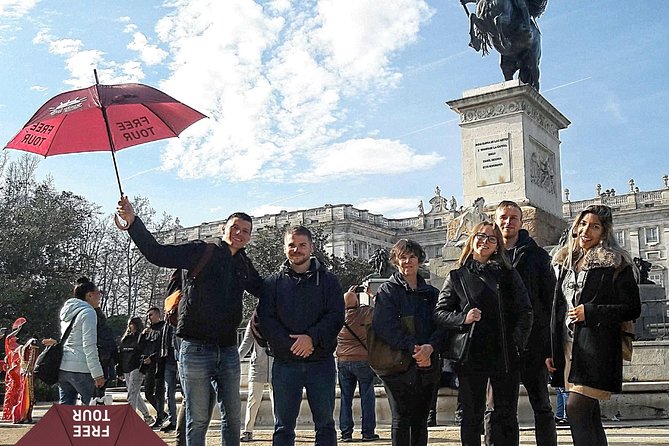
- Strong guide-led storytelling: Guides including Tambo, Tomas, Marta, Maikel, and Alba use printed material and teaching tools during the walk.
- A useful two-hour orientation: The 2-hour-20-minute route helps you understand how Madrid’s main streets and monuments fit together.
- A very low advertised price: The $3.59 booking cost is attractive, but tips are not included and should be budgeted separately.
- A memorable finish: The walk ends beside the lake in Retiro Park, a pleasant place to continue exploring on your own.
From Puerta del Sol to Madrid’s grand boulevard
This tour begins at Puerta del Sol, one of Madrid’s most useful starting points. It is not simply a meeting square. You will see the Royal Post Office, the statue of Carlos III, the famous Kilometre Zero marker, the Tío Pepe sign, and Madrid’s bear and strawberry tree symbol.
The opening stop lasts about 15 minutes. That is enough time for a quick explanation and a look around, but not enough for a long architectural study. Treat it as your orientation to central Madrid. If you are new to the city, this is where the tour’s practical value begins: you learn the symbols and landmarks you will keep seeing during your stay.
From there, the group moves onto Calle de Alcalá, described as Madrid’s longest street. The walk uses this broad urban route to connect the old central square with the grander buildings farther east. You get about 10 minutes here, so expect a moving lesson rather than a long pause.
The route is easy to understand geographically. You are not being driven from one isolated attraction to another. Instead, you watch the city change as the street carries you toward the financial, cultural, and monumental parts of Madrid.
More walking tours in Madrid:
- Toledo Tour & Vineyard Walk with Wine Tasting from Madrid
★ 5.0 · 2,546 reviews - Madrid Walking Tour from Puerta del Sol to Retiro Park
★ 5.0 · 2,285 reviews - Madrid Old Town & Royal Palace Walking Tour Skip the Line Ticket
★ 4.5 · 1,829 reviews
Casino de Madrid and the city’s golden mile
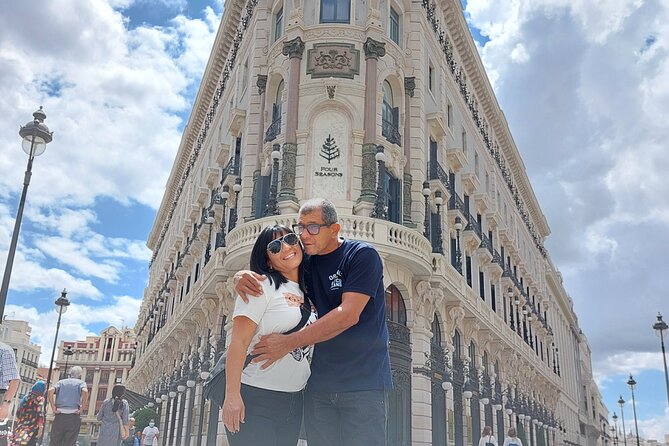
The next stop is the Casino de Madrid, with about 20 minutes for the surrounding area. The focus is not on entering the casino. Instead, you look across at the Four Seasons Hotel and the BBVA building, known for its rooftop quadrigas.
This section shows Madrid’s taste for grand scale. Historic façades, modern luxury, banking, and ceremonial sculpture meet within a short stretch of street. I find this useful because it keeps the tour from becoming a parade of old buildings only. Madrid is a living capital, and this part of the walk helps you see its newer wealth alongside its older civic style.
The stop also gives your guide room to explain how the area developed. The available route details call this stretch the golden mile of the country, a phrase that signals its role as one of Madrid’s most prestigious addresses. You should expect exterior views and street-level explanation rather than indoor access.
Gran Vía, where Madrid goes big
Gran Vía receives about 10 minutes, but it is one of the route’s most recognizable stops. This famous avenue is lined with theatres, bars, and shops, and it remains one of the main arteries through central Madrid.
A short visit works well here. Gran Vía is best understood as a broad urban scene rather than a single monument. You can look up at the buildings, see the theatre district, and get a feel for Madrid’s commercial energy before continuing toward the civic landmarks near Cibeles.
I would not treat this stop as time for shopping. The schedule is tight, and the purpose is to understand the avenue’s place in the city. If you want to explore its shops or theatres, save that for another walk after the tour.
Instituto Cervantes and Madrid’s language connection
The Instituto Cervantes stop lasts around 10 minutes. The building was formerly a bank and now houses the institution devoted to the Spanish language and culture. The route description also points to important works of Castilian literature associated with the institution.
This is a good reminder that Madrid’s identity is not only royal and political. Language is one of Spain’s great cultural forces, and the stop gives your guide a chance to connect a handsome former financial building with Spanish writing and education.
Again, the tour does not include entry. You see the building from the outside and hear the explanation as part of the larger route. That limitation is worth knowing if you hoped to browse inside the institution.
A different sort of afternoon around Madrid:
- Madrid: Tour Bernabéu Entry Ticket
★ 4.5 · 21,573 reviews - Madrid: Prado Museum Entry Ticket
★ 4.6 · 17,509 reviews - Madrid: Royal Palace Fast-Access Admission Ticket
★ 4.6 · 13,856 reviews - Madrid: “Emociones” Live Flamenco Performance
★ 4.8 · 12,866 reviews
Cibeles Fountain, Banco de España, and the city’s symbols
The Cibeles Fountain is one of the tour’s key moments. It is widely recognized as one of Madrid’s main symbols, and the stop lasts about 10 minutes. The fountain presents the goddess Cibeles in a chariot pulled by lions, though the supplied tour details focus mainly on its importance as an icon of Madrid.
The setting becomes even more interesting when you continue to Banco de España. The bank is traditionally linked with Spain’s national gold reserves, and the guide uses this stop to explain the institution’s role. You are looking at a serious civic building, but the story gives it a little drama.
These two stops work well together. One is a public monument known across the city, and the other is a powerful financial institution. You see how Madrid places art, government, money, and national symbolism within the same central district.
Cibeles Palace and the view along Paseo del Prado
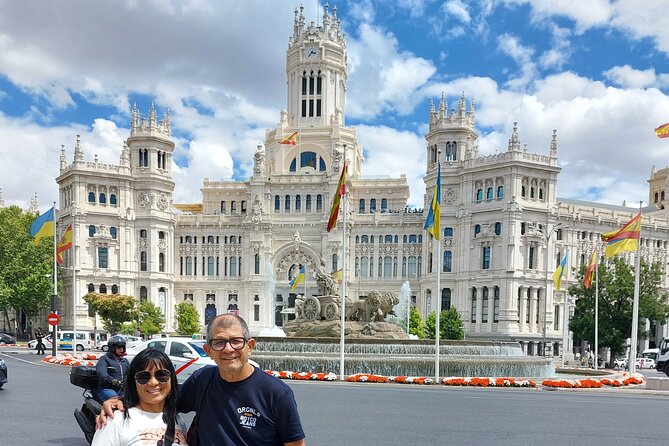
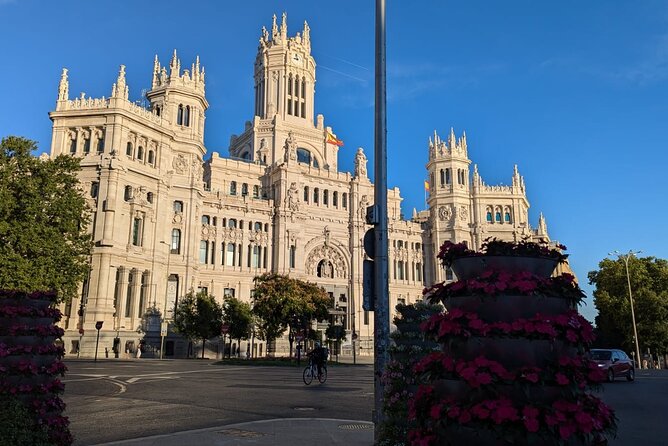
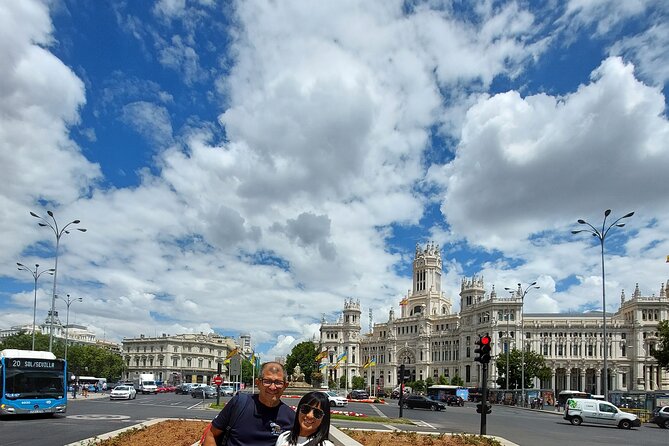
The Cibeles Lounge refers to the Palace of Cibeles, now the seat of Madrid’s city council. You get about 10 minutes to take in the building. Its pale façade and monumental towers make it hard to miss, especially from the open space around the fountain.
The palace is a strong exterior photo stop, but the larger value comes from seeing it as part of the Cibeles complex. The fountain, bank, palace, and surrounding avenues form one of Madrid’s most important civic scenes. Your guide’s printed material and teaching tools can help you connect the buildings instead of viewing each one as a separate picture.
Next comes Paseo del Prado, with another 10-minute stop. This boulevard stretches from the Charles V Roundabout to Plaza de Cibeles and is lined with mature trees, museums, cultural buildings, and public art. It is recognized as a UNESCO World Heritage Site, and the route passes through one of Madrid’s most important cultural zones.
The Prado Museum, Thyssen-Bornemisza Museum, CaixaForum Madrid, and Royal Botanical Gardens are all associated with this stretch. You do not enter them during the walk, but you will learn where they are and how they fit into the city’s cultural center.
This is one of the best planning benefits of the tour. If you intend to visit a museum later, the guide helps you place it on your mental map. You can also decide which places deserve a longer visit after the group walk ends.
Puerta de Alcalá and the route into Retiro
Puerta de Alcalá is the city’s most famous gateway and was built under King Charles III. The stop lasts roughly 10 minutes. It is a classic Madrid sight, and its position near Retiro Park makes it a natural bridge between the formal city and the park.
The gateway is impressive from the open street, but the short stop means you will not receive a full architectural lecture. You get the key context, a chance to look closely, and time for photographs before moving into the park.
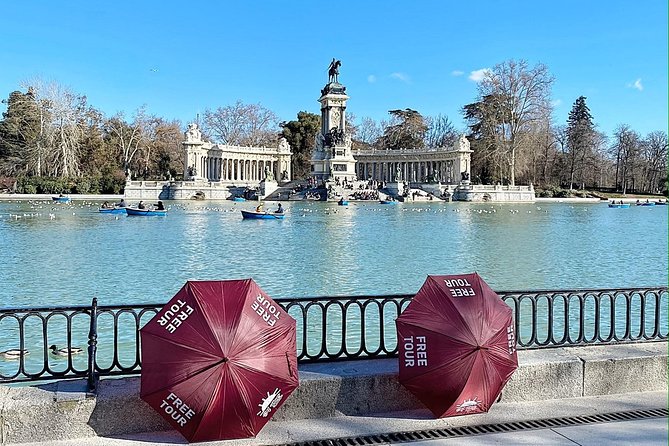
The final 25 minutes take place at Parque del Retiro, Madrid’s central green space. The tour ends at Park Lake, giving the walk a calmer finish after the traffic and grand avenues of the city center.
Retiro is called the vegetable lung of central Madrid in the tour description. That phrase captures its role as a large public refuge near the museums and government buildings. The end point is practical, too. You can continue around the park, sit by the lake, or use the area as a starting point for more sightseeing.
What the guide adds to the walk
The route covers many major names in a fairly short time, so the guide’s storytelling matters more than the simple list of stops. Tambo is praised for clear explanations, humor, and answering questions, even in light rain. Tomas is described as enthusiastic and especially good at explaining the city’s architecture and past.
Marta is another guide to look out for. Her approach includes practical suggestions for restaurants and other things to do after the walk. Maikel is noted for making complicated Spanish history easier to follow, while Alba Gallego is described as friendly, entertaining, and willing to answer questions.
Guide quality can vary from one departure to another, but these names give you a sense of the style to expect: lively explanation, questions from the group, and local suggestions after the formal route ends. Printed material and teaching tools are included, which should help when the guide is explaining several dates, buildings, and political figures in quick succession.
The tour also promises personalized attention after the walk, including recommendations for what to do in Madrid. Consider that a useful extra if you are at the beginning of your stay and still choosing museums, restaurants, or neighborhoods.
Price, group size, and the tip question
At $3.59 per person, the advertised booking price is extremely low for a 2-hour-20-minute guided walk. You are paying very little for a route that covers several of Madrid’s best-known public sights, and no entry tickets are needed because the tour stays outside.
The important qualification is the payment language. Soda is not included, site entries are not included, and tips are not included. The booking payment is described as covering management rather than the full guide service.
One person reported being surprised when a guide asked for at least $15 in additional payment for taxes and gave $30 because no euros were available. That is a serious point to clarify before you go. The tour information says tipping is expected as a way to value the guide’s work, but it does not present one fixed final amount.
I would budget for a tip in euros and ask at the start how the payment works. That avoids an awkward surprise at the end and lets you judge the guide’s work fairly. Even with a tip, the walk may offer good value, but the true cost is not simply $3.59.
The group can include up to 30 people. That is large enough to affect how easily you hear the guide, especially near traffic or crowded squares. On the other hand, a group of this size can keep the price low. If you want a quiet, highly personal walk, this may not be the right format.
Weather, walking comfort, and who should book
The walk lasts more than two hours and moves through central streets, open plazas, a boulevard, and a park. Wear comfortable shoes and prepare for changing weather. Light rain did not prevent one departure from enjoying the route, but an umbrella or rain jacket would still be sensible.
Most people can participate, and service animals are allowed. The meeting point is near public transportation, which makes Puerta del Sol easy to reach from other parts of Madrid. You finish in Retiro Park, not back at the starting square, so plan your next step from the park area.
I think this tour suits a first visit, a short stay, or anyone who wants a basic map of central Madrid before choosing paid attractions. Families may like the mix of statues, stories, grand buildings, and open park space. A 13-year-old was able to enjoy the experience, which suggests the guide style can work for younger visitors when the storytelling is lively.
Art specialists and architecture fans may want more time at each building. Since the group does not go inside the museums, bank, palace, or other sites, this is an introduction rather than a substitute for museum visits or specialist tours.
Should you book the Madrid Modern walking tour?
Book it if you want a low-cost, English-language orientation that covers Madrid’s main central sights in one continuous walk. The route is well chosen, the finish in Retiro Park is useful, and the guides appear to put real effort into making complicated Spanish history understandable and entertaining.
Before booking, accept two limits: you will not enter the attractions, and the $3.59 payment does not include the guide’s tip. Clarify the expected tip and carry euros. If you are comfortable with those terms, this is a sensible first-day activity that can help you decide how to spend the rest of your time in Madrid.
FAQ
How long does the Walking Tour of Madrid Modern last?
The tour lasts approximately 2 hours and 20 minutes.
Where does the tour start?
It starts at Puerta del Sol, Prta del Sol, s/n, Centro, 28013 Madrid, Spain.
Where does the tour finish?
The tour ends in El Retiro Park, near Park Lake.
Is the tour offered in English?
Yes. The tour is offered in English.
Does the tour include admission to museums or monuments?
No. The route views the sites from outside, and no attraction entry tickets are required or included.
What is included in the booking?
A local guide, printed material, teaching tools during the route, a link to personalized Madrid recommendations, and personalized attention from the guide after the tour are included.
How large can the group be?
The maximum group size is 30 people.
Can I cancel for a full refund?
Yes. You can cancel at least 24 hours before the start time for a full refund. Cancellations or changes made within 24 hours are not accepted, and no refund is provided.
Just added around Madrid
- Private Vacation Photography Session with Photographer in Madrid★ 5.0 · 3 reviews
- Arrival Private Transfer from MAD Airport to Madrid in a Minibus★ 5.0 · 3 reviews
- Segovia: 3-Hour Private Walking Tour★ 5.0 · 3 reviews
- Tour Segovia and La Granja de San Ildefonso from Madrid★ 5.0 · 3 reviews
- Madrid: Prado & Reina Sofia Museum Skip-the-Line Guided Tour★ 5.0 · 3 reviews
- Salamanca: Private Guided Customizable Walking Tour★ 5.0 · 3 reviews
- Total Reboot and Renew with top wellnes 3 hours couple experience★ 5.0 · 3 reviews
- Madrid: Prado Museum Private Tour★ 5.0 · 3 reviews
Walking Tours, compared.

Toledo Tour & Vineyard Walk with Wine Tasting from Madrid
Read our review →
Madrid Old Town & Royal Palace Walking Tour Skip the Line Ticket
Read our review →
Spanish Inquisition and Legends Evening Walking Tour
Read our review →
6-Hour Day Trip to Toledo with Guided Walking Tour
Read our review →
Madrid Old City Guided Exclusive Guided Walking Tour
Read our review →
Guided Monument Walking Tour with Wristband Pass
Read our review →Browse the lists this tour appears in