Review · STREET ART
Street Art Guided Tour in Madrid
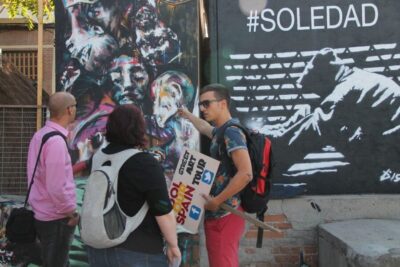
Madrid’s street-art story is best read on foot, one wall at a time. This two-hour walk takes you through Lavapiés, with stops at La Tabacalera, an old tobacco warehouse, and community art spaces shaped by local activism. You may also see work by Himen, Ze Carrión, or Laguna626, along with newer pieces that can disappear as quickly as they appear.
I like the tour’s local focus and its mix of legal murals, unsanctioned graffiti, stencils, and public projects. I also like the chance to visit places such as La Neomudéjar and Campo de Cebada, which show how Madrid’s art scene reaches beyond gallery walls. The main consideration is that access and artwork can change, and La Tabacalera has restrictive weekday hours.
In This Review
- Key points at a glance
- Why this Madrid walk feels different
- Starting near Atocha and La Neomudéjar
- La Tabacalera, from tobacco warehouse to art center
- Esta es Una Plaza and the value of shared space
- Lavapiés, the real subject of the walk
- Campo de Cebada and Madrid’s 15-M legacy
- What $30.38 buys you
- Who will enjoy this street-art tour
- My practical verdict
- FAQ
- Where does the Street Art Guided Tour in Madrid start?
- Where does the tour finish?
- How long does the tour last?
- What language is the tour offered in?
- Is admission to the art sites included?
- Is the tour suitable in bad weather?
- Can I cancel for a full refund?
Key points at a glance

- La Tabacalera’s graffiti walls: Study one of Madrid’s major urban-art sites, with attention to artists, techniques, and social messages.
- A walk through Lavapiés: Learn how the district’s multicultural character connects with its street art.
- Community art in action: See spaces such as Esta es Una Plaza and Campo de Cebada, where residents have reclaimed unused city areas.
- Small-group format: The group is limited to 13 people, which helps you stay close to the guide.
- Artists and politics: The route can include work by Himen, Ze Carrión, and Laguna626, plus discussion of Spanish Article 626 and graffiti enforcement.
- Good value at $30.38: For two hours with a local guide, this is a reasonably priced way to see a side of Madrid that costs nothing to enter.
Why this Madrid walk feels different
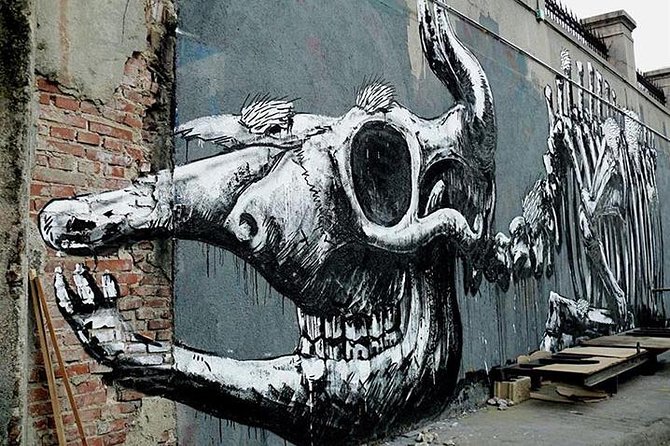
I like that this is not simply a parade of colorful walls. The guide explains who made the work, how it was made, and what it may be trying to say. That turns a quick photo stop into a better way to read the city.
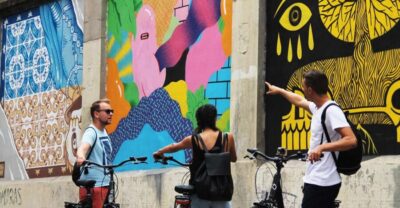
The route also gives you a reason to explore Lavapiés. This central district is known for its mix of cultures, narrow streets, art spaces, and independent projects. You are not being taken from one isolated mural to another. You are walking through a neighborhood where art appears on shutters, walls, courtyards, former industrial buildings, and shared public spaces.
Guides such as Santi and Julia have been especially effective at making the subject accessible. Santi is an active street artist, and that matters because he can speak from inside the scene rather than treating graffiti as a museum object. Julia has been praised for making the walk informative and friendly for families.
The style of the guide can shape the whole experience. On a good day, the discussion is lively and personal, with plenty of room for questions. One useful detail from past tours is that groups have occasionally encountered artists painting new murals for the Calle Lavapiés festival. That is not something you can count on, but it shows how closely the route is tied to current activity.
A few more Madrid days to weigh up
- Madrid: Street Art Tour with Local Graffiti Hunter
★ 4.8 · 270 reviews - Madrid: Street Art Bike Tour
★ 4.5 · 21 reviews - Madrid Hidden Street Art Tour
★ 5.0 · 12 reviews
Starting near Atocha and La Neomudéjar
The meeting point is Teatro Valle-Inclán at Plaza de Ana Diosdado. The listed start time is 11:15 a.m., and the walk begins in central Madrid. You do not need hotel pickup, so plan to reach the meeting point on your own.
One description of the route begins with La Neomudéjar, only about a five-minute walk from the starting area. This former power plant once helped supply electricity to Atocha train station. Today, the building is an avant-garde art center with work by artists from Spain and abroad.
The walk toward it passes the big-headed babies monument near Atocha and the Mediodía metro station. The station houses an art center with photographic exhibitions and gallery shows, giving you an early example of how Madrid places contemporary art in everyday public settings.
At La Neomudéjar, the guide may point out work by Himen, Ze Carrión, and Laguna626. The building is especially useful for understanding the tension between street art and official control. Some artists use their work to protest Spanish Article 626, which seeks to penalize graffiti creators.
I find this context valuable because it keeps the tour from becoming a hunt for attractive backdrops. You learn that street art can be decoration, protest, personal signature, neighborhood memory, or all four at once.
Access can affect this part of the experience. Art centers and former industrial buildings do not always operate like open-air streets, and the route may adapt to the day’s schedule. Ask the guide at the beginning what will be open, especially if visiting on a weekday.
La Tabacalera, from tobacco warehouse to art center
La Tabacalera is one of the strongest stops because its building already tells a story. The 19th-century warehouse once employed more than 1,000 people to chop, shred, and roll tobacco. Its later use as a creative space gives the old structure a new public life.
The exterior graffiti walls are tied to one of Madrid’s major urban-art festivals. Here, the guide focuses on the artists, messages, and techniques. You may look at the difference between a quick tag, a carefully planned mural, a stencil, and a piece created for a festival.
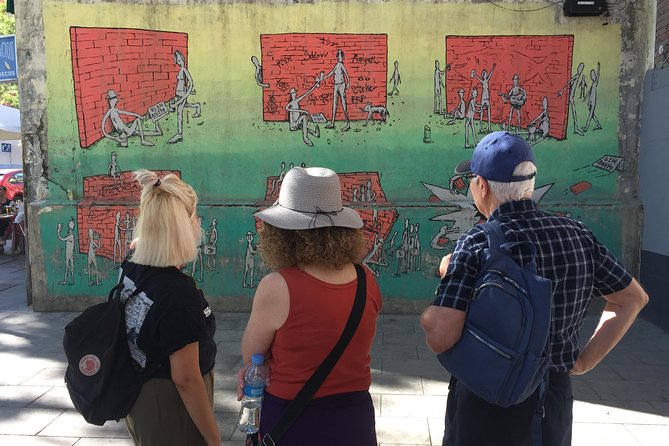
That comparison is one of the tour’s best teaching moments. A large sanctioned mural may have permission and preparation behind it, while nearby unsanctioned work can be faster, rougher, and more vulnerable to removal. Both belong to the visual story of Lavapiés, but they communicate in different ways.
The basement adds another layer. Hundreds of street-art projects and stencils line its walls, creating a much tighter and more enclosed setting than the exterior festival walls. The range of work can be exciting, but it may also feel crowded visually. I would pay attention to the guide’s explanations rather than trying to photograph everything.
La Tabacalera also hosts dance, music, painting, and other performances. Its role is not limited to displaying finished art. It gives Madrid’s creative community space to work, perform, and experiment.
There is an important practical warning here: La Tabacalera has restrictive weekday timing. If this stop matters most to you, confirm the day’s access when booking or ask the operator before the tour. The outdoor walls can still offer plenty to see, but interior access may change.
Esta es Una Plaza and the value of shared space
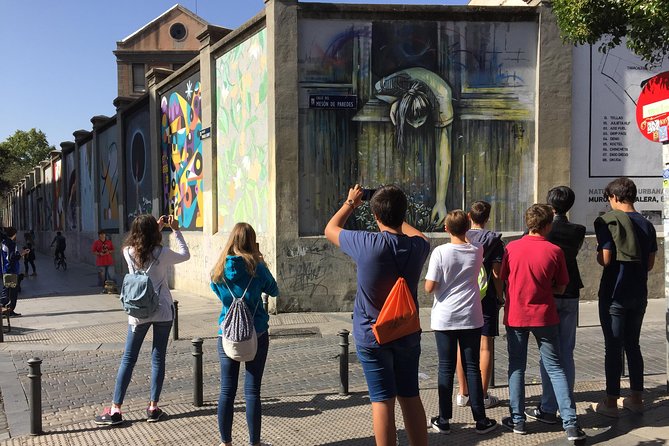
Esta es Una Plaza is an urban garden and community project in Lavapiés. The tour includes a look at its walls, but entry is only guaranteed when the site is open.
That condition is worth taking seriously. You may see the surrounding art and hear about the project even if the garden itself is closed, but do not book the walk solely for guaranteed access to this one stop.
I like the idea behind the place because it gives the tour a needed pause from painted walls. Street art here connects with gardening, neighborhood use, and local cooperation. You see how residents can turn an overlooked space into somewhere people meet and work together.
The guide can also help you notice how the artwork fits the setting. A mural beside a shared garden has a different purpose from a piece on a commercial wall. It can mark local identity, invite participation, or simply make an everyday route more pleasant.
A different sort of afternoon around Madrid:
- Madrid: Tour Bernabéu Entry Ticket
★ 4.5 · 21,573 reviews - Madrid: Prado Museum Entry Ticket
★ 4.6 · 17,509 reviews - Madrid: Royal Palace Fast-Access Admission Ticket
★ 4.6 · 13,856 reviews - Madrid: “Emociones” Live Flamenco Performance
★ 4.8 · 12,866 reviews
Lavapiés, the real subject of the walk
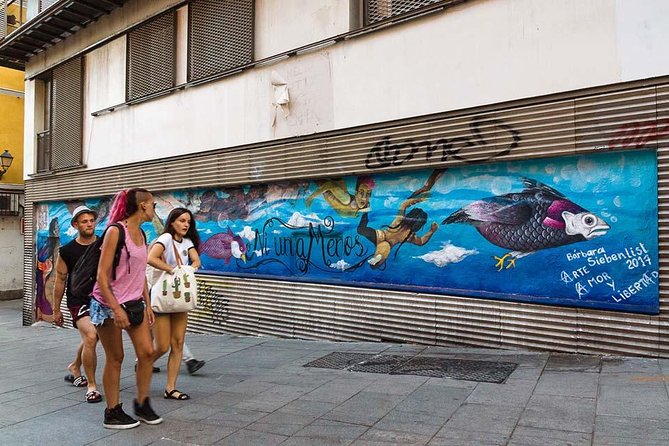
The tour spends about an hour walking through Lavapiés. That is more time than any one art venue, and it is the part I consider most important.
You learn the district’s story while moving through streets filled with different forms of graffiti and public art. The guide points out how the area’s multicultural character appears in its walls and creative projects. This is a useful antidote to the idea that street art is only an attraction placed for visitors.
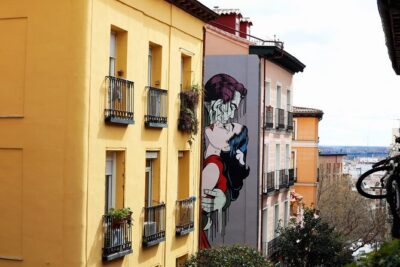
The route can include newly completed festival murals as well as work that has not been officially approved. Because the art is temporary, the exact selection changes. A wall that looked fresh one month may be painted over the next. That uncertainty is part of the subject, not a flaw in the tour.
The changing nature of the art does create one possible disappointment. Online photographs may show pieces that are no longer there, while current walls may not match the most dramatic examples used in promotion. One person found the graffiti selection weaker than expected and felt the explanations went on too long. If you want a fast photo walk with only the biggest murals, this may not be your ideal outing.
I would choose this tour if you want to understand how the art works within the neighborhood. The best moments come from asking questions about technique, permission, politics, and the difference between an artist’s work and random tagging.
Campo de Cebada and Madrid’s 15-M legacy
The route described for this experience finishes at Campo de Cebada, near Plaza de Cascorro. The end point is close to La Latina and Tirso Molina metro stations, so you can continue sightseeing in central Madrid afterward.
Campo de Cebada began with Spain’s 15-M Movement, when citizens reclaimed streets and squares for shared public use. The site once held a swimming pool. Local groups later reshaped it into a place for films, music, gardening, and neighborhood gatherings.
This is a fitting final stop because it widens the definition of street art. The story is not only about spray paint. It is also about who controls public space and how residents use it.
The site has hosted summer movies, music, and a collective vegetable garden. Depending on the day, you might find the place quiet or active, but the guide can explain why it matters even when no event is taking place.
The end at Plaza de Cascorro is practical. You are not left in an outlying industrial zone. From here, you can explore more of Lavapiés, walk toward El Rastro when it is operating, or use the nearby metro stations.
What $30.38 buys you
At $30.38 per person, the tour offers a fair price for roughly two hours of guiding in a central neighborhood. Admission to the listed stops is free, so most of what you pay for is the guide’s local knowledge, route planning, and interpretation.
That value depends on your interests. If you would happily wander Lavapiés alone and only want to photograph murals, you can see plenty without paying. If you want an artist’s explanation of techniques, local projects, and the politics around graffiti, the fee is easier to justify.
The maximum group size is 13 people. That is small enough to feel more personal than a large city tour, though you may still need to stay close when the guide is speaking. One past participant found it hard to hear every explanation while also looking around. Stand near the guide at stops, and ask for a repeat if street noise gets in the way.
The tour is offered in English, with multilingual guiding also listed in English, French, and Spanish. The experience operates in all weather, so wear suitable clothing and comfortable walking shoes. Food and drinks are not included, but Lavapiés gives you plenty of options before or after the walk.
Free cancellation is available if you cancel at least 24 hours before the local start time. Changes or cancellations inside that period are not refundable.
Who will enjoy this street-art tour
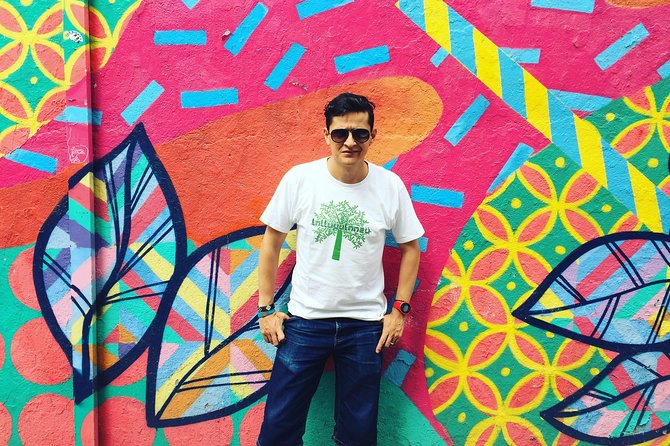
I would recommend it to first-time visitors who want an alternative to Madrid’s major museums, as well as repeat visitors looking for a different part of the city. It works especially well for people who enjoy photography, urban design, politics, social history, and local creative scenes.
Families can enjoy it too, particularly when the guide keeps the discussion interactive. The chance to try spray painting has also been part of at least one tour, though you should not treat that as a guaranteed feature.
The walk suits anyone comfortable with about two hours on foot. Most people can participate, and service animals are allowed. The group size is limited, but you should still expect an informal walking tour rather than a quiet, seated lecture.
I would be more cautious about booking if you want a fixed list of famous murals, guaranteed access to every interior, or a fast route with minimal explanation. Street art changes, venues have opening restrictions, and the guide may spend time on social and legal issues that are less visually exciting but central to the subject.
My practical verdict
Book this tour if you want Madrid’s street art explained in its local setting. The combination of Lavapiés, La Tabacalera, community gardens, former industrial buildings, and 15-M public projects gives you more than a collection of painted walls.
For the best experience, stay close to the guide, wear shoes for city walking, and confirm what will be open at La Tabacalera and Esta es Una Plaza. Guides such as Santi and Julia can add a personal connection, but the exact guide and artwork may vary.
At $30.38, I see this as a good-value introduction to Madrid’s creative side, provided you accept that the route is changeable. If you want to leave the tour seeing ordinary walls with a more curious eye, this is a smart two-hour choice.
FAQ
Where does the Street Art Guided Tour in Madrid start?
The tour starts at Teatro Valle-Inclán, Plaza de Ana Diosdado, Madrid. The listed start time is 11:15 a.m.
Where does the tour finish?
The tour finishes at Plaza de Cascorro in central Madrid. The nearest metro stations are La Latina and Tirso Molina.
How long does the tour last?
The experience lasts approximately two hours.
What language is the tour offered in?
The tour is offered in English. Multilingual guiding is also listed in English, French, and Spanish.
Is admission to the art sites included?
The local guide and visit to Muros La Tabacalera are included. The listed itinerary stops have no admission charge. Access to Esta es Una Plaza is only guaranteed when the garden is open.
Is the tour suitable in bad weather?
Yes. The tour operates in all weather conditions, so you should dress appropriately.
Can I cancel for a full refund?
Yes, if you cancel at least 24 hours before the experience’s local start time. Cancellations or changes made less than 24 hours before the start are not accepted for a refund.
Just added around Madrid
- Private Vacation Photography Session with Photographer in Madrid★ 5.0 · 3 reviews
- Arrival Private Transfer from MAD Airport to Madrid in a Minibus★ 5.0 · 3 reviews
- Segovia: 3-Hour Private Walking Tour★ 5.0 · 3 reviews
- Tour Segovia and La Granja de San Ildefonso from Madrid★ 5.0 · 3 reviews
- Madrid: Prado & Reina Sofia Museum Skip-the-Line Guided Tour★ 5.0 · 3 reviews
- Salamanca: Private Guided Customizable Walking Tour★ 5.0 · 3 reviews
- Total Reboot and Renew with top wellnes 3 hours couple experience★ 5.0 · 3 reviews
- Madrid: Prado Museum Private Tour★ 5.0 · 3 reviews