
Review · TUK-TUKS
Tour en tuk-tuk electrico por MADRID MODERNO
Madrid’s grandest sights pass by quickly on this private electric tuk-tuk tour, which links the Royal Palace, Prado Museum, Retiro landmarks, Salamanca, Cibeles, Atocha, and Gran Vía in about 90 minutes. It is a smart way to get your bearings before exploring on foot.
I like the small private setting and the amount of ground covered without a long walk. I also like that guides such as Juan, Jimena, José, Javier, and George have been praised for clear English, good local suggestions, and lively stories. The main concern is reliability: several bookings had no driver appear, so confirm the meeting details before setting out.
In This Review
- Key points to know before booking
- What this 90-minute Madrid tour actually does
- The Royal Palace and Almudena Cathedral
- San Francisco el Grande and the Toledo Gate
- Atocha, Reina Sofía, and the Prado district
- Los Jerónimos, the Casón, and the old Buen Retiro
- The Royal Spanish Academy and Puerta de Alcalá
- Las Ventas and the Salamanca district
- Colón, the National Library, Cibeles, and the Bank of Spain
- Neptune Fountain and Gran Vía
- What the guides add to the ride
- Price, timing, and practical value
- Who should choose this Madrid tuk-tuk tour?
- Should you book it?
- FAQ
- How long is the electric tuk-tuk tour?
- How many people can join one private tour?
- What language is the tour offered in?
- Where does the tour begin and end?
- Are museum and attraction admission tickets included?
- What happens if bad weather cancels the tour?
Key points to know before booking
- Private group of up to four: You ride with your own party rather than joining a large sightseeing bus.
- A fast look at Madrid’s big names: The route includes the Royal Palace, Almudena Cathedral, Prado, Puerta de Alcalá, Cibeles, Salamanca, and Gran Vía.
- Photo stops, not museum visits: You receive brief explanations and can stop for pictures, but admission to the interiors is not part of the experience.
- English-speaking guides make the difference: Juan, Jimena, José, Javier, and George have each been praised for friendly service and clear explanations.
- Best for first-day orientation: The tour helps you decide where to return for a longer visit on foot or inside a museum.
- Good-weather activity: Poor weather can lead to a new date or a full refund.
What this 90-minute Madrid tour actually does
This is not a museum tour or a detailed architectural walk. It is a moving introduction to Madrid, with an electric tuk-tuk carrying you between major sights while your guide provides short historical notes.
The route has a broad reach. You begin near the Royal Palace at C. de Vergara, 1, in central Madrid, then pass through the old center, the Prado district, Retiro, Salamanca, and the grand avenues around Cibeles and Gran Vía. That range is the chief value of the experience. In 90 minutes, you can see parts of the city that would take much longer to connect on foot.
The tour ends back at the meeting point. Bottled water and the guide-driver are included. Tips are not included, so bring a little extra if the service is good.
Because the tuk-tuk is small and the activity is private, it suits a couple, a family, or a small group of friends. The published capacity is four people per group. If your party is larger, you should clarify arrangements before booking rather than assume one vehicle will carry everyone.
A few more Madrid days to weigh up
- Madrid Welcome Tour with Local Guide in Eco Tuk Tuk Private
★ 5.0 · 2,936 reviews - Madrid: Private City Tour by Eco Tuk Tuk
★ 4.9 · 2,876 reviews - Madrid Historical Tour with Local Guide in Eco Tuk Tuk Private
★ 5.0 · 876 reviews
The Royal Palace and Almudena Cathedral

The Royal Palace is the opening landmark and one of Madrid’s most impressive sights. The palace covers about 135,000 square meters and contains 3,418 rooms, making it the largest royal palace in Western Europe by area.
You will not tour the palace rooms on this experience. Instead, your guide gives you background on the building and points out its importance from the tuk-tuk or during a brief photo stop. That approach works well if you plan to return later for a full visit, since the palace deserves far more time than this tour allows.
Next door, Almudena Cathedral gives you a useful contrast. The cathedral was built on the site of an older mosque and takes its name from the Arabic al-mudayna, meaning citadel. Its construction stretched from the late 19th century into the late 20th century, which helps explain its mix of styles.
Look for the neoclassical exterior, Neo-Gothic interior, and Neo-Romanesque crypt. The building is about 102 meters long and 73 meters high, so even a short explanation helps you read what you are seeing. Again, this is a stop for orientation and photographs, not an included interior visit.
San Francisco el Grande and the Toledo Gate
The route then moves toward the Royal Basilica of San Francisco el Grande, officially the Basilica of Our Lady of the Angels. It occupies the western side of Plaza de San Francisco, near the intersection of Calle Bailén and Carrera de San Francisco.
The church is tied to a Franciscan foundation dating to the early 13th century. Your guide can give you the basic story while you take in the large urban setting around it. This is one of the useful features of a tuk-tuk: you get close to central monuments without committing to a long detour.
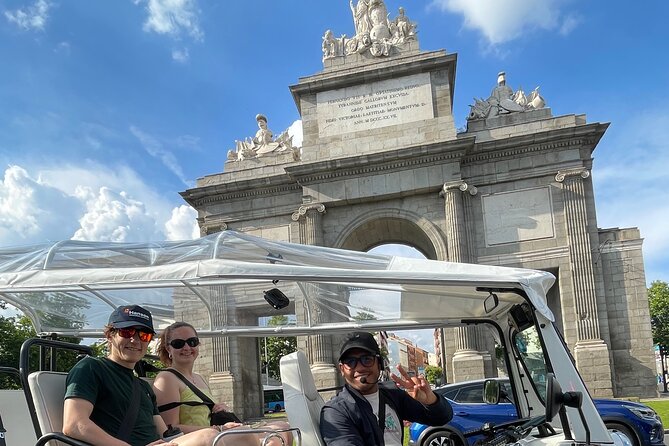
At the Toledo Gate, Madrid’s history becomes more tied to the city walls and royal ceremony. Earlier gates with the same name once occupied nearby locations, but the present gate dates from the first third of the 19th century.
It was designed by architect Antonio Aguado as a triumphal arch honoring King Ferdinand VII and recalling Spanish independence after the French occupation. The gate sits in the middle of a roundabout, so a quick photo stop is more practical than a long visit. You will see the monument, hear the context, and keep moving.
Atocha, Reina Sofía, and the Prado district
Atocha station is one of Madrid’s key transport hubs and the country’s busiest railway station by passenger traffic. It began as a simple halt in 1851 and grew into the Midi station, inaugurated in 1892.
The tuk-tuk gives you a quick look at this important part of the city. Atocha is useful to recognize even if you are not taking a train, since the station sits close to the museums and boulevards of central Madrid.
Nearby, the Reina Sofía Museum occupies Madrid’s former General Hospital, an 18th-century neoclassical building associated with José de Hermosilla and Francesco Sabatini. The museum opened in its current form in 1992, and the Nouvel building expanded the complex in 2005.
The collection focuses on 20th-century and contemporary Spanish art. The museum is especially known for Picasso’s Guernica, although the famous painting moved there from the Casón del Buen Retiro in 1992. You will hear about the museum, but admission is not part of the tuk-tuk tour.
The Prado Museum comes next. The Prado is one of the world’s major art museums, with particularly strong collections of Spanish and European painting from the 15th through the 18th centuries, plus Spanish works from the 19th century.
Its most important names include Velázquez, El Greco, Goya, Titian, Rubens, and Bosch. Goya has the largest representation, while the museum’s Velázquez and Bosch collections are among its great strengths. The stop gives you a useful first look at the building and its place in Madrid’s cultural center.
The itinerary lists a five-minute stop at the Prado with free admission noted, but this should not be confused with a full museum visit. You will need a separate ticket and several hours if you want to see the galleries properly.
A different sort of afternoon around Madrid:
- Madrid: Tour Bernabéu Entry Ticket
★ 4.5 · 21,573 reviews - Madrid: Prado Museum Entry Ticket
★ 4.6 · 17,509 reviews - Madrid: Royal Palace Fast-Access Admission Ticket
★ 4.6 · 13,856 reviews - Madrid: “Emociones” Live Flamenco Performance
★ 4.8 · 12,866 reviews
Los Jerónimos, the Casón, and the old Buen Retiro
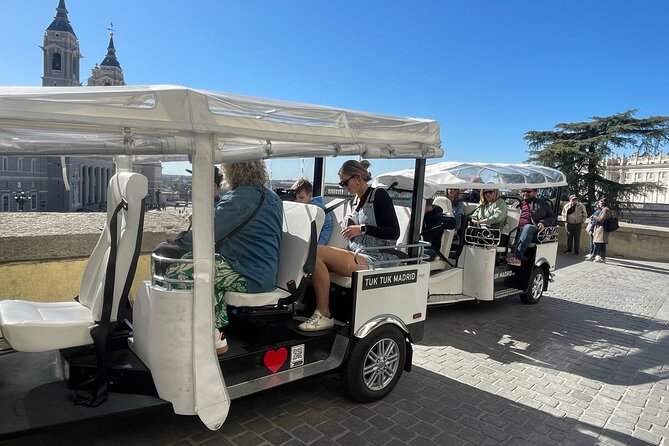
The former monastery of San Jerónimo el Real, commonly called Los Jerónimos, was once one of Madrid’s most important monasteries. It stood beside a royal room that later grew into the Buen Retiro Palace under Philip IV.
Only two buildings from the old Buen Retiro Palace survived its destruction. One is the Casón del Buen Retiro, built by Alonso Carbonel in 1637 as a ballroom for the court of Philip IV.
The Casón later became part of the Prado Museum. It once held 19th-century paintings and, for a period, Picasso’s Guernica. After the painting moved to Reina Sofía, the Casón reopened in 2009 as a museum study center.
The Salón de Reinos, or Hall of Realms, is the other major survivor. Built between 1630 and 1635, it was the main ceremonial room of the Buen Retiro Palace and once held many of the paintings now seen in the Prado.
Its name comes from the coats of arms of the 24 kingdoms that formed the Hispanic Monarchy under Philip IV. The building was also known for its later use by the Army Museum, before that collection moved to the Alcázar of Toledo.
These stops are valuable because they connect several famous Madrid institutions. The Prado, Casón, Salón de Reinos, and Buen Retiro were not separate pieces of a sightseeing puzzle. They were part of a royal and cultural center shaped over centuries.
The Royal Spanish Academy and Puerta de Alcalá
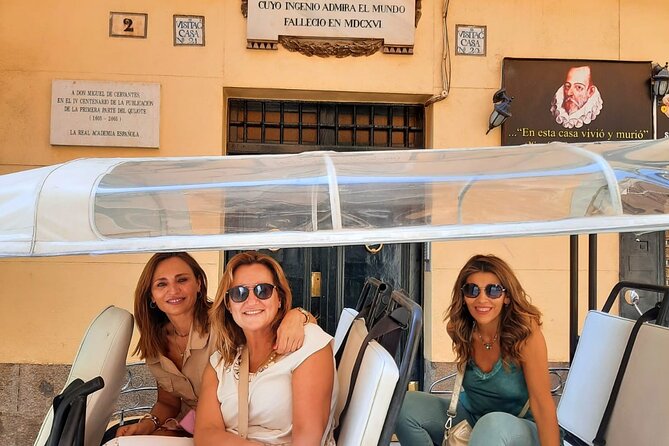
The Royal Spanish Academy is a short stop with a clear purpose. Founded in 1713 on the initiative of Juan Manuel Fernández Pacheco, the academy was modeled partly on the French Academy and received royal approval from Philip V.
The institution now works with 23 other Spanish-language academies through the Association of Spanish Language Academies. You will receive a brief explanation outside, but admission is not included.
Puerta de Alcalá is one of Madrid’s five old royal gates. It occupies the center of Plaza de la Independencia, near the entrances to Retiro Park and the crossing of Alcalá, Alfonso XII, Serrano, and Salustiano Olózaga streets.
The gate is one of the easiest symbols of Madrid to recognize. Its location also shows how the older city meets the broad avenues and formal parks of the modern capital. The tuk-tuk can help you see that relationship without spending your morning crossing several major roads.
Las Ventas and the Salamanca district
Las Ventas is Madrid’s largest bullring, with seating for 23,798 people. Its ring measures 61.5 meters in diameter, and the building is an important example of the city’s bullfighting tradition.
You should think of this as a visual and cultural stop rather than a bullring tour. The experience does not include entry, and the guide’s short explanation will be most useful if you want to decide later if the venue deserves a separate visit.
The Salamanca district provides a different side of Madrid. It was developed in part during the 19th century by José de Salamanca y Mayol, the Marquis of Salamanca, whose name the district carries.
Today, Salamanca is known for high-end shopping and some of Madrid’s most expensive streets, especially Serrano, Claudio Coello, and Ortega y Gasset. The tour allows about 20 minutes here, the longest listed stop on the route.
That extra time makes sense. Salamanca is not one single monument. It is a district to read through its avenues, façades, shops, and polished urban design. You might use this stop to note places you want to revisit for shopping, coffee, or a closer look at the architecture.
Colón, the National Library, Cibeles, and the Bank of Spain
Plaza de Colón brings together several major roads, including Goya, Génova, Paseo de la Castellana, and Paseo de Recoletos. The square takes its name from Christopher Columbus and includes a Neo-Gothic monument to him built between 1881 and 1885.
The National Library of Spain is nearby. Its role is larger than a normal public library: it gathers, catalogs, and preserves Spain’s published and documentary heritage.
The collection includes around 30 million items, from books and magazines to maps, engravings, drawings, sheet music, and pamphlets. You will not enter to examine those holdings, but the guide can help place the institution within Spain’s cultural life.
At Plaza de Cibeles, you see one of Madrid’s most familiar fountains. The fountain was part of an 18th-century urban plan promoted by Charles III, who wanted the capital to reflect neoclassical taste.
Cibeles was designed alongside other projects such as the Neptune Fountain, the Prado’s predecessor as a natural science museum, and the Royal Botanical Garden. The plaza became known locally as the Salón del Prado because of its beauty and pleasant setting.
The nearby Bank of Spain occupies a grand headquarters built between 1884 and 1891 at the junction of Calle Alcalá and Paseo del Prado. The institution was founded in Madrid in 1782 by Charles III and now serves as Spain’s central bank and banking supervisor within the European system.
Cibeles and the Bank of Spain are excellent examples of how Madrid uses monumental buildings to frame important intersections. You get a quick succession of architecture, public institutions, and city symbolism without needing a separate walking route.
Neptune Fountain and Gran Vía
The Neptune Fountain dates from the same broad neoclassical planning period as Cibeles. Proposed in 1777 and completed in 1786, it first stood along the Carrera de San Jerónimo facing the Cibeles Fountain before moving to its current location in 1898.
The two fountains are often treated as a pair, and seeing both helps you understand Madrid’s formal boulevards. The stop is short, but the guide’s explanation adds useful context to what could otherwise be just another large roundabout.
The final major landmark is Gran Vía. The avenue begins at Calle de Alcalá and runs to Plaza de España, serving as one of Madrid’s main shopping, entertainment, and sightseeing streets.
The section between Plaza de Callao and Plaza de España is known for musical theater and is often compared with Broadway. Other stretches are filled with international fashion chains, cinemas, and busy city traffic.
The itinerary allows about 10 minutes here. That is enough for a quick look and photographs, but not enough to shop, see a show, or walk the whole avenue. I would treat Gran Vía as a useful finish and return later if you want its full atmosphere.
What the guides add to the ride
The guide-driver is central to the experience. The best reports single out Juan for his fun, clear English and strong command of Madrid’s past. Jimena is described as patient, kind, and well informed.
José and Javier have received praise for courtesy, energy, and restaurant suggestions. Javier has also been credited with explaining Spanish and Madrid history in a way that helps you choose where to go afterward. George has guided mixed-language groups successfully, including parties with both Spanish and English speakers.
Those details matter because the route contains many monuments. Without a good guide, the ride could become a quick parade of façades. With a good guide, the Royal Palace, Retiro buildings, fountains, and grand avenues connect into a story about monarchy, empire, art, language, and city planning.
Traffic noise can make conversation difficult. One useful improvement would be an individual headset, since the tuk-tuk moves through busy Madrid streets. Ask questions while stopped, when you can hear the answer more easily.
Price, timing, and practical value
The price is $131.54 per group of up to four. For four people, that works out to about $32.89 per person for 90 minutes. For two people, the per-person cost is much higher, so the value improves when you fill the vehicle.
You are paying for privacy, a driver-guide, bottled water, and the ability to cover a wide section of central Madrid quickly. You are not paying for museum tickets, extended guided visits, or a full historical tour at each monument.
The 9:00 a.m. start is useful if you want an early overview before the day gets busy. It also gives you time afterward to return to the Prado, Royal Palace, Reina Sofía, or Retiro on your own.
The experience is booked well ahead by many people, with an average booking lead time of 119 days. That suggests planning ahead is sensible, especially if your Madrid dates are fixed. Free cancellation is available up to 24 hours before the start time. Inside that window, the payment is not refunded.
Good weather matters. If conditions cause cancellation, you can accept another date or receive a full refund. Most people can participate, service animals are allowed, and the meeting point is near public transportation.
One practical warning deserves attention. Several bookings had problems with the driver not appearing at the agreed time, while other outings began exactly as planned and received excellent service. Confirm the time and meeting point through the provided contact feature before 9:00 a.m., and arrive a few minutes early at C. de Vergara, 1.
Who should choose this Madrid tuk-tuk tour?
I would choose this for a first morning in Madrid, particularly if you want a city overview before committing to museums and long walks. It also fits visitors with limited time who want to see the major districts in one compact outing.
Families and small private groups benefit from the flexible format. The guide can focus on the sights that interest you most, and you can ask for restaurant or follow-up suggestions. The vehicle’s four-person limit makes it more personal than a large coach, though larger parties need to check how the booking will be arranged.
Art lovers should see this as a preview. You pass the Prado, Reina Sofía, and Casón del Buen Retiro, but none can be properly explored in a few minutes. Use the ride to choose which museum deserves your afternoon.
You may want a different activity if you prefer long interior visits, detailed walking commentary, or a slow look at one neighborhood. This route is broad by design. It gives you many useful glimpses rather than one sustained visit.
Should you book it?
Book it if you want a private orientation to Madrid, you value covering ground, and you plan to explore several of these sights later. The strongest part is the combination of scale and personal guiding: in 90 minutes, you connect the royal center, museum quarter, Retiro, Salamanca, and Gran Vía.
Skip it if your priority is entering monuments or spending serious time with art. Also take the meeting reliability concern seriously. Confirm your arrangements in advance, then use the tour as a starting map for the rest of your Madrid stay.
FAQ
How long is the electric tuk-tuk tour?
The experience lasts approximately 1 hour and 30 minutes.
How many people can join one private tour?
The private tour is for a group of up to four people.
What language is the tour offered in?
The tour is offered in English.
Where does the tour begin and end?
It begins at C. de Vergara, 1, Centro, 28013 Madrid, and ends back at the same meeting point.
Are museum and attraction admission tickets included?
No. The tour provides brief historical information and photo opportunities, but admission to places such as the Royal Palace, Prado Museum, Reina Sofía, and Royal Spanish Academy is not included.
What happens if bad weather cancels the tour?
You will be offered a different date or a full refund if the activity is canceled because of poor weather. You can also cancel for a full refund up to 24 hours before the scheduled start time.
Just added around Madrid
- Private Vacation Photography Session with Photographer in Madrid★ 5.0 · 3 reviews
- Arrival Private Transfer from MAD Airport to Madrid in a Minibus★ 5.0 · 3 reviews
- Segovia: 3-Hour Private Walking Tour★ 5.0 · 3 reviews
- Tour Segovia and La Granja de San Ildefonso from Madrid★ 5.0 · 3 reviews
- Madrid: Prado & Reina Sofia Museum Skip-the-Line Guided Tour★ 5.0 · 3 reviews
- Salamanca: Private Guided Customizable Walking Tour★ 5.0 · 3 reviews
- Total Reboot and Renew with top wellnes 3 hours couple experience★ 5.0 · 3 reviews
- Madrid: Prado Museum Private Tour★ 5.0 · 3 reviews
Tuk-Tuks, compared.
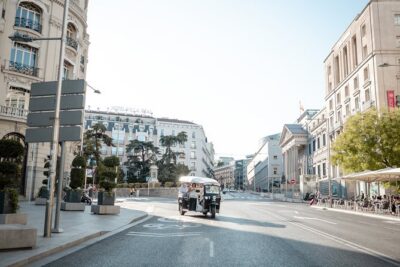
Madrid Historical Tour with Local Guide in Eco Tuk Tuk Private
Read our review →
Madrid Express Tour with Local Guide in Eco Tuk Tuk Private
Read our review →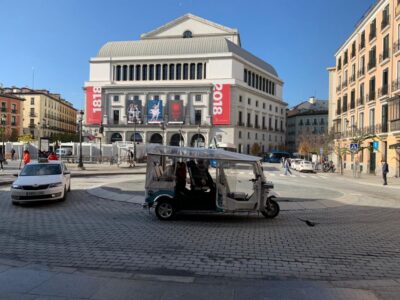
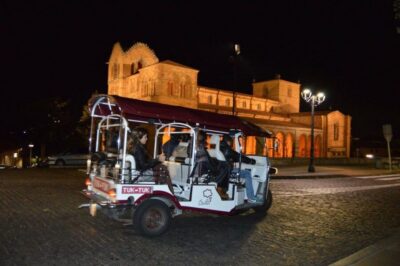
Tour Guiado En Tuk Tuk Recorre Avila De La Forma Mas Comoda
Read our review →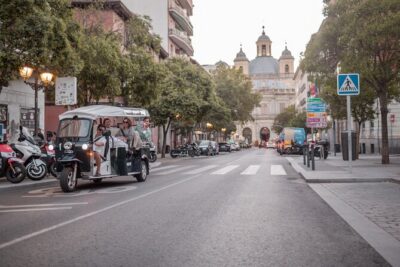
Madrid Expert Tour with Local Guide in Eco Tuk Tuk Private
Read our review →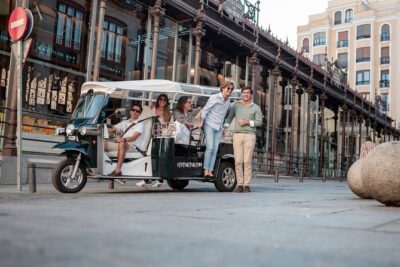
Madrid Expert Plus Tour with Local Guide in Eco Tuk Tuk Private
Read our review →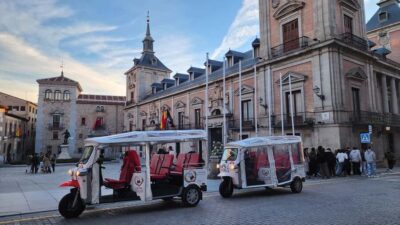

Christmas Lights Tour of Madrid in Eco Tuk Tuk Private
Read our review →Browse the lists this tour appears in