
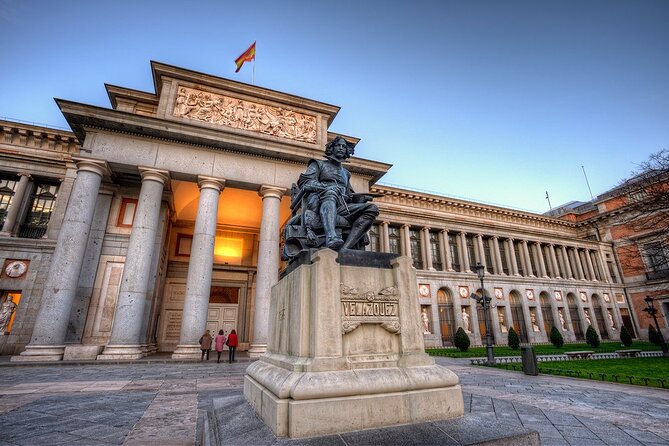
Review · PRADO MUSEUM TOURS
Paseo del Arte: Prado, Reina Sofía and Thyssen Museum
Madrid’s three great art museums tell three very different stories. The Prado takes you into royal Spain, the Reina Sofía brings you face to face with Picasso’s Guernica, and the Thyssen fills in many of the artistic gaps between the old masters and modern art. This eight-hour Paseo del Arte tour gives you a guided route through all three.
I like the small group size, capped at seven, and the clear historical thread connecting the paintings. Guides Ana Cristina and Laura receive especially strong praise for making art easier to understand, not just naming artists and dates. The main drawback is the pace: three museums in one day is a lot, and art lovers who want long, quiet study time may prefer separate visits.
In This Review
- Key points to know
- A full day along Madrid’s Paseo del Prado
- The Prado: royal power, religious drama, and Las Meninas
- Reina Sofía: why Guernica needs its history
- A 90-minute lunch break in central Madrid
- The Thyssen: the bridge between old masters and modern art
- What the small group changes
- Is eight hours too much art?
- Value, tickets, and what you receive
- Timing, transport, and practical planning
- Who should book the Paseo del Arte tour?
- Final verdict: a smart choice for the right art day
- FAQ
- How long does the Paseo del Arte tour last?
- What time does the tour start?
- Where does the tour begin?
- Where does the tour end?
- Which museums are included?
- Is the tour offered in English?
- How many people can join the tour?
- Is lunch included?
- Can I cancel for a full refund?
Key points to know
- Three major museums in one day: Visit the Prado, Reina Sofía, and Thyssen-Bornemisza with admission included.
- A very small group: The maximum is seven people, with high-quality radio guides for easier listening.
- Strong focus on art history: Guides explain techniques, symbols, political events, and the society behind the paintings.
- The Prado highlights Goya and Velázquez: Expect attention to Las Meninas, Flemish painting, Bosch, Raphael, Titian, and more.
- Picasso’s Guernica gets serious attention: The Reina Sofía visit covers the bombing, the painting’s creation, and its journey to Spain.
- Lunch is flexible: You receive about 90 minutes of free time, with lunch available as an optional addition.
A full day along Madrid’s Paseo del Prado
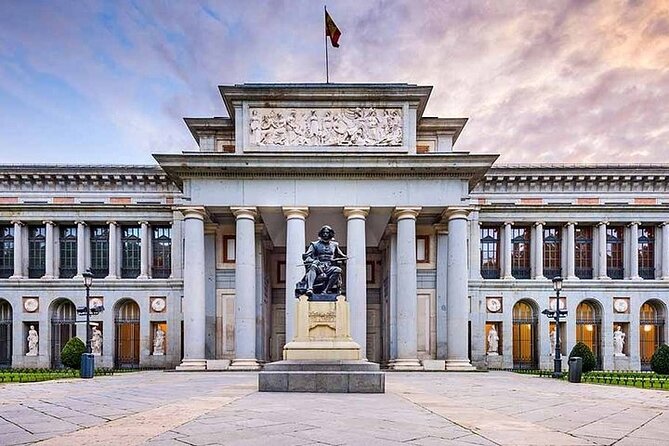
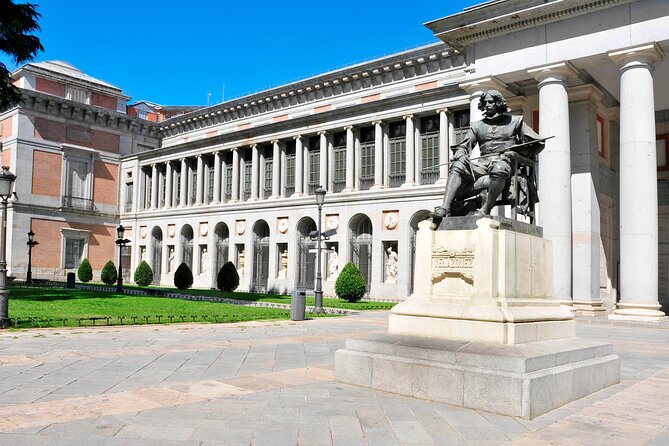
The tour begins at the Museo Nacional del Prado at 10:00 a.m. You meet near the museum on the Paseo del Prado, close to public transportation, then spend roughly 90 minutes inside before walking with the guide to the next museum.
That walking connection matters. You are not being moved around Madrid by coach or left to find the next entrance on your own. The three museums sit in the same central museum district, and the route lets the day unfold in a logical order.
The structure is also helpful if you are trying to make sense of Madrid’s art scene quickly. Instead of seeing three unrelated buildings, you move from court art and religious painting to political modernism and then across a broad survey of European art from the 13th through the 20th centuries.
Still, you should set your expectations properly. Ninety minutes in a museum as large as the Prado is not enough for every famous room, and the same is true of the other two museums. This is a guided introduction with selected highlights, not an exhaustive inspection of every gallery.
More ways to see the Prado:
- Madrid: Prado Museum Entry Ticket
★ 4.6 · 17,509 reviews - Madrid: Small Group of Prado Museum Tour & Optional Tapas
★ 4.6 · 2,437 reviews - Madrid: Prado Museum Guided Tour with Skip-the-Line Ticket
★ 4.5 · 2,018 reviews
The Prado: royal power, religious drama, and Las Meninas
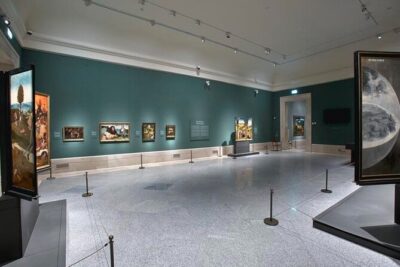
The Prado is the heavyweight of the morning. Opened in 1819, it holds more than 7,000 paintings, though no sensible one-day visit tries to see them all. The guide’s job is to choose important works and show you how to look at them.
Velázquez and Goya receive special attention, and that is exactly where the Prado can become more than a parade of famous names. You learn how artists used perspective, light, gesture, costume, and composition to reveal the values of their time.
Velázquez’s Las Meninas is the essential stop. Its famous perspective is only the beginning. Look at who appears in the room, where each figure is looking, and how the painter places himself within the scene. The guide points out details and stories that are easy to miss when you are standing in front of the painting alone.
Goya offers a different view of Spain. His work can show court life, personal expression, violence, and social change with an unsettling directness. The value of the tour is not simply hearing that Goya was important. You begin to see how his approach differs from the polished royal portrait tradition around him.
The route also covers Northern European painting, including the Flemish Primitives and works by Van Dyck. These paintings reward close looking. Fine surfaces, elaborate fabrics, small objects, and carefully painted faces carry social and religious meaning.
Hieronymus Bosch adds another turn. His strange, crowded scenes can look like fantasy, but they also reflect the fears, beliefs, and moral concerns of his era. A guide can help you read the symbols without reducing the work to a single tidy answer.
The Italian collection brings in Fra Angelico, Raphael, and Titian. Their religious scenes and portraits show different ways of handling color, human emotion, ideal beauty, and movement. Titian’s equestrian portraits, in particular, help explain how artists shaped the image of power for later generations.
The Prado portion is best for you if you want a framework. It gives you a way to compare Spanish, Flemish, and Italian painting rather than treating each room as an isolated display.
Reina Sofía: why Guernica needs its history
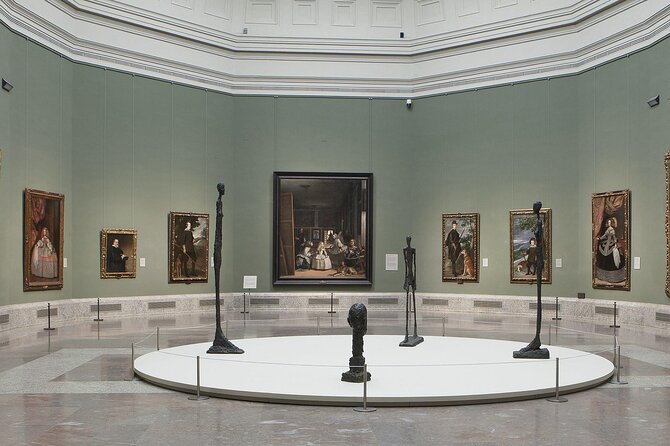
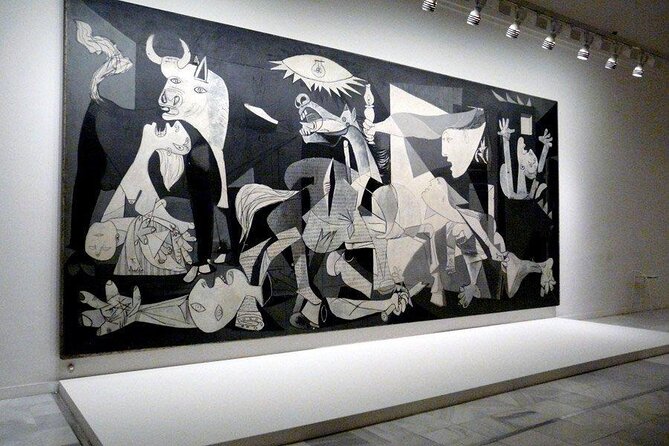
After the Prado, the tour turns to the Museo Nacional Centro de Arte Reina Sofía. The emotional center is Picasso’s Guernica, painted in Paris between May and June 1937 after the bombing of the Basque town of Guernica during the Spanish Civil War.
This is the part of the day where historical context matters most. Without it, Guernica can seem like a huge, fractured monochrome puzzle. With the background in place, the distorted bodies, anguished faces, wounded animals, and harsh geometric forms carry a much clearer force.
The guide explains the symbols and the process behind the painting, along with the story of how it reached Spain. Picasso made the work in 1937, but it did not arrive in Spain until 1981. It was first shown at the Casón del Buen Retiro and has been displayed at the Reina Sofía since 1992.
The tour’s attention to the Spanish Civil War is one of its most useful features. You are not simply told to admire Picasso’s technique. You are given the political and human setting needed to understand why the painting became an international symbol.
The Reina Sofía also gives you a change of rhythm. The Prado asks you to consider court culture, religion, and traditional painting. The Reina Sofía asks how artists respond to war, ideology, trauma, and modern life.
A practical point: Guernica can command much of your attention, especially if you have come mainly for Picasso. The 90-minute visit gives you context and selected works, but it will not cover every part of the museum in detail.
A 90-minute lunch break in central Madrid
The schedule includes about an hour and a half of free time for lunch. You can add lunch to the booking if you prefer not to arrange it yourself.
That break is welcome. Three museums require concentration, and a proper pause gives you time to reset before the Thyssen. It also makes the day less rigid than a continuous march from one gallery to another.
The available information does not name a specific restaurant or menu, so do not book this expecting a particular dining experience. Think of lunch as a practical pause built into the day. If you want freedom, use the time independently. If you value convenience, the lunch option may be worth considering.
The break also helps with the tour’s physical and mental demands. You will walk between museums and spend much of the day standing. Even people who love art can reach the point where every painting starts to blur together.
More Reina Sofia visits:
- Madrid: Reina Sofía Museum Entrance Ticket
★ 4.5 · 6,889 reviews - Madrid: Reina Sofía Museum Guided Tour
★ 4.3 · 659 reviews - Reina Sofia Museum Small Group Tour -6 people maximum-
★ 5.0 · 433 reviews - Madrid: Guided Tour of Reina Sofía Museum with Entry Ticket
★ 4.9 · 363 reviews
The Thyssen: the bridge between old masters and modern art
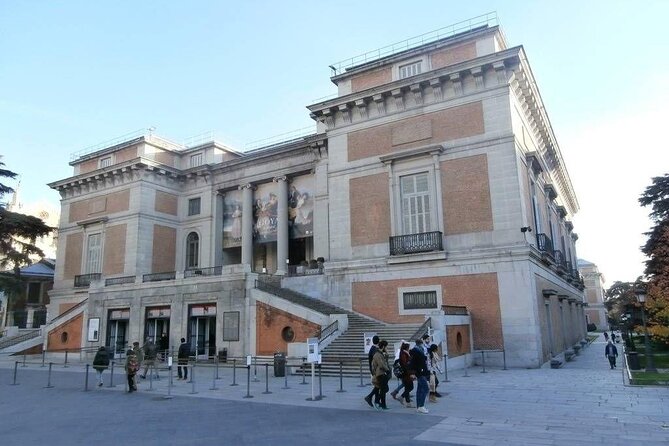
The Museo Nacional Thyssen-Bornemisza is the final museum. Its collection covers the 13th to the 20th centuries and brings together artists who are not always represented in the same place elsewhere in Madrid.
You can expect works by Titian, Rubens, Rembrandt, Caravaggio, Manet, Renoir, Van Gogh, Gauguin, Kandinsky, Hopper, and Picasso. The museum is particularly useful because it shows the changes in European art across time, rather than focusing only on one national tradition.
The collection includes Italian and Flemish early masters, Renaissance painting, Impressionism, and major 20th-century movements. Fauvism, Expressionism, Surrealism, Abstraction, and Pop Art all have a place here.
This makes the Thyssen a good closing stop. After the Prado’s traditional forms and the Reina Sofía’s modern political statement, you can see how artists gradually broke apart old rules about color, shape, perspective, and subject matter.
Works by Van Gogh and Gauguin connect the museum to the changing color and brushwork of the late 19th century. Kandinsky introduces abstraction. Hopper offers a quieter, more psychologically charged modern world. Picasso and Dalí bring the focus back to Spain while keeping the conversation international.
The drawback is the same one found throughout the day: the Thyssen is substantial, and 90 minutes only gives you a guided sample. You will leave with a map of the collection and a list of artists to revisit, not a complete account of the museum.
What the small group changes
The group limit of seven is one of the strongest practical features. A small group makes it easier to hear the guide, ask questions, and keep a steady pace through crowded galleries.
The tour also supplies high-quality radio guides. That is useful in large rooms, where a normal speaking voice can disappear into the general museum noise. You can focus on the painting instead of standing shoulder to shoulder with the guide to catch every word.
Ana Cristina is especially suited to people who want art history explained as a connected subject. Her approach, as described through the experience, links painting styles to political and social change. She also uses questions and visual puzzles, including a playful way of working out what may be happening in a Cubist painting.
Laura is another named guide associated with the experience. Her strength is careful explanation and attention to the group’s pace. The guide you receive may vary, but Ana Cristina and Laura are the clearest examples of the style you can expect: serious about art, yet relaxed enough to keep the day from feeling like a classroom lecture.
One point needs clarification. The tour is described as semi-private, with up to seven people. That is not the same as a fully private tour for just you and your companions. If you want individual attention without paying for a private booking, the small maximum is useful. If you want complete control over the route and timing, you should check the available booking option before committing.
Is eight hours too much art?
For an art lover, the long format is the reason to book. Madrid’s three museums are the obvious challenge: choosing only one means leaving out major parts of the city’s art story.
For a first-time visitor, the day can work well because the guide filters the collections. You do not have to spend precious time deciding which rooms matter. You receive a broad introduction to Spanish art and to the European movements that shaped it.
For a specialist, the experience may feel too brisk. You may already know the main works and want to study less famous paintings at your own speed. The tour’s value comes from interpretation and organization, not from unlimited gallery time.
The reviews of the experience point to an especially strong fit for people who want education. One couple booked it specifically for an in-depth lesson in Spanish art history and found that the tour matched that goal. That is a useful clue: this is not simply a ticket bundle with a guide attached.
The day also suits companions with different levels of art knowledge. Someone who already loves Velázquez can still enjoy the social and technical details, while someone new to art history gets a clear starting point. The guide’s use of questions and comparisons helps keep the visit active.
Value, tickets, and what you receive
The tour price is not provided here, so I cannot give you a fair euro-by-euro verdict. You should compare the cost with three museum admission tickets, an English-speaking guide for the full day, radio equipment, and the time saved planning the route.
The strongest value comes if you want all three museums and would otherwise need to research the collections yourself. You are paying for selection, explanation, and coordination, not only for entry.
The value is weaker if you want to visit just one museum or if you prefer audio guides and independent wandering. In that case, a standard museum visit may give you more control and longer with the works you care about.
Group discounts are available, which can improve the price for families or larger bookings. The listed maximum is seven participants, so ask how the discount applies to your group before booking.
Admission to all three museums is included. Lunch is not part of the basic inclusions unless you add that option. The tour begins at the Prado and ends at the Thyssen-Bornemisza National Museum on Paseo del Prado, 8, which is convenient if you plan to continue exploring central Madrid afterward.
Timing, transport, and practical planning
The start time is 10:00 a.m. Confirmation is sent at booking, and the meeting point is near public transportation. The route between museums is on foot, so wear comfortable shoes and keep your day bag manageable.
Most people can take part, according to the activity details. No special accessibility claims are provided, so if you have mobility concerns, contact the provider before booking and ask about the walking route and museum arrangements.
The experience requires good weather because part of the connection between museums is outdoors. If poor weather causes cancellation, you are offered another date or a full refund.
You can cancel for a full refund up to 24 hours before the start time. Cancellations or changes made within 24 hours are not refunded or accepted, and the cut-off is based on Madrid local time.
Who should book the Paseo del Arte tour?
I would choose this experience if you want a guided art-history day rather than three disconnected museum visits. It is especially useful for first-time visitors, couples, families with an interest in culture, and anyone who wants help understanding why the paintings matter.
It also suits you if Guernica is a major reason for visiting Madrid. The historical explanation can turn a difficult modern painting into a far more meaningful encounter.
I would hesitate if you dislike fixed schedules, need hours with a single artist, or plan to see every room in each museum. The guide selects highlights, and the 90-minute museum blocks move quickly.
Final verdict: a smart choice for the right art day
Book this tour if you want the broadest useful introduction to Madrid’s major collections in one day. The small group, included tickets, radio guides, and strong emphasis on art history make it more valuable than simply rushing through three museums alone.
Go in ready to listen, compare, and keep moving. You will not see everything, but you will understand far more about Las Meninas, Guernica, Spanish art, and the European movements shown at the Thyssen. If that sounds like a good day to you, the Paseo del Arte is a strong choice.
FAQ
How long does the Paseo del Arte tour last?
The experience lasts approximately eight hours, including visits to the three museums, walking time, and about 90 minutes of free time for lunch.
What time does the tour start?
The tour starts at 10:00 a.m.
Where does the tour begin?
The meeting point is at the Museo Nacional del Prado in Madrid, near Retiro on the Paseo del Prado.
Where does the tour end?
The tour ends at the Thyssen-Bornemisza National Museum at Paseo del Prado, 8, in central Madrid.
Which museums are included?
Admission is included for the Prado Museum, the Reina Sofía Museum, and the Thyssen-Bornemisza Museum.
Is the tour offered in English?
Yes. The tour is offered in English.
How many people can join the tour?
The activity has a maximum of seven participants and is described as a semi-private small-group tour.
Is lunch included?
Free time for lunch is included in the schedule. You can add lunch as an optional service, but it is not included in the standard inclusions.
Can I cancel for a full refund?
Yes. You can cancel at least 24 hours before the experience start time for a full refund. Cancellations or changes made less than 24 hours before the start time are not refunded or accepted.
More Museums in Madrid
- Madrid: Museum of Illusions Ticket
★ 4.1 · 1,909 reviews - Madrid: Prado Museum Guided Tour With Fast Access
★ 4.8 · 1,785 reviews - Prado Museum Small Group Tour with Skip the Line Ticket
★ 5.0 · 1,738 reviews - Royal Palace & Prado Museum Skip the Line Guided Tour
★ 4.5 · 1,347 reviews
More Thyssen-Bornemisza Visits
- Museo Nacional Thyssen-Bornemisza with Skip the line ticket
★ 4.5 · 435 reviews - Madrid: Thyssen Museum Guided Tour with Skip-the-Line Entry
★ 4.5 · 165 reviews - Madrid: Thyssen-Bornemisza Museum Guided Tour & Entry Ticket
★ 4.6 · 70 reviews - Madrid Thyssen Museum Small Group Guided Tour
★ 5.0 · 59 reviews
Just added around Madrid
- Arrival Private Transfer from MAD Airport to Madrid in a Minibus★ 5.0 · 3 reviews
- Private Vacation Photography Session with Photographer in Madrid★ 5.0 · 3 reviews
- Segovia: 3-Hour Private Walking Tour★ 5.0 · 3 reviews
- Tour Segovia and La Granja de San Ildefonso from Madrid★ 5.0 · 3 reviews
- Madrid: Prado & Reina Sofia Museum Skip-the-Line Guided Tour★ 5.0 · 3 reviews
- Salamanca: Private Guided Customizable Walking Tour★ 5.0 · 3 reviews
- Total Reboot and Renew with top wellnes 3 hours couple experience★ 5.0 · 3 reviews
- Madrid: Prado Museum Private Tour★ 5.0 · 3 reviews
Prado Museum Tours, compared.

Small Group of Prado Museum Tour & Optional Tapas
Read our review →
Prado Museum Guided Tour with Skip-the-Line Ticket
Read our review →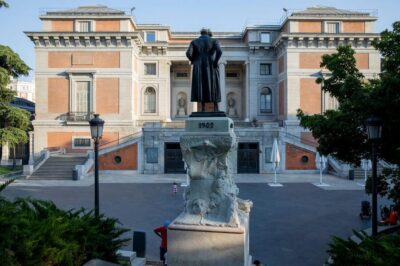
Prado Museum Small Group Tour with Skip the Line Ticket
Read our review →
Royal Palace & Prado Museum Skip the Line Guided Tour
Read our review →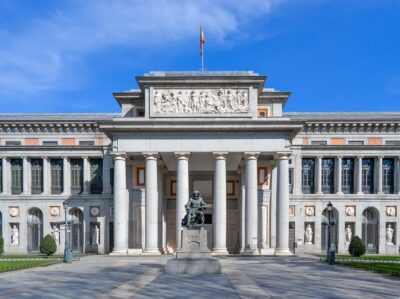
Prado Museum Guided Tour with Skip-the-Line Ticket
Read our review →Browse the lists this tour appears in